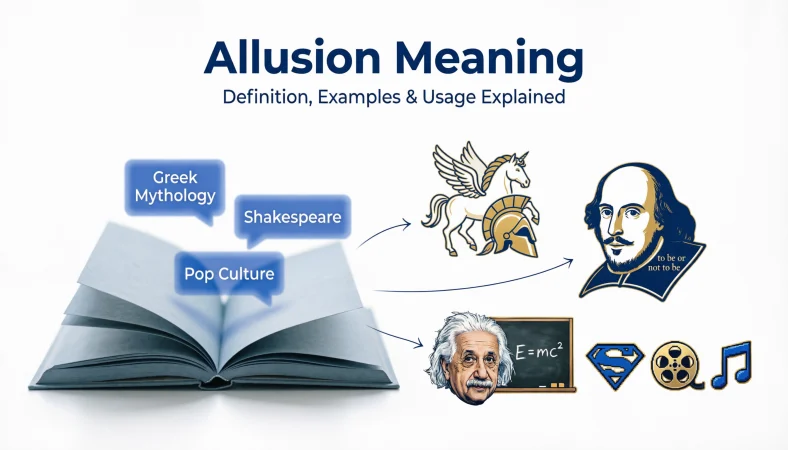
Definition: An allusion is an indirect reference to a person, place, event, book, movie, or idea that the audience is expected to recognize without being explicitly explained.
Have you ever heard someone say, “He’s a real Einstein,” or “Don’t open Pandora’s box”? These expressions don’t explain themselves, yet many people instantly understand them. That’s because they’re allusions subtle references that rely on shared knowledge to create deeper meaning.
Whether you’re studying literature, improving your writing, or simply curious about the term, understanding allusion meaning can help you recognize hidden references in everyday conversations, books, movies, speeches, and social media.
What Is an Allusion?
An allusion is a figure of speech that briefly refers to a famous person, historical event, literary work, myth, religion, or pop culture without explaining it in detail.
Instead of directly describing something, the speaker assumes the audience already understands the reference.
Simple Definition
Allusion = An indirect reference to something well-known.
It adds extra meaning while keeping the message concise.
Example:
- “He’s the Sherlock Holmes of our office.”
The speaker doesn’t mean the person is actually Sherlock Holmes they’re comparing them to the famous detective’s intelligence.
Origin of the Word Allusion
The word allusion comes from the Latin word alludere, meaning “to play with” or “to refer to indirectly.”
It entered English during the 16th century and became widely used in literature and rhetoric.
Writers have long used allusions to enrich stories by connecting them to mythology, history, religion, or famous works of art.
Today, allusions appear everywhere from novels and speeches to memes and TikTok captions.
Why Are Allusions So Popular?
Allusions are powerful because they communicate complex ideas quickly.
Instead of writing a long explanation, one reference can instantly create imagery and emotion.
For example:
- “This project is my Mount Everest.”
Most readers understand it means a huge challenge without further explanation.
People use allusions because they:
- Save words
- Add sophistication
- Create humor
- Build emotional connections
- Reference shared culture
- Make writing more memorable
How Is Allusion Used in Real Life?
Allusions appear in many forms of communication.
In Literature
Authors use allusions to deepen themes and symbolism.
Example:
“He carried the world on his shoulders like Atlas.”
This references Greek mythology.
In Everyday Conversation
People use allusions casually.
Example:
“Don’t be such a Scrooge.”
This alludes to the miserly character from A Christmas Carol.
In Movies and TV Shows
Films constantly reference older movies, myths, famous quotes, or historical events.
Example:
A superhero sacrificing themselves may be called a “Christ-like figure.”
In Politics
Politicians often allude to famous historical events to strengthen speeches.
Example:
“This is our moonshot.”
This references the Apollo Moon mission to describe an ambitious goal.
On Social Media
Internet users often make pop culture allusions.
Examples:
- “Main character energy.”
- “This is giving Cinderella.”
- “Corporate Hunger Games.”
These rely on shared cultural knowledge.
Common Types of Allusions
Historical Allusion
References history.
Example:
“He met his Waterloo.”
Meaning: He suffered a final defeat.
Biblical Allusion
References the Bible.
Example:
“The forbidden fruit looked tempting.”
Meaning: Something attractive but dangerous.
Mythological Allusion
References myths.
Example:
“Don’t fly too close to the sun.”
References Icarus.
Literary Allusion
References famous books.
Example:
“He opened a Pandora’s box.”
Pop Culture Allusion
References celebrities, movies, music, or TV.
Example:
“She’s living her Barbie era.”
Examples of Allusions in Context
| Situation | Allusion | Meaning |
| School | He’s Einstein. | Very smart |
| Sports | Our David beat Goliath. | Underdog won |
| Office | That’s Pandora’s box. | Will create problems |
| Family | Don’t be Scrooge. | Stop being stingy |
| Work | This is my Everest. | Biggest challenge |
| Dating | Romeo strikes again. | Romantic person |
| Politics | Crossing the Rubicon | Point of no return |
| Social Media | Main character energy | Acting like the hero |
Allusion Examples with Different Tones
Friendly 😊
“You’re basically our team’s Superman.”
Compliment for someone dependable.
Neutral 😄
This meeting feels like Groundhog Day.”
Meaning it keeps repeating.
Negative 😒
“Nice job, Einstein.”
Used sarcastically after someone makes a mistake.
Humorous 😂
“My bank account after vacation? Titanic.”
Meaning it’s sinking financially.
How to Identify an Allusion
Look for references that are:
- Brief
- Indirect
- Well-known
- Not fully explained
- Based on shared knowledge
Ask yourself:
“Is this referring to something famous?”
If yes, it’s probably an allusion.
Difference Between Allusion and Similar Terms
| Term | Meaning |
| Allusion | Indirect reference |
| Reference | Direct mention |
| Analogy | Detailed comparison |
| Metaphor | Says one thing is another |
| Symbolism | Object represents an idea |
| Idiom | Fixed expression with figurative meaning |
Example:
Allusion:
“He’s a Romeo.”
Reference:
“The character Romeo from Shakespeare.”
Allusion vs Illusion
Many people confuse these words.
| Allusion | Illusion |
| Indirect reference | False appearance |
| Literary device | Optical or mental trick |
| Related to language | Related to perception |
Example:
- Allusion: “He’s Hercules.”
- Illusion: “The magician created an illusion.”
Why Writers Use Allusions
Allusions make writing:
- Richer
- More engaging
- More emotional
- More intelligent
- Easier to visualize
They also help readers connect ideas quickly.
Instead of describing bravery for several sentences, simply saying someone is “a Hercules” communicates strength immediately.
Tips for Using Allusions Correctly
- Know your audience.
- Use references people recognize.
- Don’t overuse them.
- Make sure the allusion fits the context.
- Avoid obscure references unless writing for experts.
Good writing uses allusions naturally rather than forcing them.
Alternate Meanings of Allusion
The word allusion has one primary meaning in English: an indirect reference.
However, people sometimes mistakenly use it when they actually mean:
- Illusion
- Reference
- Mention
- Hint
- Suggestion
In formal writing, these words should not be used interchangeably.
Professional Alternatives to “Allusion”
Depending on context, you can use:
- Indirect reference
- Subtle reference
- Literary reference
- Implicit mention
- Hint
- Suggestion
- Symbolic reference
- Cultural reference
Example:
“The speech contained several subtle historical references.”
Common Mistakes About Allusions
Mistake 1
Thinking an allusion must come from literature.
Reality: It can come from history, movies, religion, mythology, music, or pop culture.
Mistake 2
Confusing allusion with quotation.
An allusion only hints at something.
A quotation repeats exact words.
Mistake 3
Explaining the reference immediately.
If you explain it fully, it stops functioning as an allusion.
Frequently Asked Questions
1. What is the simple meaning of allusion?
An allusion is an indirect reference to something famous without directly explaining it.
2. What is an example of an allusion?
Calling someone “Einstein” to mean they are very intelligent is an allusion.
3. Is an allusion a metaphor?
No. A metaphor directly compares things, while an allusion indirectly references something well known.
4. What is the difference between allusion and illusion?
An allusion is an indirect reference, while an illusion is something that deceives the senses.
5. Why do authors use allusions?
They add deeper meaning, symbolism, emotion, humor, and cultural connections.
6. Are allusions only used in literature?
No. They appear in conversations, speeches, advertising, movies, music, politics, and social media.
7. Can an allusion refer to pop culture?
Yes. References to movies, celebrities, games, or internet trends are modern allusions.
8. How do you recognize an allusion?
Look for a brief indirect reference that depends on shared knowledge instead of explanation.
Conclusion
Understanding allusion meaning makes reading and writing much more enjoyable. From literature and history to memes and movies, allusions connect ideas through shared cultural knowledge. They allow writers and speakers to communicate complex thoughts with just a few carefully chosen words.
The next time someone says a project is their “Mount Everest” or calls a genius “Einstein,” you’ll recognize the hidden reference immediately. Learning to identify and use allusions effectively can strengthen communication, improve writing, and deepen your appreciation of language.

Caleb Foster is a professional content creator at RepllyNova.com, recognized for producing clear, engaging and insightful articles. He is committed to making complex topics understandable, interesting and accessible for all audiences.