
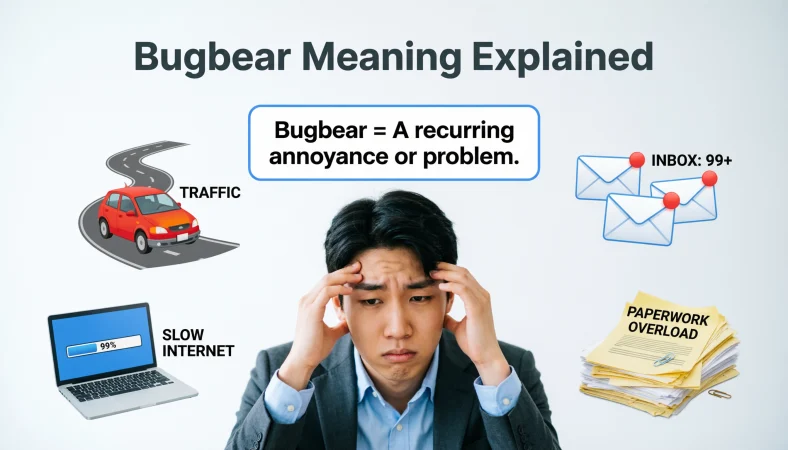
Definition: A bugbear is something that consistently annoys, worries, or irritates a person. It can also refer to an imagined fear or a recurring source of frustration. In modern English, the word is commonly used to describe a pet peeve, ongoing complaint, or persistent problem.
For example:
“Slow internet is one of my biggest bugbears.”
Understanding the bugbear meaning helps readers recognize how this expressive term is used in modern English. While its historical roots trace back to folklore and imaginary monsters, contemporary usage is far more figurative. People often describe ongoing challenges, irritating habits, or recurring concerns as their “bugbear.”
For example, someone might say, “Traffic congestion is my biggest bugbear,” meaning it is a constant source of frustration. The word adds color and emphasis to everyday communication, making it useful in both casual conversations and professional writing.
From a language and usage perspective, “bugbear” remains a valuable vocabulary word because it conveys more than simple annoyance. It suggests a problem that continually resurfaces and occupies a person’s thoughts. Whether referring to workplace inefficiencies, financial worries, or personal irritations, the term captures the idea of a recurring obstacle that people find difficult to ignore.
Origin of the Word Bugbear
The term bugbear dates back to the Middle Ages.
Originally, a bugbear was believed to be a frightening imaginary creature used to scare children into behaving properly. The word combines:
- Bug = ghost, goblin, or frightening spirit
- Bear = a powerful and intimidating animal
Together, the word described a monster-like figure used in folklore and bedtime warnings.
Historical Example
Parents might have said:
“Behave yourself, or the bugbear will come for you.”
Over time, the literal monster disappeared from everyday use, but the figurative meaning survived. Today, a bugbear is usually a recurring annoyance, concern, or frustration rather than a mythical creature.
Modern Bugbear Meaning
In modern English, a bugbear generally refers to:
1. A Persistent Irritation
Something that regularly annoys someone.
Example:
“Unnecessary meetings are a bugbear for many employees.”
2. A Repeated Problem
An issue that keeps returning.
Example:
“Traffic congestion remains a bugbear for city planners.”
3. An Imagined Fear or Concern
A worry that may be exaggerated or not entirely realistic.
Example:
“The fear of technological change became a bugbear for some workers.”
How Popular Is the Word Bugbear?
While bugbear isn’t as common as words like “annoyance” or “pet peeve,” it remains popular in:
- British English
- Newspapers and magazines
- Professional writing
- Opinion pieces
- Academic discussions
- Everyday conversations among native speakers
You’ll often see it used to describe long-standing frustrations.
Examples:
- Workplace bugbears
- Travel bugbears
- Technology bugbears
- Political bugbears
- Customer service bugbears
How to Use Bugbear in a Sentence
The word is typically used as a noun.
Basic Formula
Something + is + a bugbear + for someone
Examples:
- “Poor communication is a bugbear for many managers.”
- “Late deliveries are a bugbear for customers.”
- “Grammar mistakes are one of my biggest bugbears.”
Plural Form
Bugbears
Examples:
- “What are your biggest workplace bugbears?”
- “Travel delays and cancellations are common holiday bugbears.”
Bugbear Meaning Examples Table
| Situation | Example Sentence | Tone |
|---|---|---|
| Workplace | “Micromanagement is my biggest workplace bugbear.” | Neutral |
| School | “Homework deadlines became a bugbear for students.” | Mildly Negative |
| Technology | “Frequent software updates are a bugbear for some users.” | Neutral |
| Travel | “Long airport queues are a common traveler bugbear.” | Negative |
| Family Life | “Messy rooms are a constant bugbear for parents.” | Friendly |
| Business | “Customer complaints remain a bugbear for the company.” | Professional |
Common Contexts Where People Use Bugbear
Workplace
Employees often discuss workplace bugbears such as:
- Endless meetings
- Poor communication
- Lack of organization
- Slow approvals
Example:
“Email overload has become a major bugbear in modern offices.”
Travel
Travel-related frustrations are frequently described as bugbears.
Examples:
- Flight delays
- Lost luggage
- Traffic jams
- Long security lines
Technology
Tech users commonly mention:
- Software bugs
- Slow internet
- Constant notifications
- Complicated interfaces
Example:
“Password requirements are a bugbear for many users.”
Daily Life
Everyday bugbears may include:
- Loud neighbors
- Long waits
- Untidy spaces
- Poor customer service
Is Bugbear Positive or Negative?
The word usually carries a negative or mildly negative tone because it refers to something annoying or problematic.
Tone Guide
| Tone Type | Example |
| Friendly | “One of my little bugbears is people leaving lights on.” |
| Neutral | “Traffic remains a bugbear for local authorities.” |
| Negative | “Rising costs have become a major bugbear for consumers.” |
Although negative, it is often softer and less harsh than words like “hate” or “disaster.”
Bugbear vs Pet Peeve
Many people confuse bugbear with pet peeve.
Comparison Table
| Term | Meaning | Severity |
| Bugbear | Ongoing annoyance or concern | Moderate |
| Pet Peeve | Personal irritation | Mild |
| Problem | Issue requiring a solution | Varies |
| Obstacle | Barrier preventing progress | Higher |
| Concern | Worry about something | Neutral |
Example
Pet Peeve
“People chewing loudly is my pet peeve.”
Bugbear
“Office politics are a bugbear for many professionals.”
A bugbear is often broader and more significant than a simple pet peeve.
Bugbear vs Annoyance
While similar, they are not identical.
Annoyance
Any irritating thing.
Example:
“The noise was an annoyance.”
Bugbear
A recurring or long-term annoyance.
Example:
“Noise pollution has become a bugbear for residents.”
A bugbear typically suggests repetition and persistence.
Synonyms of Bugbear
Depending on the context, you can replace bugbear with:
Common Synonyms
- Annoyance
- Irritation
- Nuisance
- Pet peeve
- Headache
- Frustration
- Problem
- Concern
- Obstacle
- Difficulty
Example Replacements
| Bugbear Sentence | Alternative |
| “Traffic is my bugbear.” | “Traffic is my biggest frustration.” |
| “Paperwork is a bugbear.” | “Paperwork is a nuisance.” |
| “Delays are a bugbear.” | “Delays are a headache.” |
Professional Alternatives to Bugbear
In formal writing, consider using:
- Challenge
- Concern
- Operational issue
- Ongoing problem
- Area of difficulty
- Persistent issue
- Pain point
Example
Instead of:
“Late reports are a bugbear.”
You could write:
“Late reports remain an ongoing operational challenge.”
This sounds more professional in business settings.
Alternate Meanings of Bugbear
Although the modern meaning dominates today, bugbear has two recognized meanings.
1. Mythical Creature (Historical)
A fictional monster used to frighten children.
Example:
“The bugbear appeared in old folklore stories.”
2. Persistent Annoyance (Modern)
The most common current meaning.
Example:
“Parking shortages are a bugbear for residents.”
Most modern speakers mean the second definition.
Why Do Writers and Journalists Use the Word Bugbear?
Writers like bugbear because it is:
- Vivid
- Memorable
- Expressive
- Slightly dramatic
- More colorful than “problem”
Compare:
Plain
“Traffic is a problem.”
More Expressive
“Traffic remains a major bugbear.”
The second sentence sounds more engaging and descriptive.
Real-World Examples of Bugbear
In Business
“Staff turnover continues to be a bugbear for employers.”
In Education
“Large class sizes are a bugbear for teachers.”
In Politics
“Healthcare costs remain a bugbear for policymakers.”
In Technology
“Data privacy concerns have become a bugbear for social media platforms.”
In Personal Life
“Clutter is one of my biggest bugbears.”
Tips for Using Bugbear Correctly
Use It for Recurring Issues
✅ Correct:
“Parking shortages are a bugbear.”
Use It for Ongoing Frustrations
✅ Correct:
“Slow customer service is a bugbear for shoppers.”
Avoid Using It for One-Time Events
❌ Less Natural:
“Yesterday’s rainstorm was a bugbear.”
A single event usually isn’t a bugbear unless it happens repeatedly.
Consider Your Audience
The word is common in British English but may sound slightly formal or literary in some regions.
Frequently Asked Questions
What does bugbear mean?
A bugbear is a recurring annoyance, irritation, concern, or problem that repeatedly bothers someone.
Is bugbear a negative word?
Generally yes. It usually refers to something frustrating or troublesome, though often in a mild or conversational way.
What is an example of a bugbear?
Example:
“Long customer service wait times are a bugbear for many consumers.”
Is bugbear the same as pet peeve?
Not exactly. A pet peeve is usually a personal irritation, while a bugbear can be a broader ongoing problem or concern.
Can bugbear refer to a fear?
Yes. Historically and in some contexts, bugbear can refer to an imagined fear or source of anxiety.
Is bugbear formal or informal?
It works in both formal and informal contexts. Journalists, professionals, and everyday speakers all use it.
What is the plural of bugbear?
The plural form is bugbears.
Example:
“Everyone has different bugbears at work.”
Where did the word bugbear come from?
It originated in medieval English folklore, where it referred to a frightening imaginary creature used to scare children.
Conclusion
Understanding the bugbear meaning helps you recognize one of English’s most colorful words for describing recurring frustrations and concerns. Originally a mythical creature from folklore, bugbear has evolved into a practical modern term for anything that repeatedly annoys, worries, or troubles someone.
Whether you’re talking about workplace challenges, travel frustrations, technology issues, or everyday irritations, bugbear provides a vivid alternative to words like “problem,” “annoyance,” or “pet peeve.”
Using the word correctly can make your writing and conversations more expressive, engaging, and precise.