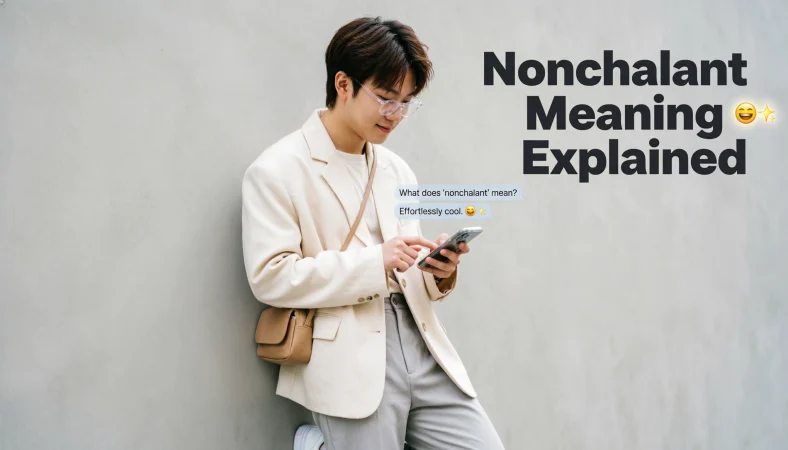
Nonchalant meaning: A person who is nonchalant behaves in a cool, casual, and emotionally unbothered way, often seeming relaxed or indifferent even in serious or surprising situations.
Example:
She stayed nonchalant during the interview, even when asked difficult questions.
In a world where emotions are often displayed openly, the word nonchalant stands out as a description of someone who remains remarkably calm and unaffected. Whether it’s handling criticism, facing a stressful situation, or reacting to unexpected news, a nonchalant person appears relaxed and unconcerned. This quality can be admired as a sign of confidence and emotional control, though it may sometimes be mistaken for apathy or disinterest.
Understanding the meaning of nonchalant is important because the word is frequently used in conversations, books, workplace discussions, and social media. While it generally refers to a casual and composed attitude, its exact tone depends on the situation. In this guide, you’ll learn what nonchalant means, how to use it correctly, common examples, synonyms, and the subtle differences between being genuinely relaxed and simply not caring.
Why “Nonchalant” Is Such a Popular Word Today
The word nonchalant has become extremely popular on social media platforms like TikTok, Instagram, Snapchat, and X (Twitter). People frequently use it to describe someone who:
- Acts calm under pressure
- Doesn’t show too much emotion
- Seems naturally confident
- Replies casually in relationships or chats
- Maintains a “cool” personality
For example:
- “Why is he so nonchalant all the time?”
- “She responded so nonchalantly like it was no big deal.”
In online culture, being nonchalant is sometimes seen as attractive because it gives off a confident and emotionally controlled vibe.
Origin of the Word “Nonchalant”
The word nonchalant comes from the French word nonchaloir, which means “to disregard” or “to not care.”
It entered the English language in the 18th century and gradually evolved into a term describing someone who appears:
- Unworried
- Casual
- Emotionally calm
- Indifferent
Even though the word has old origins, its popularity exploded again through internet culture and texting slang.
How to Pronounce Nonchalant
Pronunciation
Nonchalant:
non-shuh-LAHNT
Simple Pronunciation Guide
| Part | Sound |
|---|---|
| Non | “non” |
| Cha | “shuh” |
| Lant | “lahnt” |
Nonchalant Meaning in Simple Words
If someone asks for the meaning in very easy English, you can explain it like this:
A nonchalant person acts like nothing bothers them.
They may appear:
- Relaxed
- Casual
- Cool
- Emotionally unaffected
Sometimes this attitude is genuine. Other times, people act nonchalant intentionally to seem confident or mysterious.
Examples of Nonchalant in Sentences
Here are real-life examples showing different tones and situations.
Friendly Tone 😊
| Sentence | Meaning |
| “He gave a nonchalant smile and said everything was fine.” | Calm and relaxed |
| “She walked into the party looking completely nonchalant.” | Cool and confident |
| “His nonchalant attitude made everyone feel less nervous.” | Comforting calmness |
Romantic or Flirty Tone ❤️
| Sentence | Meaning |
| “Why do girls like nonchalant guys?” | Calm and mysterious personality |
| “He texted back so nonchalantly.” | Casual and emotionally controlled |
| “She acted nonchalant even though she liked him.” | Hiding emotions |
Negative or Dismissive Tone 😒
| Sentence | Meaning |
| “Her nonchalant response felt rude.” | Too indifferent |
| “He seemed nonchalant about the serious issue.” | Uncaring |
| “Don’t be so nonchalant when people need help.” | Emotionally detached |
Is Being Nonchalant Good or Bad?
Being nonchalant is not automatically positive or negative. It depends on the situation and how the behavior affects others.
When Nonchalant Behavior Is Positive
A nonchalant attitude can be helpful when someone:
- Stays calm during stress
- Avoids overreacting
- Appears confident
- Handles pressure well
- Keeps emotions under control
Example:
A pilot remaining nonchalant during turbulence can reassure passengers.
When Nonchalant Behavior Is Negative
It can become a problem when someone appears:
- Emotionally unavailable
- Uninterested
- Cold
- Disrespectful
- Careless
Example:
Being nonchalant during an important conversation may hurt someone’s feelings.
Nonchalant Meaning in Relationships
This is one of the most searched versions of the term online.
In relationships, “nonchalant” often refers to someone who:
- Doesn’t show emotions openly
- Texts casually
- Acts hard to impress
- Avoids appearing too attached
- Stays emotionally cool
Example
- “He likes her, but he acts nonchalant.”
This usually means the person is trying not to appear overly emotional or needy.
However, excessive nonchalance in relationships can sometimes create misunderstandings or emotional distance.
Nonchalant Meaning in Texting and Social Media
On social media, the word often describes a vibe or personality.
Common Social Media Usage
- “Nonchalant king 👑”
- “Trying to stay nonchalant.”
- “She’s too nonchalant for me.”
- “That calm confidence is attractive.”
People may intentionally act nonchalant online by:
- Replying late
- Using short messages
- Avoiding emotional reactions
- Acting “unbothered”
Signs of a Nonchalant Person
Here are common traits associated with nonchalant personalities.
Typical Characteristics
- Calm under pressure
- Relaxed body language
- Minimal emotional reactions
- Casual communication style
- Quiet confidence
- Rarely overreacting
- Appearing emotionally detached
Not every quiet or calm person is truly nonchalant, though. Some people simply express emotions differently.
Difference Between Nonchalant and Similar Words
Many words are related to nonchalant, but they have slightly different meanings.
Comparison Table
| Word | Meaning | Tone |
| Nonchalant | Calm and unconcerned | Neutral |
| Cool | Stylish or emotionally controlled | Positive |
| Indifferent | Not caring | Often negative |
| Relaxed | Comfortable and calm | Positive |
| Detached | Emotionally distant | Negative |
| Casual | Informal and easygoing | Neutral |
| Unbothered | Not affected emotionally | Modern slang |
Nonchalant vs Indifferent
People often confuse these two words.
Nonchalant
- Calm and composed
- May still care internally
- Often stylish or confident
Indifferent
- Truly does not care
- Emotionally disconnected
- More negative meaning
Example
- “She looked nonchalant before the exam.”
→ Calm but still concerned internally. - “She was indifferent to everyone’s feelings.”
→ She genuinely didn’t care.
Synonyms of Nonchalant
Here are common synonyms you can use depending on the context.
Positive or Neutral Synonyms
- Relaxed
- Calm
- Cool
- Easygoing
- Casual
- Unruffled
- Composed
- Laid-back
More Negative Synonyms
- Detached
- Unconcerned
- Aloof
- Indifferent
- Emotionless
Antonyms of Nonchalant
Words opposite to nonchalant include:
- Nervous
- Anxious
- Emotional
- Concerned
- Excited
- Stressed
- Panicked
How to Use Nonchalant Correctly
The word is usually used as an adjective.
Basic Sentence Structure
Someone + is/was + nonchalant
Examples
- He was surprisingly nonchalant.
- She stayed nonchalant during the argument.
- They acted nonchalant after winning.
Common Mistakes When Using Nonchalant
1. Using It Only Negatively
Nonchalant does not always mean rude or careless.
Sometimes it simply means calm and confident.
2. Confusing It With “Lazy”
A nonchalant person may still work hard. They just appear relaxed.
3. Assuming Nonchalant Means Emotionless
Many nonchalant people still feel emotions deeply but do not show them openly.
Why People Find Nonchalant Personalities Attractive
Modern psychology and social trends suggest that calm behavior can appear:
- Confident
- Emotionally mature
- Independent
- Stable
- Mysterious
That’s why nonchalant characters in movies, TV shows, and social media often gain popularity.
However, balance matters. Too much emotional distance can make relationships difficult.
Nonchalant in Pop Culture
The “nonchalant” personality archetype appears everywhere:
- Quiet movie protagonists
- Cool anime characters
- Calm athletes
- Mysterious romantic interests
- Influencers with relaxed confidence
Social media has turned “nonchalant energy” into an entire aesthetic.
Professional and Polite Alternatives to “Nonchalant”
In formal settings, you may want softer or more professional alternatives.
| Informal Word | Professional Alternative |
| Nonchalant | Calm |
| Nonchalant | Composed |
| Nonchalant | Relaxed |
| Nonchalant | Unfazed |
| Nonchalant | Self-assured |
Example
Instead of saying:
- “He was nonchalant during the meeting.”
You could say:
- “He remained calm and composed during the meeting.”
Alternate Meanings or Interpretations
While the core meaning stays the same, people sometimes interpret nonchalant differently depending on context.
Possible Interpretations
- Confident
- Emotionally unavailable
- Carefree
- Cool
- Uninterested
- Mature
- Dismissive
Tone and situation matter a lot.
Nonchalant Meaning in Different Contexts
In School
A student who seems relaxed before exams.
At Work
An employee who stays calm under pressure.
In Dating
Someone who hides strong emotions.
Online
A person acting “unbothered” on social media.
Quick Usage Tips
Use “nonchalant” when someone:
✅ Appears calm
✅ Acts emotionally controlled
✅ Seems casually confident
✅ Avoids dramatic reactions
Avoid using it when someone is:
❌ Clearly emotional
❌ Panicking
❌ Overreacting
❌ Highly expressive
FAQs
What does nonchalant mean in simple terms?
Nonchalant means acting calm, relaxed, and not easily bothered by situations.
Is nonchalant a compliment?
It can be. Many people see nonchalant behavior as confident and emotionally mature. However, it may sound negative if someone seems uncaring.
What is a nonchalant person like?
A nonchalant person usually appears calm, cool, relaxed, and emotionally controlled.
Does nonchalant mean rude?
Not always. But excessive nonchalance can sometimes appear dismissive or emotionally distant.
Why do people act nonchalant?
People may act nonchalant to appear confident, avoid vulnerability, reduce stress, or hide emotions.
What is the difference between nonchalant and indifferent?
Nonchalant means calm and unconcerned on the surface, while indifferent means genuinely not caring.
Can nonchalant be attractive?
Yes. Many people find calm confidence and emotional control attractive in friendships and relationships.
How do you use nonchalant in a sentence?
Example:
“She gave a nonchalant shrug and continued walking.”
Conclusion
The word nonchalant describes someone who appears calm, relaxed, and emotionally unbothered, even in situations that might affect others strongly. Depending on the context, nonchalant behavior can seem confident, cool, mature, careless, or emotionally distant.
In today’s social media culture, the term is more popular than ever. People often associate nonchalant personalities with confidence, mystery, and emotional control. Still, balance is important. Being calm is valuable, but showing empathy and genuine emotion matters too.
If you want to use the word naturally:
- Use it to describe calm behavior
- Pay attention to tone and context
- Avoid confusing it with indifference
- Remember that nonchalant can be positive or negative depending on the situation
Understanding words like nonchalant helps improve communication, social awareness, and everyday conversations both online and offline.