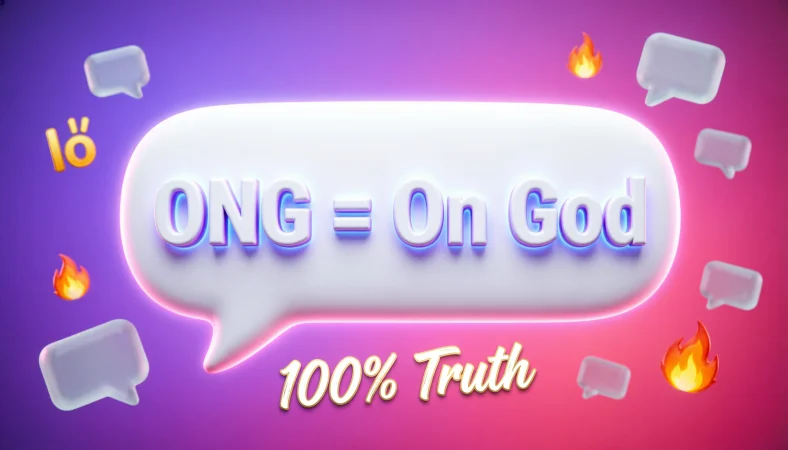

ONG most commonly stands for “On God” in text messages and on social media. It is used to emphasize that someone is being completely honest, serious, or sincere. Similar to saying “I swear” or “I’m telling the truth,” ONG is popular on platforms like TikTok, Snapchat, Instagram, and in everyday texting, especially among Gen Z users.
Ever received a message that simply says “ONG” and wondered what it means? You’re not alone. This popular internet slang appears everywhere from TikTok comments and Snapchat chats to Instagram DMs and text messages. While ONG most commonly stands for “On God,” its exact meaning depends on the conversation, making it helpful to understand how and when it’s used.
In this guide, we’ll explain the meaning of ONG in text, where it originated, and how people use it across different social media platforms. Drawing on common online usage and current messaging trends, you’ll find clear definitions, real-life examples, and context-based explanations so you can confidently understand and use ONG in everyday conversations.
The Origin and Rise of “Ong” in Digital Culture
Where Did “On God” Come From?
The phrase “On God” itself traces back to African American Vernacular English (AAVE) and has been a staple in Black communities for decades. It’s used in the same way someone might say “I swear to God” or “As God is my witness.
The abbreviation “ong” emerged naturally as internet culture evolved. Young people, constantly seeking faster ways to communicate, took the already shortened “on god” and condensed it further. It followed the trajectory of many other texting acronyms like “omg” (Oh My God), “brb” (Be Right Back), and “lol” (Laugh Out Loud).
Why Did It Go Viral?
The rise of “ong” can be attributed to:
- Platform culture: TikTok, Twitter (X), and Instagram have accelerated slang dissemination. Viral videos and memes featuring the term have propelled it into mainstream usage.
- The need for emphasis: In a world where sarcasm and irony dominate online, people needed a way to signal genuine sincerity. “Ong” serves that purpose.
- Generation Alpha and Gen Z adoption: Young people have embraced “ong” as part of their digital vernacular, making it a marker of being in the know.
- Gaming culture: In high-stakes games where calling “cap” (lies) is common, saying “ong” has become a way to assert that you’re not gaming the system.
How to Use “Ong” in Text: Examples and Tone
The beauty of “ong” lies in its versatility. Let’s look at how the ong meaning in text shifts depending on context.
1. Affirmative / Serious (Neutral Tone)
When you want to back up a claim or respond positively to a question.
Example:
Friend: “Are you actually coming to the party on Saturday?”
You: “ong, I’ll be there. I even took a day off work.”
Breakdown: Here, “ong” functions like “I promise” and reinforces the speaker’s commitment.
2. Exclamatory (Positive Tone)
Using “ong” to express shock, disbelief, or excitement about something good.
Example:
You: “ong, that new song is fire!”
Breakdown: This is a casual, emphatic statement. It means “I’m being so serious right now; this song is amazing.”
3. Supportive (Friendly Tone)
When you agree with someone strongly.
Example:
Friend: “I think this is the best pizza in the city.”
You: “ong, I was just about to say that!”
Breakdown: It’s a way to validate someone’s opinion.
4. Negative/Dismissive (Defensive Tone)
If you’re insulted or need to defend yourself.
Example:
Friend: “You totally ghosted me yesterday.”
You: “ong, I didn’t! I lost my phone.”
Breakdown: You’re using “ong” as a form of defense, signaling that the accusation is false.
5. Humorous / Ironical (Sarcastic Tone)
If there’s a hint of irony or sarcasm (though not always recommended).
Example:
You: “ong, I was born to eat pizza.”
Breakdown: Here, it’s a playful exaggeration, treating a casual truth like a sacred vow.
Adding Emojis for Impact
Emojis are the punctuation of modern texting. Pairing them with “ong” can significantly shift the tone:
- 😭 – “ong, I can’t believe you did that” (Emotionally charged)
- 🔥 – “ong this food is fire” (Hype)
- 🤞 – “ong, trust me” (Solidifying the promise)
- 🤣 – “ong, you’re hilarious” (Though ironic if you’re a bad liar)
“Ong” vs. Similar Terms: A Comparison
Understanding where “ong” sits in the hierarchy of texting slang helps you choose the right word for the right moment.
| Term | Abbreviation For | Meaning | Vibe | Usage |
|---|---|---|---|---|
| ONG | On God | I swear it’s true; dead serious. | Serious, Emotional, Defensive | When you need to emphasize absolute sincerity. |
| FR | For Real | Are you serious? / I agree. | Casual, Inquisitive | Used to ask if something is true or to agree. |
| DEADASS | Dead Ass | Completely serious / very much. | Aggressive, Urban | Emphasizes literal truth or intensity. |
| CAP / NO CAP | Capping (lying) / No Cap | No lie / no BS. | Casual, Cool | Used to deny lying; less intense than “ong.” |
| FOR REAL | For Real | Serious inquiry. | Neutral | Used in all contexts; more formal than “fr.” |
How They Differ
- Cap/No Cap: You use “no cap” to say “I’m not lying.” It’s often jokey. “Ong” is a bit more serious, akin to putting your hand on a Bible.
- Fr: Short for “For Real.” A bit more passive. “Fr?” asks a question; “ong” asserts a fact.
- Deadass: More “urban” and aggressive. Used in the Northeast U.S. heavily. “Ong” is more universally understood across the internet.
Alternate Meanings of “Ong”
While “On God” is the dominant interpretation, you might occasionally see “ong” in different contexts:
- Business/Careers (Rare): In some professional settings, “ONG” might refer to a “Non-Governmental Organization” (NGO) if someone makes a typo, though “NGO” is the correct abbreviation.
- Name/Entity: “Ong” is also a surname of Chinese origin (often spelled Wang in Mandarin but “Ong” in Hokkien).
- Health/Chemistry: You might see “Ong” or “ONG” used in testing or scientific acronyms, but that’s rare.
- Misspellings: Occasionally, people misspell “omg” (Oh My God) as “ong” due to autocorrect or fat-finger syndrome.
For 99% of digital interactions, however, the meaning of “ong” is purely the slang abbreviation for “On God.”
When NOT to Use “Ong” and Professional Alternatives
Context is key. “Ong” is the language of teenagers, friends, gamers, and close acquaintances. You should avoid using it in:
- Job Interviews (verbal or written)
- Work Emails to your boss or clients
- Academic Papers or Essays
- Formal Letters or Legal Documents
Polite Alternatives to “Ong”
If you need to convey sincerity without using internet slang, try these professional alternatives:
- “I promise.” (Classic, neutral, and trustworthy.)
- “I guarantee it.” (Confident and firm.)
- “Without a doubt.” (Expresses surety.)
- “I give you my word.” (Honorable and serious.)
- “Frankly,” or “To be honest.” (Good for softening a statement.)
Frequently Asked Questions About “Ong Meaning in Text”
Here are the 8 most common questions people ask about this viral term.
Q1: What does “ONG” mean in texting?
Answer: “ONG” stands for “On God.” It means you are swearing that something is true, emphasizing that you are not joking or lying.
Q2: Is “ONG” the same as “OMG”?
Answer: No. “OMG” is “Oh My God” (used for surprise). “ONG” is “On God” (used for truthfulness and sincerity).
Q3: Is “ONG” a bad word?
Answer: It is not a “bad” word. However, it is informal and uses “God” in a casual way. It might be considered disrespectful in overly religious or formal settings.
Q4: Who uses “ONG”?
Answer: Mostly younger generations (Gen Z and Gen Alpha) use “ONG” on platforms like TikTok, Snapchat, and Twitter. It has become a mainstream part of internet slang.
Q5: Do people say “O-N-G” out loud?
Answer: Usually, no. Most people say “On God” or sometimes “on-jee” casually. Saying “O-N-G” sounds robotic.
Q6: What is the opposite of “ONG”?
Answer: The opposite would be “Cap” (lying) or “Sus” (suspicious). If you say “ong,” you’re saying you’re not capping.
Q7: Can “ONG” be used sarcastically?
Answer: Yes. For example, if your friend spills water and you say “Ong, you’re so clumsy,” it is usually a sarcastic jab (unless said very seriously). Context matters.
Q8: What are common reactions to seeing “ONG”?
Answer: If someone says “ong,” a typical response is “Fr?” or “Cap?”—they are asking you to confirm your sincerity.
Tips for Using “ONG” Correctly
Want to master the art of “ong”? Here are some practical tips:
- Use it for big promises: Reserve “ong” for things that actually matter. Don’t use it for the weather if you want to keep the word potent.
- Follow it with evidence: Saying “ong” works best when followed by facts. “Ong, I saw the video, look at this link.”
- Read the room: If you’re talking to a grandparent, a boss, or someone from an older generation, stick to “I promise.”
- Check for autocorrect: “Ong” might correct to “On God” or “OMG.” Make sure you’re sending the right vibe.
Bonus: Contextual Examples (Table)
Here are various scenarios demonstrating how ong meaning in text comes alive:
| Scenario | Text Message | Meaning |
|---|---|---|
| Making a Promise | “I’ll be there at 8, ong.” | “I swear I’ll be there.” |
| Shocking News | “Did you see that goal? Ong!” | “I can’t believe it; it was so good.” |
| Strong Agreement | “Anime > normal TV, ong.” | “I strongly agree with that statement.” |
| Defending Yourself | “I had nothing to do with it, ong.” | “I am telling the absolute truth.” |
| Asking for Trust | “Trust me on this one, ong.” | “Take my word for it.” |
The Psychology Behind Why We Use “Ong”
The psychology behind using “ong” is fascinating. In a digital world, we are surrounded by edited photos, curated identities, and anonymous trolls. We crave authenticity. “Ong” is a linguistic tool designed to break through the noise of sarcasm and lies. It signals: “I am vulnerable enough to put my word on the line.” It builds digital trust.
FAQs
Q1: What does “ONG” mean in texting?
Answer: “ONG” stands for “On God.” It means you are swearing that something is true, emphasizing that you are not joking or lying.
Q2: Is “ONG” the same as “OMG”?
Answer: No. “OMG” is “Oh My God” (used for surprise). “ONG” is “On God” (used for truthfulness and sincerity).
Q3: Is “ONG” a bad word?
Answer: It is not a “bad” word. However, it is informal and uses “God” in a casual way. It might be considered disrespectful in overly religious or formal settings.
Q4: Who uses “ONG”?
Answer: Mostly younger generations (Gen Z and Gen Alpha) use “ONG” on platforms like TikTok, Snapchat, and Twitter. It has become a mainstream part of internet slang.
Q5: Do people say “O-N-G” out loud?
Answer: Usually, no. Most people say “On God” or sometimes “on-jee” casually. Saying “O-N-G” sounds robotic.
Q6: What is the opposite of “ONG”?
Answer: The opposite would be “Cap” (lying) or “Sus” (suspicious). If you say “ong,” you’re saying you’re not capping.
Q7: Can “ONG” be used sarcastically?
Answer: Yes. For example, if your friend spills water and you say “Ong, you’re so clumsy,” it is usually a sarcastic jab (unless said very seriously). Context matters.
Q8: What are common reactions to seeing “ONG”?
Answer: If someone says “ong,” a typical response is “Fr?” or “Cap?”—they are asking you to confirm your sincerity.
Conclusion:
The ong meaning in text transcends just being a three-letter abbreviation. It represents a desire for connection, truth, and reliability in the fast-moving world of internet slang.
While “ong” is rooted in AAVE, it has been embraced by global youth culture as a universal signal for “I’m being serious.” It is a marker of the times, a shorthand for the emotional weight of an oath.
As with any slang, the key to using “ong” well is understanding your audience and context. Use it with friends when you need to stress your sincerity, but avoid it in your cover letter or resignation email!