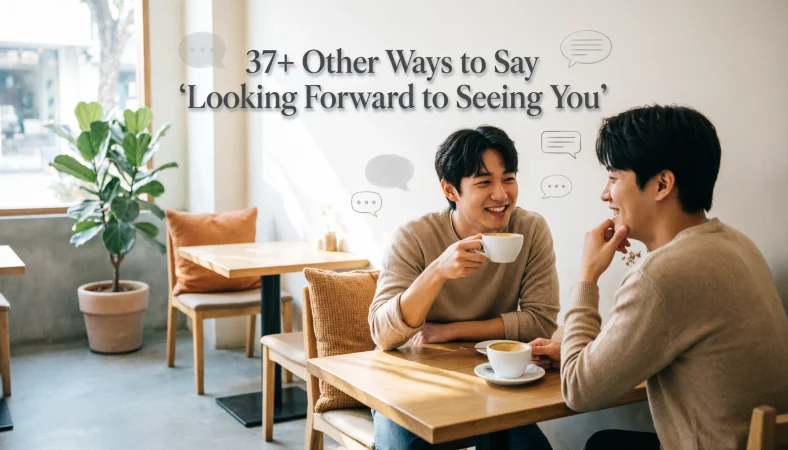

Other ways to say “Looking forward to seeing you” include “Can’t wait to see you,” “Excited to catch up,” “See you soon,” “I’m eager to meet you,” and “It’ll be great to see you.”
The phrase “looking forward to seeing you” is one of the most common expressions used in English to convey anticipation, excitement, and enthusiasm about an upcoming meeting or gathering. Whether you’re sending a business email, a casual text to a friend, or writing a formal invitation, this phrase helps establish warmth and connection before you even meet.
Learning alternatives to looking forward to seeing you can dramatically improve your spoken and written fluency. When you rely on the same expression repeatedly, your communication becomes predictable and less engaging. By expanding your vocabulary with varied ways to express anticipation in English, you’ll sound more sophisticated, emotionally intelligent, and culturally aware in every interaction.
Quick Categories Section
Formal Alternatives to “Looking Forward to Seeing You”
- Eagerly anticipating our meeting
- Awaiting our upcoming discussion
- Looking forward to our scheduled appointment
- Anticipating our conversation with great interest
- Excited to meet with you
- Looking forward to our professional engagement
- Expecting our meeting with enthusiasm
Professional Alternatives to “Looking Forward to Seeing You”
- Looking forward to our catch up
- Excited to connect with you
- Eager to meet and discuss
- Looking forward to our collaboration
- Can’t wait to meet in person
- Keen to see you and chat further
- Ready to meet with you
Casual Alternatives to “Looking Forward to Seeing You”
- Can’t wait to see you
- Excited to see you
- Looking forward to our hangout
- Can’t wait to catch up
- Counting down to see you
- Really looking forward to seeing you
- Excited for our time together
Informal Expressions to Say “Looking Forward to Seeing You”
- Can’t wait to see your face
- Dying to see you
- Counting down the hours
- So excited to see you
- Can’t wait to hang
- Looking forward to it big time
- Hyped to see you
Enthusiastic Alternatives to “Looking Forward to Seeing You”
- Thrilled to see you
- Overjoyed to meet you
- Absolutely pumped to see you
- Delighted to see you again
- Beyond excited to see you
- So looking forward to seeing you
- Incredibly excited to see you
💡 Pro Tips Box
For professional contexts: Always match your enthusiasm to the relationship. A new client deserves formal anticipation, while a long term colleague can handle casual warmth. For casual conversations: Use shorter, punchier phrases like “Can’t wait!” or “Excited!” to sound more natural and conversational.
Common Mistakes People Make Using “Looking Forward to Seeing You”
1. Using “looking forward to see you” instead of “seeing”
❌ “I’m looking forward to see you tomorrow.”
✅ “I’m looking forward to seeing you tomorrow.”
2. Using it in formal written contracts or legal documents
❌ “The contract is signed, and we look forward to seeing you.”
✅ “The contract is signed, and we anticipate meeting you on the scheduled date.”
3. Using it too casually with senior executives
❌ “Can’t wait to see you, boss!”
✅ “I look forward to our meeting, sir.”
4. Forgetting to specify the time or place
❌ “Looking forward to seeing you.”
✅ “Looking forward to seeing you at 3 PM in the conference room.”
5. Using “looking forward to see you” in writing
❌ “Looking forward to see you next week.”
✅ “Looking forward to seeing you next week.”
What Does “Looking Forward to Seeing You” Mean?
“Looking forward to seeing you” is an expression used to convey positive anticipation and enthusiasm about an upcoming encounter or meeting with someone. The phrase indicates that the speaker genuinely expects and desires the future interaction, whether personal or professional.
Grammar Explanation: The phrase uses the verb “look forward to” followed by a gerund ( ing form). The word “to” here functions as a preposition, not an infinitive marker, which is why “seeing” is used instead of “see.”
Example Sentence: “I’m looking forward to seeing you at the conference next Thursday.”
When to Use “Looking Forward to Seeing You”
- ✅ At the end of professional emails to colleagues and clients
- ✅ In personal messages to friends and family before a gathering
- ✅ In formal invitations and event confirmations
- ✅ During phone calls before ending the conversation
- ✅ In social media posts about upcoming meetups
- ✅ In letters of gratitude or appreciation
- ✅ At the conclusion of interviews or business meetings
- ✅ In follow up messages after scheduling a meeting
Is It Professional or Polite to Say “Looking Forward to Seeing You”?
While “looking forward to seeing you” is widely used in professional settings, it is generally considered polite but casual in tone. In highly formal or legal contexts, more professional alternatives are preferred.
Business Style Example: “I look forward to seeing you at the shareholders’ meeting on Friday.”
| ✔️ Polite? | ❌ Professional? |
| Yes | No (in most formal cases) |
Pros and Cons of Using “Looking Forward to Seeing You”
Pros
- Simple and natural expression
- Conveys warmth and enthusiasm
- Commonly understood by all English speakers
- Easy to remember and use correctly
Cons
- Too informal for professional documents
- Overused and predictable
- Lacks emotional variation
- Not suitable for formal writing like contracts or official letters
Other Ways to Say “Looking Forward to Seeing You” (With Examples)
These alternatives will help you sound more fluent, confident, and natural in different situations. Use them according to tone, context, and audience to express anticipation, excitement, or professional expectation.
1. Phrase: Eagerly Awaiting Our Meeting
Meaning: Expressing strong excitement about an upcoming professional encounter.
Explanation: More formal than “looking forward to,” this phrase is appropriate for business correspondence.
Example Sentence: “I am eagerly awaiting our meeting next Tuesday to discuss the new project.”
Best Use: Formal business communication
Worst Use: Casual text messages
Tone: Professional, formal, respectful
Context Variability: Formal / Professional / Written
2. Phrase: Can’t Wait to See You
Meaning: Expressing urgent excitement about meeting someone.
Explanation: Very informal and emotional, commonly used in personal relationships.
Example Sentence: “Can’t wait to see you this weekend!”
Best Use: Friends and family
Worst Use: Work emails to clients
Tone: Enthusiastic, casual, personal
Context Variability: Casual / Informal / Spoken
3. Phrase: Looking Forward to Our Catch Up
Meaning: Anticipating a conversation to update each other on recent news.
Explanation: Professional yet warm, suitable for colleagues or friends.
Example Sentence: “Looking forward to our catch up next week lots to share!”
Best Use: Work or personal catch ups
Worst Use: First time business meetings
Tone: Warm, friendly, professional
Context Variability: Professional / Casual / Written
4. Phrase: Counting Down to Our Get Together
Meaning: Expressing excitement by referencing time passing until the meeting.
Explanation: Playful and emotional, best for close relationships.
Example Sentence: “Counting down to our get together on Saturday!”
Best Use: Friends and family events
Worst Use: Professional emails
Tone: Playful, excited, personal
Context Variability: Casual / Informal / Spoken
5. Phrase: Anticipating Our Time Together
Meaning: Looking forward to the experience of spending time with someone.
Explanation: Warm and slightly formal, good for both personal and professional contexts.
Example Sentence: “I’m truly anticipating our time together at the retreat.”
Best Use: Retreats, conferences, personal gatherings
Worst Use: Very formal business documents
Tone: Warm, elegant, sincere
Context Variability: Professional / Casual / Written
6. Phrase: Excited to Connect with You
Meaning: Expressing enthusiasm about a professional or personal interaction.
Explanation: Modern and professional, often used in networking contexts.
Example Sentence: “I’m excited to connect with you at the summit.”
Best Use: Networking events, conferences
Worst Use: Very formal legal correspondence
Tone: Professional, friendly, modern
Context Variability: Professional / Networking / Written
7. Phrase: Keen to See You and Chat Further
Meaning: Showing strong interest in continuing a conversation in person.
Explanation: Slightly formal and business appropriate, with a friendly tone.
Example Sentence: “I’m keen to see you and chat further about the proposal.”
Best Use: Business follow ups
Worst Use: Casual social gatherings
Tone: Professional, interested, polite
Context Variability: Professional / Formal / Written
8. Phrase: Ready to Meet with You
Meaning: Expressing preparedness and willingness for a meeting.
Explanation: Neutral and professional, focuses on being prepared.
Example Sentence: “I’m ready to meet with you to finalize the agreement.”
Best Use: Business meetings, interviews
Worst Use: Personal social events
Tone: Professional, neutral, prepared
Context Variability: Professional / Formal / Written
9. Phrase: Overjoyed to See You
Meaning: Expressing extreme happiness about meeting someone.
Explanation: Very emotional and personal, suitable for close relationships.
Example Sentence: “I’m overjoyed to see you after all these years!”
Best Use: Reunions, personal meetups
Worst Use: Business settings
Tone: Emotional, excited, warm
Context Variability: Casual / Personal / Spoken
10. Phrase: So Looking Forward to Seeing You
Meaning: Adding emphasis to the standard expression.
Explanation: Informal and enthusiastic, commonly used in spoken English.
Example Sentence: “I’m so looking forward to seeing you at the party!”
Best Use: Social gatherings, casual events
Worst Use: Formal business emails
Tone: Enthusiastic, friendly, casual
Context Variability: Casual / Informal / Spoken
11. Phrase: Delighted to See You Again
Meaning: Expressing pleasure about reconnecting with someone.
Explanation: Formal and polite, appropriate for professional or personal settings.
Example Sentence: “I’m delighted to see you again at this year’s conference.”
Best Use: Professional events, reunions
Worst Use: Very informal texting
Tone: Polite, warm, formal
Context Variability: Formal / Professional / Written
12. Phrase: Beyond Excited to See You
Meaning: Expressing extreme enthusiasm about meeting.
Explanation: Very informal and emotional, used with close friends or family.
Example Sentence: “I’m beyond excited to see you next month!”
Best Use: Personal messages
Worst Use: Professional communication
Tone: Emotional, excited, personal
Context Variability: Casual / Informal / Spoken
13. Phrase: Looking Forward to Meeting You
Meaning: The standard phrase for first time meetings.
Explanation: Formal and professional, used when meeting someone for the first time.
Example Sentence: “I’m looking forward to meeting you in person.”
Best Use: First time business meetings
Worst Use: Repeating frequently
Tone: Professional, polite, neutral
Context Variability: Formal / Professional / Written
14. Phrase: Can’t Wait to Meet You in Person
Meaning: Expressing excitement about transitioning from online to in person meeting.
Explanation: Common in today’s digital world, used when meeting online contacts.
Example Sentence: “After all our video calls, I can’t wait to meet you in person!”
Best Use: Virtual to in person transitions
Worst Use: Very formal contexts
Tone: Friendly, excited, professional
Context Variability: Professional / Casual / Spoken
15. Phrase: Looking Forward to Our Meeting
Meaning: Anticipating a scheduled professional gathering.
Explanation: Business appropriate, focused on the meeting itself.
Example Sentence: “I’m looking forward to our meeting at 10 AM tomorrow.”
Best Use: Calendar invites, business emails
Worst Use: Personal messages
Tone: Professional, neutral, formal
Context Variability: Professional / Formal / Written
16. Phrase: Excited to See You
Meaning: A shorter, more direct expression of anticipation.
Explanation: Casual and warm, suitable for many contexts.
Example Sentence: “Excited to see you at dinner tonight!”
Best Use: Friends, family, casual social events
Worst Use: Formal business correspondence
Tone: Enthusiastic, friendly, casual
Context Variability: Casual / Informal / Spoken
17. Phrase: Looking Forward to Hanging Out
Meaning: Anticipating an informal social gathering.
Explanation: Very casual expression used exclusively in social contexts.
Example Sentence: “Looking forward to hanging out this weekend!”
Best Use: Friends, social plans
Worst Use: Business or professional contexts
Tone: Casual, friendly, relaxed
Context Variability: Casual / Informal / Spoken
18. Phrase: Can’t Wait to Catch Up
Meaning: Expressing excitement about updating each other on recent news.
Explanation: Informal and friendly, common among friends and colleagues.
Example Sentence: “Can’t wait to catch up over coffee tomorrow!”
Best Use: Friends, colleagues
Worst Use: Formal business settings
Tone: Friendly, casual, warm
Context Variability: Casual / Professional / Spoken
19. Phrase: Looking Forward to Our Encounter
Meaning: A more formal way to anticipate an interaction.
Explanation: Slightly archaic but formal, sometimes used in literary or professional writing.
Example Sentence: “I look forward to our encounter at the summit.”
Best Use: Literary contexts, formal invitations
Worst Use: Everyday conversation
Tone: Formal, literary, sophisticated
Context Variability: Formal / Literary / Written
20. Phrase: Hyped to See You
Meaning: Expressing high excitement using modern slang.
Explanation: Very informal and trendy, used mostly by younger generations.
Example Sentence: “So hyped to see you at the concert!”
Best Use: Friends, social events, music events
Worst Use: Professional or formal contexts
Tone: Excited, trendy, casual
Context Variability: Casual / Informal / Spoken
21. Phrase: Dying to See You
Meaning: Expressing extreme, almost desperate excitement.
Explanation: Emotional and somewhat dramatic, used for strong feelings.
Example Sentence: “I’m dying to see you, it’s been way too long!”
Best Use: Long distance friends, reunions
Worst Use: Professional settings
Tone: Emotional, dramatic, personal
Context Variability: Casual / Personal / Spoken
22. Phrase: Thrilled to See You
Meaning: Expressing great excitement and pleasure.
Explanation: More enthusiastic than “happy,” used in both personal and professional contexts.
Example Sentence: “I’m thrilled to see you at the event!”
Best Use: Events, celebrations, reunions
Worst Use: Everyday casual chatting
Tone: Enthusiastic, positive, warm
Context Variability: Casual / Professional / Written
23. Phrase: Looking Forward to Our Discussion
Meaning: Anticipating a meaningful conversation or debate.
Explanation: Formal and professional, appropriate for work contexts.
Example Sentence: “I’m looking forward to our discussion on the new strategy.”
Best Use: Business meetings, academic contexts
Worst Use: Social gatherings
Tone: Professional, intellectual, formal
Context Variability: Formal / Professional / Written
24. Phrase: Excited for Our Time Together
Meaning: Expressing positive anticipation about spending time together.
Explanation: Warm and friendly, works in both personal and professional contexts.
Example Sentence: “I’m excited for our time together at the retreat.”
Best Use: Team building events, personal gatherings
Worst Use: Formal documents
Tone: Warm, friendly, positive
Context Variability: Professional / Casual / Written
25. Phrase: Counting Down the Days to See You
Meaning: Emphasizing eagerness by counting time.
Explanation: Emotional and informal, perfect for expressing strong anticipation.
Example Sentence: “Counting down the days to see you again!”
Best Use: Close friends, family reunions
Worst Use: Professional contexts
Tone: Emotional, excited, personal
Context Variability: Casual / Personal / Spoken
26. Phrase: Looking Forward to Connecting
Meaning: Anticipating a meaningful interaction.
Explanation: Modern professional language emphasizing the relationship aspect.
Example Sentence: “I’m looking forward to connecting with you at the workshop.”
Best Use: Networking events, LinkedIn interactions
Worst Use: Very formal contexts
Tone: Professional, modern, friendly
Context Variability: Professional / Networking / Written
27. Phrase: Anticipating Our Meeting with Enthusiasm
Meaning: Formal and enthusiastic about an upcoming meeting.
Explanation: More elaborate and formal, suitable for business letters.
Example Sentence: “I am anticipating our meeting with enthusiasm and optimism.”
Best Use: Formal business letters, proposals
Worst Use: Daily conversations
Tone: Formal, professional, optimistic
Context Variability: Formal / Professional / Written
28. Phrase: Looking Forward to Seeing You in Action
Meaning: Anticipating observing someone’s performance or skills.
Explanation: Professional and encouraging, great for work contexts.
Example Sentence: “I’m looking forward to seeing you in action at the presentation.”
Best Use: Work settings, interviews, assessments
Worst Use: Social gatherings
Tone: Professional, encouraging, interested
Context Variability: Professional / Formal / Written
29. Phrase: Can’t Wait to See Your Face
Meaning: A very personal, emotional expression of anticipation.
Explanation: Used with close friends, family, or partners.
Example Sentence: “Can’t wait to see your face, it’s been too long!”
Best Use: Romantic partners, family, close friends
Worst Use: Professional communication
Tone: Emotional, personal, warm
Context Variability: Casual / Personal / Spoken
30. Phrase: Looking Forward to Working Together
Meaning: Anticipating a collaborative professional relationship.
Explanation: Specifically highlights teamwork, used in professional introductions.
Example Sentence: “I’m really looking forward to working together on this project.”
Best Use: New team members, collaborative projects
Worst Use: Social, non professional contexts
Tone: Professional, collaborative, warm
Context Variability: Professional / Formal / Written
31. Phrase: Pumped to See You
Meaning: Expressing high energy and excitement about meeting.
Explanation: Very informal slang, common in American English.
Example Sentence: “Pumped to see you at the game on Friday!”
Best Use: Friends, social events, sports events
Worst Use: Professional communication
Tone: Energetic, casual, trendy
Context Variability: Casual / Informal / Spoken
32. Phrase: Looking Forward to Reuniting
Meaning: Anticipating meeting after a period of separation.
Explanation: Formal and emotional, suitable for reunions after a long time.
Example Sentence: “We’re all looking forward to reuniting at the family dinner.”
Best Use: Family, alumni, long term colleagues
Worst Use: Regular weekly meetings
Tone: Warm, emotional, formal
Context Variability: Formal / Personal / Written
33. Phrase: Excited to See You Again
Meaning: Expressing happiness about reconnecting.
Explanation: Warm and personal, used when meeting someone again.
Example Sentence: “I’m excited to see you again at the conference.”
Best Use: Recurring events, reconnecting with people
Worst Use: First time meetings
Tone: Warm, enthusiastic, friendly
Context Variability: Professional / Casual / Spoken
34. Phrase: Looking Forward to Our Next Meeting
Meaning: Anticipating future professional engagement.
Explanation: Focuses on continuity, professional and structured.
Example Sentence: “I look forward to our next meeting to review progress.”
Best Use: Business follow ups, project updates
Worst Use: Personal social encounters
Tone: Professional, structured, formal
Context Variability: Professional / Formal / Written
35. Phrase: Positively Looking Forward to Seeing You
Meaning: Emphasizing a positive outlook on the upcoming meeting.
Explanation: Adds emphasis to show genuine positive anticipation.
Example Sentence: “I’m positively looking forward to seeing you next week.”
Best Use: Both professional and casual contexts
Worst Use: Formal business letters
Tone: Positive, friendly, optimistic
Context Variability: Professional / Casual / Written
36. Phrase: Looking Forward to Chatting with You
Meaning: Anticipating a friendly conversation.
Explanation: Informal and warm, suitable for both professional and personal contexts.
Example Sentence: “Looking forward to chatting with you over coffee tomorrow.”
Best Use: Colleagues, friends, informal meetings
Worst Use: Formal board meetings
Tone: Warm, casual, friendly
Context Variability: Casual / Professional / Spoken
37. Phrase: Anxiously Awaiting Our Meeting
Meaning: Expressing strong eagerness, sometimes with slight nervousness.
Explanation: Use with caution “anxious” implies worry, but can be positive in context.
Example Sentence: “I’m anxiously awaiting our meeting to present the results.”
Best Use: Important presentations, reviews
Worst Use: Casual social events
Tone: Eager, slightly nervous, formal
Context Variability: Formal / Professional / Written
“The difference between the right word and the almost right word is the difference between lightning and a lightning bug.”
Mini Quiz / Self Check
1. Which phrase is most appropriate for a formal business email to a new client?
- A) Can’t wait to see you
- B) I am eagerly awaiting our meeting
- C) So hyped to see you
- D) Counting down to see you
Answer: B
2. Your friend just announced they’re visiting after a year. Which expression shows the most excitement?
- A) Looking forward to our meeting
- B) I anticipate our interaction
- C) I’m beyond excited to see you!
- D) I look forward to seeing you
Answer: C
3. You’re emailing a senior executive about an important meeting. Which phrase is most appropriate?
- A) Can’t wait to see you
- B) I’m dying to see you
- C) I look forward to our meeting
- D) Pumped to see you
Answer: C
4. Which of these is grammatically incorrect?
- A) I’m looking forward to seeing you
- B) I look forward to seeing you
- C) I’m looking forward to see you
- D) We look forward to seeing you
Answer: C
Comparison Table: Top Alternatives
| Phrase | Tone | Best Use |
| Eagerly awaiting our meeting | Formal | Business emails |
| Can’t wait to see you | Casual | Friends, family |
| Looking forward to our catch up | Professional | Colleagues |
| Excited to connect with you | Modern Professional | Networking |
| Thrilled to see you | Enthusiastic | Events, reunions |
| Looking forward to meeting you | Formal | First time meetings |
| Can’t wait to catch up | Friendly | Friends, colleagues |
| So looking forward to seeing you | Casual | Social gatherings |
| Overjoyed to see you | Emotional | Close relationships |
| Looking forward to working together | Professional | New team members |
FAQs
1. Is “looking forward to seeing you” grammatically correct?
Yes, it is grammatically correct. Remember to use the gerund ( ing) form of the verb after “to” in this phrase.
2. Can I use “looking forward to seeing you” instead?
No, that is grammatically incorrect. “To” in this phrase is a preposition, so it must be followed by a gerund (seeing), not an infinitive (see).
3. What is the best formal alternative to “looking forward to seeing you”?
The best formal alternative is “eagerly awaiting our meeting” or “I anticipate our meeting with great interest.” These phrases are professional and polished.
4. Is “looking forward to seeing you” professional enough for work?
Yes, it is widely used in professional emails and is considered polite. However, for formal documents or legal correspondence, choose more formal alternatives.
5. What is the most casual way to express anticipation in English?
The most casual expressions include “Can’t wait!” “Excited to see you!” or “So hyped!” These are commonly used among friends and in informal settings.
Conclusion:
Learning alternatives to looking forward to seeing you is essential for anyone aiming to improve their spoken and written English. By varying your vocabulary, you demonstrate emotional intelligence, cultural awareness, and professional sophistication. Whether you’re sending a formal business email or a warm text to a friend, the right phrase can make all the difference in how your message is received.
Practice using these alternatives to looking forward to seeing you in different contexts. Pay attention to the tone, formality, and your relationship with the recipient. The more you use varied expressions, the more natural and confident your English will become. Remember, great communication isn’t just about being understood it’s about connecting with people in the right way.