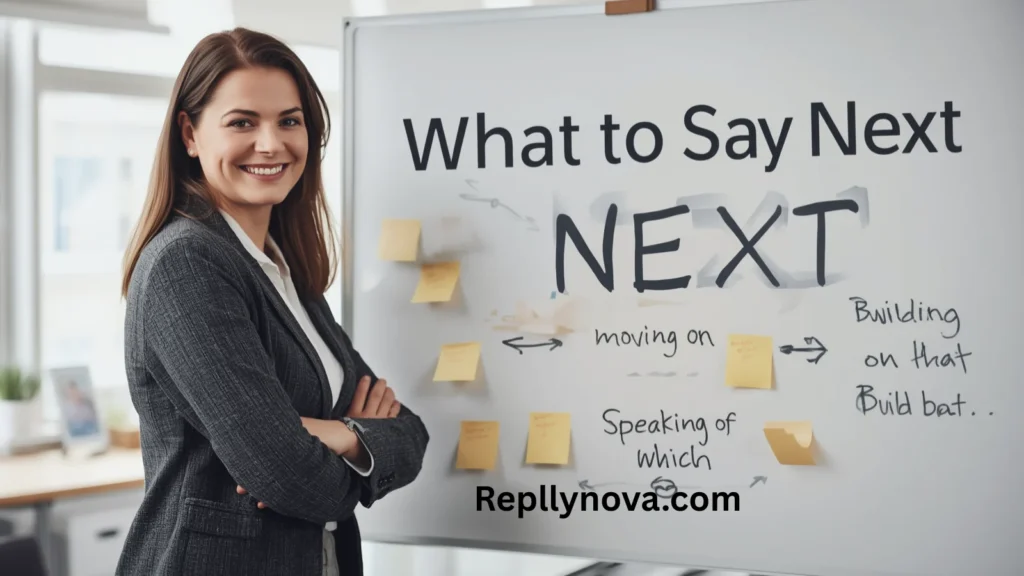

Other ways to say “What to Say Next” include “What should I say now?”, “How should I respond?”, and “What can I say after this?” You can also use “What do I say next?” for a simple, natural option.
We’ve all been there. You’re in the middle of a conversation, a presentation, or even a casual chat, and suddenly your mind goes blank. You know you need to transition to a new point, respond to what was just said, or simply keep the dialogue moving but the right words just won’t come.
Learning alternatives to “what to say next” is one of the most underrated fluency hacks in English. It’s not just about avoiding repetition; it’s about maintaining control of the conversation, sounding confident, and ensuring your listener stays engaged. Whether you’re leading a business meeting, teaching a class, or catching up with a friend, having a toolkit of transition phrases is essential.
Just as you need alternatives to express excitement in English to show enthusiasm naturally, you need other ways to say “what to say next” to project authority, warmth, or curiosity depending on your audience. The right transitional phrase can transform a clumsy pause into a polished pivot.
Quick Categories
Formal Alternatives to “What to Say Next”
- Moving on to
- With that in mind
- Let’s pivot to
- Building on that
- Following that
Casual Alternatives
- Anyway
- So then
- Now what?
- What’s next?
- By the way
Professional Alternatives
- Let’s turn to
- Shifting gears
- To continue
- As I was saying
- That brings us to
Informal Expressions
- And then there’s
- Speaking of which
- That reminds me
- Another thing
- What if we
“Fluency isn’t about knowing every word, it’s about knowing the right word for the right moment.”
Common Mistakes Section
- Using “um” or “uh” as a default transition
Incorrect: “So, um, what to say next… let’s talk about sales.”
Why it’s a problem: It undermines your authority and signals hesitation. Replace fillers with confident transitions. - Overusing “so” at the start of every sentence
Incorrect: “So, we need to review this. So, the budget is tight. So, what’s our plan?”
Why it’s a problem: Repetition makes you sound monotonous and unprepared. Vary your openers. - Using “next” without context
Incorrect: “Next… the report.”
Why it’s a problem: It sounds abrupt and disjointed. Always connect to the previous idea. - Forgetting to acknowledge the previous speaker
Incorrect: “Okay, moving on…” (after someone just shared a personal story)
Why it’s a problem: It feels dismissive. Use “Building on that” or “Following up on” to show you listened. - Using overly formal transitions in casual settings
Incorrect: “Permit me to pivot to the subsequent topic” (with friends)
Why it’s a problem: It sounds robotic and unnatural. Match your tone to the context.
What Does “What to Say Next” Mean?
Definition: This phrase refers to the mental search for the appropriate words, transition, or response to continue a conversation, presentation, or written discourse after a pause or at a natural junction.
Grammar Note: It functions as a question or a self referential clause. Usually used in first person context (“I don’t know what to say next”) or as a placeholder in dialogue.
Example Sentence: “I paused for a moment, unsure of what to say next, then smoothly introduced the new topic.”
When to Use “What to Say Next”
- When you need to transition between topics in a speech or meeting.
- When you’re responding to someone and need to acknowledge their point before adding yours.
- When you’re writing an essay or email and need to guide the reader logically.
- In casual conversations to keep the flow natural and engaging.
- In professional settings to demonstrate leadership and control over the discussion.
Spoken vs Written: More common in spoken English (as a filler or pause breaker), but also relevant in structured writing for transitions.
Formal vs Informal: The bare phrase “what to say next” is neutral but leans informal. It’s better to use structured alternatives in formal contexts.
Is It Professional or Polite to Say “What to Say Next”?
In its raw form, “what to say next” is polite but not professional. It’s often a self directed thought, not a direct transition. Saying it out loud “I don’t know what to say next” can expose uncertainty.
Business style example (bad): “I’m not sure what to say next, so let’s just move on.” (Sounds unprepared)
Business style example (good): “Building on that insight, let’s now consider the financial implications.” (Sounds confident)
Polite? ✔️ Yes it’s not rude.
Professional? ❌ No it lacks authority in most cases.
Pros and Cons of Using “What to Say Next”
Pros
- Simple and universally understood.
- Natural in reflective or self narrating moments.
- Relatable shows honesty in spontaneous speech.
- Easy to use for intermediate learners.
Cons
- Too vague for structured professional communication.
- Can sound hesitant or unprepared.
- Overused by non native speakers as a crutch.
- Not suitable for formal writing or presentations.
“A great transition doesn’t just move the conversation forward it makes you sound like you planned it all along.”
Other Ways to Say “What to Say Next” (With Examples)
These 40 alternatives will help you sound more fluent, confident, and natural in different situations. Use them according to tone, context, and audience to keep conversations flowing effortlessly.
1. Phrase: Moving on to…
Meaning: Signals a deliberate shift to a new subject.
Explanation: Indicates you’ve finished the current point and are progressing logically.
Example Sentence: “Moving on to the quarterly results, we saw a 15% increase.”
Best Use: Meetings, presentations.
Worst Use: Casual chats with close friends.
Tone: Professional, decisive.
Context Variability: Professional / Formal.
2. Phrase: With that in mind…
Meaning: Connects the next idea to what was just established.
Explanation: Shows you’re building on previous information.
Example Sentence: “With that in mind, let’s reconsider our marketing strategy.”
Best Use: Strategic discussions.
Worst Use: Quick casual responses.
Tone: Thoughtful, analytical.
Context Variability: Professional / Written.
3. Phrase: Let’s pivot to…
Meaning: A deliberate change of direction.
Explanation: Business jargon that implies agility and strategic thinking.
Example Sentence: “Let’s pivot to customer feedback for a moment.”
Best Use: Startup or corporate meetings.
Worst Use: Family dinners.
Tone: Dynamic, modern.
Context Variability: Professional / Informal business.
4. Phrase: Building on that…
Meaning: Adding a new layer to the existing point.
Explanation: Acknowledges the previous speaker and contributes.
Example Sentence: “Building on that, we should also examine our supply chain.”
Best Use: Collaborative discussions.
Worst Use: Monologue style speeches.
Tone: Cooperative, respectful.
Context Variability: Professional / Team settings.
5. Phrase: That brings us to…
Meaning: Logically arrives at the next point.
Explanation: Creates a causal bridge between topics.
Example Sentence: “That brings us to the main challenge we face this quarter.”
Best Use: Structured presentations.
Worst Use: Interjecting abruptly.
Tone: Logical, clear.
Context Variability: Formal / Educational.
6. Phrase: So, what about…
Meaning: Introduces a new angle or alternative.
Explanation: Softens the transition with a questioning tone.
Example Sentence: “So, what about the international markets and how do they fit in?”
Best Use: Brainstorming sessions.
Worst Use: Delivering bad news.
Tone: Curious, engaging.
Context Variability: Casual / Professional.
7. Phrase: Anyway…
Meaning: Dismisses the previous topic and moves on.
Explanation: Very casual often used to change the subject abruptly.
Example Sentence: “Anyway, that’s enough about work, how was your weekend?”
Best Use: Social conversations.
Worst Use: Formal reports or emails.
Tone: Relaxed, conversational.
Context Variability: Casual / Informal.
8. Phrase: So then…
Meaning: Continues a narrative or logical sequence.
Explanation: A natural story telling transition.
Example Sentence: “So then, we decided to try the new software.”
Best Use: Telling a story or recounting events.
Worst Use: Presenting data.
Tone: Narrative, flowing.
Context Variability: Casual / Semi formal.
9. Phrase: And then there’s…
Meaning: Adds an additional item or point.
Explanation: Casual way to introduce another element.
Example Sentence: “And then there’s the issue of the budget.”
Best Use: Informal lists or discussions.
Worst Use: Structured presentations.
Tone: Light, additive.
Context Variability: Informal / Spoken.
10. Phrase: Now, for…
Meaning: Signals a specific focus on a new subject.
Explanation: Clear and directive.
Example Sentence: “Now, for the implementation phase, we need a clear timeline.”
Best Use: Instructional content.
Worst Use: Emotional conversations.
Tone: Direct, instructional.
Context Variability: Professional / Educational.
11. Phrase: Similarly…
Meaning: Draws a parallel to the previous idea.
Explanation: Shows comparison, not a hard pivot.
Example Sentence: “Similarly, our competitors are facing the same hurdles.”
Best Use: Analytical writing or speaking.
Worst Use: Changing topics completely.
Tone: Comparative, logical.
Context Variability: Formal / Written.
12. Phrase: Conversely…
Meaning: Introduces an opposing viewpoint.
Explanation: Indicates a contrast or alternative perspective.
Example Sentence: “Conversely, some argue that remote work reduces productivity.”
Best Use: Debates or balanced arguments.
Worst Use: Friendly small talk.
Tone: Academic, precise.
Context Variability: Formal / Academic.
13. Phrase: On a related note…
Meaning: Shifts to a connected but distinct topic.
Explanation: Keeps coherence while changing focus.
Example Sentence: “On a related note, have you seen the new industry guidelines?”
Best Use: Meetings and group discussions.
Worst Use: Formal legal documents.
Tone: Smooth, coherent.
Context Variability: Semi formal / Professional.
14. Phrase: Speaking of which…
Meaning: Introduces a topic triggered by the previous one.
Explanation: Very natural, often used in casual conversation.
Example Sentence: “Speaking of which, I need to call the vendor tomorrow.”
Best Use: Social and workplace chats.
Worst Use: Written academic essays.
Tone: Spontaneous, connected.
Context Variability: Casual / Informal.
15. Phrase: That reminds me…
Meaning: Brings up a memory or associated idea.
Explanation: Shows organic thought association.
Example Sentence: “That reminds me we never followed up with the client.”
Best Use: Group conversations.
Worst Use: Formal presentations.
Tone: Reflective, associative.
Context Variability: Casual / Semi formal.
16. Phrase: By the way…
Meaning: Introduces an aside or tangential point.
Explanation: Marks a casual digression.
Example Sentence: “By the way, the meeting time has changed to 3 PM.”
Best Use: Emails, quick updates.
Worst Use: High stakes negotiations.
Tone: Light, supplementary.
Context Variability: Casual / Professional.
17. Phrase: Now what?
Meaning: A rhetorical question to prompt the next action.
Explanation: Often used after completing a task or idea.
Example Sentence: “We’ve finished the prototype. Now what?”
Best Use: Brainstorming or problem solving.
Worst Use: Formal client presentations.
Tone: Provocative, engaging.
Context Variability: Casual / Collaborative.
18. Phrase: What’s next?
Meaning: Directly asks or signals for the following item.
Explanation: Straightforward and efficient.
Example Sentence: “We covered the budget. What’s next on the agenda?”
Best Use: Meetings with clear agendas.
Worst Use: Emotional or sensitive conversations.
Tone: Direct, action oriented.
Context Variability: Professional / Semi formal.
19. Phrase: Where were we?
Meaning: Picks up after an interruption.
Explanation: Humble and collaborative way to reconnect.
Example Sentence: “Where were we? Oh yes, we were discussing the timeline.”
Best Use: Interrupted discussions.
Worst Use: Written instructions.
Tone: Friendly, humble.
Context Variability: Casual / Professional.
20. Phrase: Getting back to…
Meaning: Returns to a previous point.
Explanation: Useful after a tangent.
Example Sentence: “Getting back to the main agenda, let’s review the goals.”
Best Use: Long meetings with diversions.
Worst Use: Short, sharp presentations.
Tone: Focused, corrective.
Context Variability: Professional / Formal.
“The mark of a fluent speaker isn’t speed, it’s the smoothness of their transitions.”
21. Phrase: Let’s turn to…
Meaning: Invites attention to a new area.
Explanation: Gentle and inclusive direction.
Example Sentence: “Let’s turn to the operational side of things.”
Best Use: Team briefings.
Worst Use: Urgent, high pressure situations.
Tone: Collaborative, inclusive.
Context Variability: Professional / Formal.
22. Phrase: Following that…
Meaning: Indicates a chronological or logical sequence.
Explanation: Creates clear order.
Example Sentence: “Following that, we will move to the Q&A session.”
Best Use: Agendas and itineraries.
Worst Use: Spontaneous conversations.
Tone: Sequential, structured.
Context Variability: Formal / Written.
23. Phrase: In addition…
Meaning: Adds extra information to the current topic.
Explanation: Formal additive transition.
Example Sentence: “In addition, we need to consider the legal implications.”
Best Use: Business reports.
Worst Use: Casual chats.
Tone: Formal, additive.
Context Variability: Formal / Academic.
24. Phrase: Furthermore…
Meaning: Reinforces or extends a point.
Explanation: More emphatic than “in addition”.
Example Sentence: “Furthermore, our data supports this conclusion.”
Best Use: Persuasive essays or arguments.
Worst Use: Quick verbal updates.
Tone: Emphatic, formal.
Context Variability: Formal / Written.
25. Phrase: Moreover…
Meaning: Adds a point of greater importance.
Explanation: Elevates the subsequent point.
Example Sentence: “Moreover, this strategy aligns with our core values.”
Best Use: Executive summaries.
Worst Use: Text messages.
Tone: Sophisticated, formal.
Context Variability: Formal / Written.
26. Phrase: Next up…
Meaning: Very direct, sequential cue.
Explanation: Common in presentations and lists.
Example Sentence: “Next up, we have a guest speaker from the marketing team.”
Best Use: Stage announcements or agendas.
Worst Use: Serious, somber contexts.
Tone: Energetic, clear.
Context Variability: Professional / Event hosting.
27. Phrase: Shifting gears…
Meaning: Changing the pace or focus significantly.
Explanation: Metaphorical, implies a noticeable change.
Example Sentence: “Shifting gears, let’s talk about our long term vision.”
Best Use: Transitioning between very different topics.
Worst Use: Smooth, subtle shifts.
Tone: Dynamic, modern.
Context Variability: Professional / Casual.
28. Phrase: Changing the subject…
Meaning: Explicitly announces a topic change.
Explanation: Honest and direct.
Example Sentence: “Changing the subject, did you hear about the new policy?”
Best Use: Social conversations.
Worst Use: Formal meetings (can be abrupt).
Tone: Direct, transparent.
Context Variability: Casual / Social.
29. Phrase: To continue…
Meaning: Resumes an interrupted thought.
Explanation: Formal and straightforward.
Example Sentence: “To continue, the second phase will commence next month.”
Best Use: Formal speeches.
Worst Use: Email subject lines.
Tone: Formal, linear.
Context Variability: Formal / Written.
30. Phrase: As I was saying…
Meaning: Returns to your own point after an interruption.
Explanation: Establishes authority and regains floor.
Example Sentence: “As I was saying, we need to prioritize customer retention.”
Best Use: Interrupted presentations.
Worst Use: When you haven’t been interrupted.
Tone: Assertive, confident.
Context Variability: Professional / Formal.
31. Phrase: Anyway, back to…
Meaning: Dismisses a distraction and refocuses.
Explanation: Casual and effective for getting back on track.
Example Sentence: “Anyway, back to the budget what are the key numbers?”
Best Use: Informal team huddles.
Worst Use: Client facing reports.
Tone: Relaxed, decisive.
Context Variability: Casual / Semi formal.
32. Phrase: So, moving forward…
Meaning: Signals a forward looking transition.
Explanation: Connects past actions to future plans.
Example Sentence: “So, moving forward, we’ll adopt a hybrid work model.”
Best Use: Strategy meetings.
Worst Use: Historical analysis.
Tone: Forward thinking, action oriented.
Context Variability: Professional / Formal.
33. Phrase: Let’s see…
Meaning: Self directed thought before continuing.
Explanation: Buys time while engaging the audience.
Example Sentence: “Let’s see… we could approach this from a different angle.”
Best Use: Brainstorming.
Worst Use: Executive decisions.
Tone: Contemplative, open.
Context Variability: Casual / Collaborative.
34. Phrase: What if we…
Meaning: Proposes a hypothetical or alternative.
Explanation: Encourages creativity and discussion.
Example Sentence: “What if we tested this on a smaller scale first?”
Best Use: Problem solving sessions.
Worst Use: Announcing final decisions.
Tone: Innovative, suggestive.
Context Variability: Professional / Casual.
35. Phrase: Have you considered…
Meaning: Politely introduces a new thought for consideration.
Explanation: Shows respect while adding input.
Example Sentence: “Have you considered the impact on our overseas offices?”
Best Use: Consulting or advisory roles.
Worst Use: When a decision is already made.
Tone: Polite, thoughtful.
Context Variability: Professional / Semi formal.
36. Phrase: Another thing…
Meaning: Adds an additional point informally.
Explanation: Very casual, feels like a reminder.
Example Sentence: “Another thing don’t forget to confirm the venue.”
Best Use: Quick team updates.
Worst Use: Formal documentation.
Tone: Casual, supplementary.
Context Variability: Informal / Spoken.
37. Phrase: That said…
Meaning: Introduces a concession or contrasting point.
Explanation: Acknowledges the previous point before pivoting.
Example Sentence: “That said, we shouldn’t overlook the risks involved.”
Best Use: Balanced arguments.
Worst Use: Straightforward instructions.
Tone: Nuanced, balanced.
Context Variability: Formal / Professional.
38. Phrase: On the other hand…
Meaning: Presents an alternative viewpoint.
Explanation: Classic comparative transition.
Example Sentence: “On the other hand, this approach might save us time.”
Best Use: Discussions with multiple options.
Worst Use: Single option decisions.
Tone: Analytical, fair.
Context Variability: Formal / Academic.
39. Phrase: To illustrate…
Meaning: Prepares to give an example.
Explanation: Signals you’re about to clarify with a concrete case.
Example Sentence: “To illustrate, let’s look at our Q1 performance.”
Best Use: Teaching or explaining complex ideas.
Worst Use: Fast paced meetings.
Tone: Educational, clear.
Context Variability: Formal / Educational.
40. Phrase: For instance…
Meaning: Introduces a specific example.
Explanation: Very common and versatile.
Example Sentence: “For instance, our competitor launched a similar product last year.”
Best Use: Support your arguments.
Worst Use: When you have no example ready.
Tone: Exemplary, supportive.
Context Variability: Formal / Casual.
41. Phrase: Moving forward with…
Meaning: Focuses on the next actionable step.
Explanation: Combines transition with action.
Example Sentence: “Moving forward with the project, we need more resources.”
Best Use: Project updates.
Worst Use: Philosophical discussions.
Tone: Action driven, pragmatic.
Context Variability: Professional / Formal.
42. Phrase: Let’s move on to…
Meaning: Direct and polite directive.
Explanation: Slightly softer than just “moving on”.
Example Sentence: “Let’s move on to the agenda item about compliance.”
Best Use: Chaired meetings.
Worst Use: One on one casual conversations.
Tone: Guiding, authoritative.
Context Variability: Professional / Formal.
“Confidence in conversation comes from knowing how to steer the dialogue, not from knowing every answer.”
Mini Quiz / Self Check
1. You’re in a formal board meeting and need to introduce the next topic. Which is most appropriate?
- A) Anyway, let’s do this.
- B) Moving on to the financial review…
- C) So then, what?
- Answer: B
2. A colleague shares an idea, and you want to add your own while acknowledging theirs. Which phrase fits?
- A) Changing the subject…
- B) Building on that…
- C) By the way…
- Answer: B
3. You’re telling a story to friends and get distracted. Which casual transition works best to continue?
- A) To continue…
- B) Furthermore…
- C) Where were we? Oh yes…
- Answer: C
4. You’re writing a persuasive essay and need to add an opposing view. Which is correct?
- A) Anyway…
- B) Conversely…
- C) So then…
- Answer: B
Comparison Table: Top 10 Alternatives
| Phrase | Tone | Best Use |
| Moving on to… | Professional, decisive | Formal meetings |
| Building on that… | Cooperative, respectful | Team collaborations |
| Let’s pivot to… | Dynamic, modern | Startup/business strategy |
| Speaking of which… | Spontaneous, connected | Social and casual chats |
| What’s next? | Direct, action oriented | Agenda driven sessions |
| On a related note… | Smooth, coherent | Group discussions |
| Getting back to… | Focused, corrective | After tangents |
| Shifting gears… | Dynamic, metaphorical | Big topic changes |
| As I was saying… | Assertive, confident | After interruptions |
| That said… | Nuanced, balanced | Arguments and concessions |
FAQs
1. What is a professional way to say “what to say next”?
Use “Moving on to,” “Building on that,” or “Let’s turn to” these signals control and structure without exposing hesitation.
2. How can I avoid awkward pauses when transitioning?
Prepare 2–3 transition phrases before any meeting or presentation. Practice them until they feel automatic. Even a simple “So, what about…” buys you time.
3. Are “what to say next” and “what to do next” the same?
No. “What to say” refers to verbal transitions or responses, while “what to do” refers to actions or next steps. They are used in different contexts.
4. Can I use “anyway” in professional emails?
Rarely. “Anyway” is too casual. Use “In any case” or “Moving on” for a slightly more professional tone in writing.
5. Why do I keep saying “so” all the time?
“So” is a default filler for many speakers. To break the habit, consciously replace it with a variety of alternatives like “Thus,” “Therefore,” or “Now, for…” depending on the context.
Conclusion:
Mastering other ways to say what to say next is a game changer for your English fluency. It transforms you from a hesitant speaker into a confident communicator who can guide any conversation, presentation, or meeting with ease. The 40 alternatives above give you the tools to match your tone to any context: formal, professional, casual, or academic.
Start small: pick 3–5 phrases from each category and practice them in your daily conversations. Pay attention to the tone and context, and soon these transitions will become second nature. Remember, fluency isn’t just about vocabulary, it’s about the smooth bridges you build between your ideas.