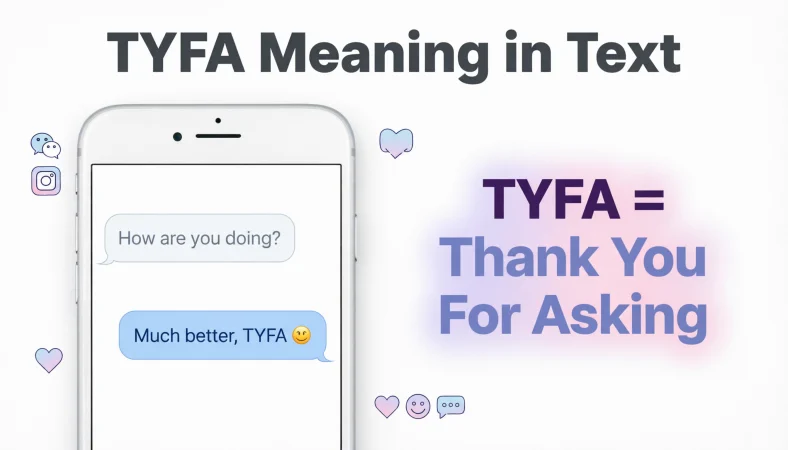
TYFA meaning in text: TYFA stands for “Thank You For Asking.” People use it in text messages, social media chats, emails, and online conversations to thank someone for showing concern, interest, or care. It is generally friendly, polite, and appreciative in tone.
Example:
- Friend: “How are you feeling today?”
- You: “Much better now, TYFA! 😊”
In today’s fast-paced digital communication, abbreviations help people express thoughts quickly without typing full sentences. One such abbreviation is TYFA, which means “Thank You For Asking.”
When someone takes the time to ask how you’re doing, check on your progress, or inquire about something important in your life, replying with TYFA is a quick way to acknowledge their kindness.
Unlike many internet slang terms that can sound casual or sarcastic, TYFA is usually associated with gratitude and positive social interaction.
Basic Meaning
| Abbreviation | Meaning | Tone |
|---|---|---|
| TYFA | Thank You For Asking | Friendly, appreciative, polite |
The phrase helps make conversations feel warmer and more personal, even in short text exchanges.
Origin of TYFA
TYFA emerged as part of the broader trend of internet abbreviations that became popular through:
- SMS texting
- Instant messaging platforms
- Online forums
- Social media conversations
- Chat applications
As character limits and quick communication became common, users started shortening frequently used phrases such as:
- TY = Thank You
- TYSM = Thank You So Much
- TYVM = Thank You Very Much
- TYFA = Thank You For Asking
While TYFA isn’t as universally recognized as LOL or BRB, it has steadily appeared in texting culture because it fills a specific conversational need: expressing gratitude when someone shows concern or interest.
Why People Use TYFA
People use TYFA because it accomplishes several things at once:
It Shows Appreciation
Instead of simply answering a question, it acknowledges the effort behind the question.
Example:
- “How’s your new job going?”
- “It’s going great, TYFA!”
It Makes Conversations More Polite
Adding TYFA creates a friendlier tone.
Without TYFA:
- “I’m doing okay.”
With TYFA:
- “I’m doing okay, TYFA 😊”
It Encourages Connection
People generally appreciate feeling noticed. TYFA reinforces positive social interactions.
It Saves Time
Typing four letters is much quicker than writing the entire phrase.
How TYFA Is Used in Real Conversations
TYFA often appears after someone asks:
- How you’re doing
- How an event went
- How you’re feeling
- How your family is doing
- Whether something was successful
- About your current situation
Common Conversation Pattern
Person A: “How was your interview?”
Person B: “It went really well, TYFA!”
The abbreviation acts as a conversational bridge between appreciation and response.
TYFA Meaning in Different Contexts
TYFA in Personal Text Messages
This is the most common usage.
Example:
- “How’s your mom doing?”
- “She’s recovering well, TYFA.”
Tone: Warm and sincere.
TYFA on Social Media
People may use TYFA when responding to comments or direct messages.
Example:
Comment:
- “Hope everything is going okay!”
Reply:
- “Yes, things are improving. TYFA ❤️”
Tone: Friendly and appreciative.
TYFA in Group Chats
TYFA can help acknowledge multiple people checking in.
Example:
- “TYFA everyone! I’m feeling much better today.”
Tone: Grateful and inclusive.
TYFA in Professional Conversations
Although less common, TYFA can occasionally appear in workplace chats.
Example:
- “How’s the project progressing?”
- “Everything is on schedule, TYFA.”
However, many professionals prefer writing out the full phrase.
Examples of TYFA in Text Messages
The table below shows how TYFA appears in different situations.
Example Table: TYFA in Context
| Situation | Message | Tone |
|---|---|---|
| Health Check | “I’m feeling much better now, TYFA.” | Appreciative |
| School | “The exam went well, TYFA!” | Positive |
| Work | “The presentation was successful, TYFA.” | Professional |
| Family | “Everyone’s doing great, TYFA 😊” | Warm |
| New Job | “Loving the new position so far, TYFA!” | Excited |
| Recovery | “Recovery is going smoothly, TYFA ❤️” | Grateful |
| Travel | “The trip has been amazing, TYFA.” | Friendly |
| Achievement | “I got the promotion, TYFA!” | Happy |
Tone and Emotional Meaning of TYFA
One reason TYFA remains useful is that it conveys emotional warmth.
Friendly Tone
Most commonly, TYFA sounds kind and appreciative.
Example:
- “I’m doing great, TYFA!”
Sincere Tone
Used when discussing something personal.
Example:
- “Things have been difficult lately, but I’m managing. TYFA.”
Professional Tone
Can work in workplace communication when used carefully.
Example:
- “The project is moving forward well, TYFA.”
Enthusiastic Tone
Sometimes paired with punctuation or emojis.
Example:
- “I got accepted!!! TYFA 🎉”
When Should You Use TYFA?
TYFA works best when someone genuinely asks about you or your situation.
Good Times to Use TYFA
✅ When someone asks how you’re doing
✅ When someone checks on your health
✅ When someone asks about an event
✅ When someone follows up on previous news
✅ When someone shows concern or support
Less Appropriate Times
❌ When no question was asked
❌ During very formal business communication
❌ In legal or academic writing
❌ When the recipient may not understand texting abbreviations
TYFA vs Similar Texting Abbreviations
Many people confuse TYFA with other thank-you abbreviations.
Comparison Table
| Abbreviation | Meaning | Main Purpose |
|---|---|---|
| TYFA | Thank You For Asking | Appreciate someone’s question |
| TY | Thank You | General gratitude |
| TYSM | Thank You So Much | Strong appreciation |
| TYVM | Thank You Very Much | Formal gratitude |
| TIA | Thanks In Advance | Appreciation before help |
| THX | Thanks | Casual gratitude |
| TYT | Take Your Time | Patience, not gratitude |
Key Difference
TYFA specifically thanks someone for showing interest or concern, while most other abbreviations simply express gratitude.
Alternative Ways to Say TYFA
Not everyone likes abbreviations. Here are some alternatives.
Casual Alternatives
- Thanks for asking!
- Appreciate you checking in.
- Thanks for thinking of me.
- That’s kind of you to ask.
- Thanks for checking up on me.
Professional Alternatives
- Thank you for your interest.
- I appreciate your inquiry.
- Thank you for checking in.
- I appreciate you reaching out.
- Thank you for following up.
Warm and Friendly Alternatives
- Thanks for caring.
- That’s thoughtful of you.
- I appreciate your concern.
- Thanks for asking about me.
- You’re very kind.
Is TYFA Popular?
TYFA is considered a moderately common niche abbreviation.
Unlike internet giants such as:
- LOL
- BRB
- OMG
- IDK
TYFA tends to appear in specific conversational situations rather than everyday texting.
Its popularity stems from the fact that it serves a unique purpose—showing gratitude toward someone’s curiosity or concern.
Can TYFA Ever Sound Sarcastic?
Usually, no.
However, context always matters.
Genuine Example
- “How’s everything going?”
- “Pretty well, TYFA!”
Friendly and sincere.
Possible Sarcastic Example
- “Oh, now you’re asking? TYFA.”
In this case, tone and wording create sarcasm, not the abbreviation itself.
The abbreviation remains inherently polite.
Alternate Meanings of TYFA
The overwhelming majority of texting usage interprets TYFA as “Thank You For Asking.”
In specialized organizations, businesses, or internal groups, TYFA could potentially represent something different. However, these alternate meanings are uncommon and highly context-specific.
For texting, messaging apps, and social media conversations, “Thank You For Asking” is by far the most widely recognized interpretation.
Common Mistakes When Using TYFA
Using It Without Context
Incorrect:
- “TYFA.”
People may wonder what they’re being thanked for.
Using It in Formal Documents
Avoid abbreviations in formal reports, contracts, and academic papers.
Assuming Everyone Knows It
TYFA is less common than LOL or BRB.
If communicating with someone unfamiliar with internet slang, consider writing the full phrase.
Tips for Using TYFA Naturally
Keep It Conversational
- “Doing much better now, TYFA.”
Pair It With Updates
- “The surgery went well, TYFA.”
Add Emojis When Appropriate
- “Everything’s great, TYFA 😊”
Match the Other Person’s Tone
Professional:
- “The project is progressing well. Thank you for asking.”
Casual:
- “Everything’s awesome, TYFA!”
FAQs
1. What does TYFA mean in text?
TYFA means “Thank You For Asking.” It’s a texting abbreviation used to show appreciation when someone asks about your well-being, situation, or experience.
2. What does TYFA stand for on Snapchat?
On Snapchat, TYFA usually stands for “Thank You For Asking.” Users often include it when replying to messages or story responses.
3. Is TYFA a positive abbreviation?
Yes. TYFA is generally positive, polite, and appreciative. It expresses gratitude toward someone who has shown interest or concern.
4. Can TYFA be used on Instagram?
Absolutely. TYFA is commonly used in comments, direct messages, and replies to followers who check in or ask questions.
5. Is TYFA formal or informal?
TYFA is primarily informal. In professional settings, writing out “Thank you for asking” is usually the better option.
6. How do you respond to TYFA?
You can respond naturally:
- “Of course!”
- “Anytime.”
- “Glad to hear it.”
- “Happy to check in.”
7. Is TYFA commonly used in texting?
It is recognized in texting culture but is less common than abbreviations such as LOL, OMG, or BRB.
8. What is the difference between TYFA and TYSM?
TYFA means “Thank You For Asking,” while TYSM means “Thank You So Much.” TYFA specifically thanks someone for their question or concern, whereas TYSM expresses stronger general gratitude.
Conclusion
TYFA is a simple but meaningful texting abbreviation that stands for “Thank You For Asking.” It allows people to acknowledge someone’s concern, curiosity, or kindness in a quick and friendly way.
Whether you’re responding to a friend checking on your health, a coworker asking about a project, or a social media follower showing support, TYFA adds warmth and appreciation to the conversation.