
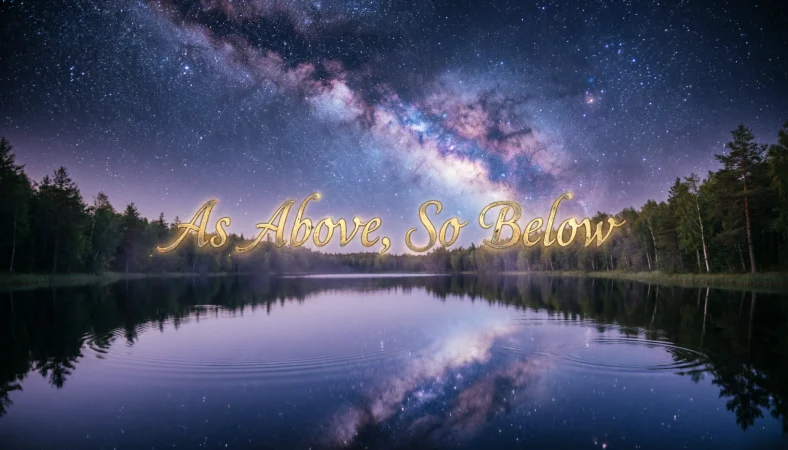
“As above, so below” is an ancient Hermetic principle stating that there is a fundamental correspondence between the macrocosm (the universe, higher realms, or the spiritual dimension) and the microcosm (the individual, the physical world, or human consciousness). It suggests that patterns, principles, and phenomena that exist on one level of reality also manifest on all other levels.
In practical terms, this means that the same laws governing the cosmos govern human psychology and behavior. The way planets move mirrors how our minds work. The cycles in nature reflect cycles in our lives. Understanding one realm helps you understand the other.
This principle implies that:
- Your inner world (thoughts, beliefs, emotions) creates your outer reality (circumstances, relationships, experiences)
- Universal patterns repeat themselves across all scales of existence
- By understanding the smaller patterns in your life, you can understand larger cosmic patterns
- There is no separation between the spiritual and the physical, the divine and the mundane
🍃 Quick takeaway: If you want to understand the universe, look within yourself. If you want to understand yourself, look at the universe.
The Ancient Origins: Where This Principle Came From
The Emerald Tablet: The Source Document
The “as above, so below” principle originates from the Hermetica, a collection of ancient Egyptian-Greek wisdom texts attributed to Hermes Trismegistus (a syncretic combination of the Greek god Hermes and the Egyptian god Thoth). The most famous source is the Emerald Tablet, a concise text that served as the foundation for Western esotericism, alchemy, and occult philosophy.
The original text reads in one translation: “That which is below is like that which is above, and that which is above is like that which is below, to accomplish the miracles of one thing.
This wasn’t just philosophical musing for ancient practitioners, this principle was practical knowledge. Alchemists used it to understand how base metals could be transformed into gold (microcosmic transformation reflecting divine creation). Astrologers used it to interpret how celestial movements influenced earthly events.
The Neo-Platonic Influence
The concept also found fertile ground in Neo-Platonic philosophy, which emphasized the “Great Chain of Being” a hierarchical structure of reality where all levels of existence are interconnected and participate in the divine nature. This philosophy heavily influenced Renaissance thinkers, who revived Hermetic wisdom and integrated it with Christian theology.
Real-World Usage: How People Apply This Wisdom Today
In Personal Development and Psychology
Modern psychology, particularly the Jungian tradition, has found deep resonance with this principle. Carl Jung famously said, “The psyche is the great mother of all human activities.” He saw the connection between personal psychology and universal archetypes as a manifestation of this Hermetic truth.
Practical applications include:
- Self-reflection: Examining your reactions to others often reveals something about yourself. If someone irritates you, what does that say about your own unresolved issues?
- Healing: Many therapeutic modalities recognize that healing happens when we align our inner world with our outer reality
- Goal setting: The outer manifestation of an intention requires inner alignment you can’t achieve external success without internal congruence
In Spirituality and New Age Practices
The principle has been embraced by modern spiritual movements:
- Law of Attraction: The idea that “like attracts like” is essentially the as above so below principle applied to personal experience
- Astrology: Continues to explore the relationship between celestial patterns and human personality
- Tarot: The famous Hierophant card often references this principle
- Meditation: The practice of finding inner peace to create outer harmony
In Business and Leadership
Forward-thinking leaders apply this principle in surprising ways:
- Organizational culture: The leadership team’s energy and values (above) determine the organization’s performance (below)
- Change management: Sustainable change happens when both vision (above) and execution (below) are aligned
- Decision-making: Understanding how small actions produce large consequences
In Science and Systems Thinking
Even scientists use variations of this principle:
- Fractals: Mathematical patterns that repeat at different scales
- Systems theory: Understanding how patterns replicate across systems
- Quantum mechanics: Observing that the observer affects the observed
- Ecology: Understanding how changes in one species affect entire ecosystems
Examples of As Above So Below in Action
Example 1: Friendly and Inspirational Context
“I’ve been working on my inner peace and self-acceptance, and honestly, it’s changed everything. My relationships are calmer, my work feels more meaningful, and I attract kinder people into my life. It’s like the world around me is just mirroring who I’m becoming inside. As above, so below my inner shift created an outer transformation. 🌟”
Example 2: Neutral and Explanatory Context
“What I appreciate about the as above so below principle is how it encourages us to look for patterns. Notice how your favorite childhood story mirrors your current career path? Or how the structure of a hurricane mirrors the structure of a galaxy? It’s a fascinating reminder that everything is connected.”
Example 3: Negative or Dismissive Context
“Look, I understand the as above so below philosophy seems profound, but blaming someone’s illness on their ‘inner state’ is not only scientifically unsupported it’s harmful and shaming. The macro-micro connection isn’t literal, and we need to treat people with real compassion, not spiritual platitudes. 🧐”
Example 4: Professional/Leadership Context
“In our quarterly review, we realized our customer satisfaction scores were dropping in the same pattern as our employee engagement scores. As above, so below how we treat our team directly impacts how they treat our customers. We need to fix the internal culture first, and the external results will follow. 📊”
Comparison with Similar Terms and Concepts
| Concept | Relationship to As Above So Below |
|---|---|
| Karma | Karma focuses on action and consequence over time, whereas as above so below describes simultaneous correspondence across levels of reality. Both suggest responsibility for one’s actions, but the Hermetic principle is about interconnectedness, not cause-effect. |
| Microcosm-Macrocosm | This is essentially a synonym for as above so below. They are often used interchangeably. |
| Law of Attraction | The Law of Attraction is a practical application of as above so below, focusing specifically on how inner states attract outer circumstances. The Hermetic principle is broader and includes cosmic and natural patterns. |
| Correspondence Principle | This is the formal academic term for this idea in Western esotericism. More technical, less commonly used in spiritual circles. |
| Systems Thinking | A scientific and academic approach to understanding how parts of a system affect the whole. Less spiritual, more practical. |
| Holism | The idea that systems should be understood as wholes, not parts. Overlaps with as above so below but without the spiritual dimension. |
| Synchronicity | Jung’s term for meaningful coincidences without causal connection. While as above so below suggests intrinsic connection, synchronicity observes meaningful patterns. |
Alternate Meanings and Misconceptions
While the core meaning remains consistent, different traditions have interpreted this principle in various ways:
The Metaphysical Interpretation
This is the most common modern understanding your inner state creates your outer reality. It emphasizes personal responsibility and spiritual growth.
The Alchemical Interpretation
Alchemists viewed it as a practical principle for transformation. What happens to matter (below) reflects divine processes (above). This fueled their search for the Philosopher’s Stone.
The Scientific/Astrological Interpretation
The literal celestial influence over earthly events. This interpretation is less popular today but historically significant.
The Psychological Interpretation
Your psyche (microcosm) reflects universal archetypes and patterns (macrocosm). This is the Jungian approach.
Common Misconceptions to Avoid:
❌ Misconception: It means the exact same events happen on all levels (a universal déjà vu)
✅ Reality: It means patterns and principles repeat, not identical events
❌ Misconception: It’s a literal law of physics
✅ Reality: It’s a philosophical and spiritual principle, not scientific law
❌ Misconception: It’s about fatalism your destiny is predetermined
✅ Reality: It’s about potential and relationship you can consciously use this principle
Polite and Professional Alternatives
Depending on your audience, you might want to express the same idea without using esoteric language:
| Context | Professional Alternative |
|---|---|
| Corporate/Workplace | “Systems thinking suggests that patterns at one level are reflected at other levels” |
| Academic/Scientific | “Self-similarity across scales is a foundational principle of complexity theory” |
| Therapeutic/Psychology | “Our internal state significantly impacts our external experience and relationships” |
| General Professional | “The whole is reflected in its parts, and the parts reflect the whole” |
| Everyday Conversation | “Everything is connected—we can’t separate ourselves from what we observe” |
| Leadership Context | “The organization’s culture flows from leadership’s values and behaviors” |
| Educational Setting | “Understanding the individual unit helps explain the larger system, and vice versa” |
The Hermetic Principle in Modern Contexts
In Pop Culture and Media
The phrase has become remarkably widespread:
- Movies: The horror film “As Above, So Below” (2014) uses the principle as its central theme
- Music: Many hip-hop artists reference it (including Jay-Z, Kendrick Lamar)
- Tattoo culture: It’s one of the most popular philosophical tattoos
- Social media: The hashtag #asabovesobelow has millions of posts
In Holistic Health
Alternative health practitioners often apply this principle:
- Psychosomatic medicine: Mental states influence physical health
- Energy healing: Blocked emotions manifest as physical tension
- Nutrition: Food choices at the physical level affect mental and spiritual well-being
- Mind-body practices: Yoga, meditation, and breathwork align all levels of being
In Environmentalism
Ecological thinkers use this concept to highlight our connection with nature:
- Climate change: Human behavior (individual microcosm) causes planetary shifts (macrocosm)
- Conservation: Biodiversity loss is a reflection of spiritual and cultural crisis
- Sustainability: Living in harmony with nature means recognizing we are nature
How to Apply the As Above So Below Principle in Daily Life
1. Morning Reflection Practice
Start your day by considering: “What do I want to see reflected in my outer world today?” Then identify one internal state you need to cultivate. If you want patience, practice being patient in the morning. If you want love, send love to yourself first.
2. Relationship Wisdom
When someone triggers you, ask: “What is this person reflecting about myself?” Often, our strongest reactions to others highlight our own unhealed wounds or unacknowledged qualities.
3. Career and Purpose
Look for the pattern of your life. What childhood interests are still showing up? What hobby keeps calling you? These are the seeds of your purpose. As you nurture them internally, opportunities will mirror them externally.
4. Decision-Making Framework
Before making a decision, consider: “What is the pattern I’m setting in motion?” Small choices create the pattern for bigger ones. The seeds you plant today determine the harvest you’ll reap tomorrow.
5. Healing and Growth
When working on healing, address both levels:
- The “above” (your mindset, beliefs, emotional patterns)
- The “below” (your physical actions, habits, environment)
This creates lasting transformation.
Summary Table: Key Interpretations of As Above So Below
| Perspective | Meaning | Application |
|---|---|---|
| Spiritual | The universe is reflected in the individual, and vice versa | Personal spiritual growth, meditation, self-awareness |
| Psychological | Your psyche contains universal archetypes and patterns | Depth psychology, shadow work, self-discovery |
| Alchemical | Transformation of matter reflects divine process | Personal and spiritual transformation |
| Metaphysical | Your inner world creates your outer reality | Law of Attraction, manifestation, personal responsibility |
| Scientific | Systems self-similarity across scales | Fractals, systems thinking, ecology |
| Practical | Small actions reflect larger patterns | Decision-making, habit formation, relationship wisdom |
FAQs
Is “as above, so below” a Bible verse?
No. The phrase is linked to the Hermetic tradition and the Emerald Tablet, not the Bible.
What does “as above, so below” mean spiritually?
It suggests that the spiritual and physical worlds reflect one another, connecting the universe with personal experience.
Who said “as above, so below”?
The phrase is traditionally associated with Hermes Trismegistus, the figure connected to Hermetic writings.
What is the original quote?
A common translation says that what is below is like what is above, and what is above is like what is below.
Is “as above, so below” the same as karma?
No. Karma focuses on actions and consequences, while this phrase focuses on correspondence between different levels of reality.
How can you use it in daily life?
Use it as a reminder to align your thoughts, habits, and values with the life you want to build.
Is “as above, so below” scientifically proven?
Not as a literal spiritual rule. It is mainly a philosophical or symbolic idea, although patterns can repeat across different systems in nature.
Why is the phrase popular on social media?
It is short, memorable, meaningful, and often used in spiritual captions, artwork, tattoos, and self-growth content.
Conclusion
The “as above so below meaning” invites us to see the world differently. Instead of viewing ourselves as isolated individuals in a cold, indifferent universe, we can recognize that we are deeply connected to something greater. Every thought we think, every action we take, and every relationship we nurture is part of a larger pattern.
This ancient wisdom offers a powerful framework for personal and professional growth:
- Self-awareness: Looking within reveals the patterns of your outer experience
- Responsibility: Your actions matter because they echo through your life
- Empowerment: Changing your inner world changes your outer experience
- Connection: You are never separate from the universe—you are a part of it
- Potential: Understanding the principle helps you unlock your true capacity
The beauty of this principle is that it invites constant inquiry. Every time you notice a pattern whether in your life, in society, or in nature you can ask: “What does this reflect? What is the larger pattern, and what is the smaller one? How are they connected?”
🍃 The simple truth is this: The wisdom of the ages reminds us that we are at once the greatest mystery and the most profound answer. As above, so below. As within, so without. As in the universe, so in the soul