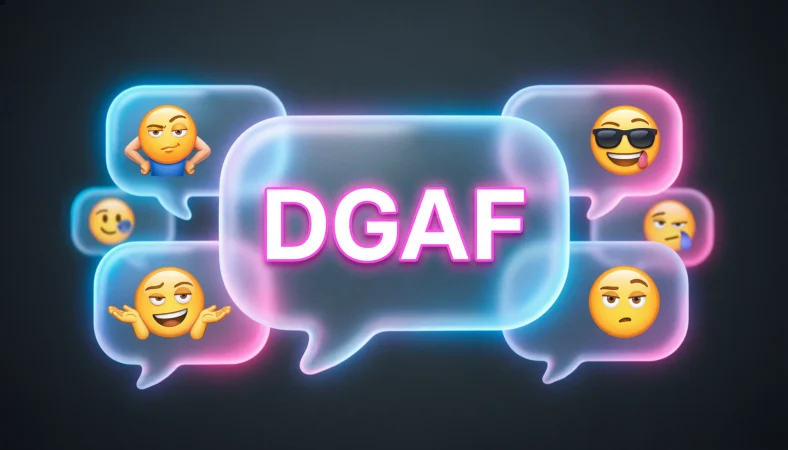
DGAF in text messaging is an internet slang acronym that stands for “Don’t Give A F*”**. It is used to express that someone does not care about a situation, opinion, problem, or outcome. The term is often used in informal communication to show indifference, confidence, frustration, or emotional detachment depending on context.
In simple words, DGAF means a strong way of saying “I don’t care” or “it doesn’t matter to me.”
If you spend even a little time on social media or texting apps, you’ve probably seen DGAF pop up in conversations, captions, or comments. It’s short, bold, and emotionally expressive—which is exactly why internet users love it.
DGAF is more than just an acronym. It reflects a modern communication style where people prefer quick, impactful expressions over long explanations. Whether someone is ignoring drama, rejecting negativity, or showing confidence, DGAF delivers the message instantly.
But here’s the interesting part: DGAF can sound rude, funny, empowering, or even sarcastic depending on how it’s used.
Let’s break it down in detail.
Origin and Popularity of DGAF
DGAF comes from the longer phrase “don’t give a f*,”** which has been used in spoken English for decades as a slang expression of indifference or rebellion.
How it became popular online:
- Early internet forums and chat rooms simplified slang into acronyms.
- Social media platforms like Twitter (now X), Instagram, and TikTok made short forms essential.
- Meme culture boosted DGAF as a bold, humorous expression.
- It became especially popular in pop culture, music lyrics, and casual texting.
Today, DGAF is widely recognized in online communication across English-speaking communities.
How DGAF Is Used in Texting and Social Media
DGAF is highly versatile. It can be used in different emotional tones depending on the situation.
Common uses of DGAF:
- Expressing indifference
- Showing confidence or self-assurance
- Responding to criticism or negativity
- Indicating rebellion or non-conformity
- Adding humor or sarcasm in casual chats
DGAF Meaning with Examples (Different Tones)
Here’s how DGAF changes meaning based on context:
1. Neutral / Indifferent Tone
- “Honestly, I DGAF what they think.”
👉 Meaning: I don’t care about their opinion.
2. Confident / Empowered Tone
- “I changed my style. DGAF if people like it or not.”
👉 Meaning: I’m confident in my choices.
3. Angry / Dismissive Tone
- “Say what you want, I DGAF anymore.”
👉 Meaning: I’m done caring or arguing.
4. Humorous / Casual Tone
- “Forgot my assignment… DGAF at this point 😂”
👉 Meaning: Playful acceptance of failure or laziness.
5. Social Media Caption Example
- “Living my life, DGAF mode on 🔥”
👉 Meaning: I’m carefree and unbothered.
Example Table of DGAF Usage
| Context Type | Example Sentence | Meaning Tone |
| Friendly chat | “I DGAF about the gossip anymore.” | Indifferent |
| Social media post | “DGAF energy only 💯” | Confident/Fun |
| Argument response | “I DGAF what you think.” | Dismissive |
| Humor | “Exam tomorrow… DGAF 😭” | Casual/Sarcastic |
| Self-expression | “She’s living a DGAF lifestyle.” | Empowered |
DGAF in Modern Internet Culture
DGAF is widely used in:
1. Memes
DGAF is often paired with funny or chaotic images to show a “carefree attitude.”
2. TikTok & Instagram captions
Influencers use it to show bold personality or confidence.
3. Music & Pop Culture
Many songs use the phrase “don’t give a f***” to express rebellion or freedom.
4. Everyday texting
Friends use DGAF casually in conversations when they want to sound relaxed or indifferent.
DGAF vs Similar Internet Slang
DGAF is often confused with or used alongside other slang terms. Here’s how it compares:
| Acronym | Full Form | Meaning | Difference |
| DGAF | Don’t Give A F*** | Strong indifference | More intense and expressive |
| IDC | I Don’t Care | Mild indifference | Softer and more polite |
| IDGAF | I Don’t Give A F*** | Same as DGAF | Slight variation in structure |
| Whatever | — | Casual dismissal | Less aggressive tone |
| Meh | — | Lack of interest | More emotional neutrality |
👉 Key takeaway: DGAF is one of the strongest expressions of indifference in texting slang.
Alternate Meanings of DGAF
Although rare, DGAF can sometimes be interpreted differently depending on niche contexts:
- In most cases, it strictly means “Don’t Give A F*.”**
- In professional or sensitive environments, people may avoid expanding it fully and simply understand it as slang.
- There are no widely accepted alternative formal meanings.
So, in almost all online conversations, DGAF has one primary meaning only.
Polite or Professional Alternatives to DGAF
Since DGAF contains profanity, it’s not suitable for formal or workplace communication. Here are better alternatives:
Polite replacements:
- “I don’t mind.”
- “It doesn’t concern me.”
- “I’m not worried about it.”
- “It makes no difference to me.”
- “I’m indifferent to that.”
Professional tone alternatives:
- “This is not a priority for me.”
- “I have no strong preference.”
- “It is outside my concern.”
👉 These options help maintain professionalism while conveying a similar meaning.
When You Should (and Shouldn’t) Use DGAF
Use DGAF when:
- Talking with friends
- Posting on social media
- Expressing humor or sarcasm
- Showing confidence or attitude
Avoid DGAF when:
- Professional emails
- Academic writing
- Job interviews
- Formal discussions
- Talking to unfamiliar people
👉 Context matters a lot. DGAF can sound rude if used in the wrong situation.
Emotional Impact of DGAF
DGAF isn’t just slang it reflects emotional states such as:
- Confidence and self-acceptance
- Frustration or burnout
- Detachment from negativity
- Humor in stressful situations
Sometimes, people use DGAF as a way to protect their mental space from stress or criticism.
FAQs
1. What does DGAF mean in texting?
DGAF means “Don’t Give A F***,” used to express indifference or not caring about something.
2. Is DGAF rude?
Yes, it can be considered rude or offensive depending on context because it contains profanity.
3. What is DGAF used for on social media?
It is used in captions, comments, and memes to show a carefree or bold attitude.
4. What is the difference between DGAF and IDC?
DGAF is stronger and more expressive, while IDC (“I don’t care”) is softer and more polite.
5. Can DGAF be used professionally?
No, it is not suitable for professional or formal communication.
6. Is DGAF positive or negative?
It can be both. It may show confidence (positive) or frustration (negative).
7. What is IDGAF?
IDGAF means “I Don’t Give A F***” and is essentially the same as DGAF.
8. Why do people use DGAF in memes?
Because it adds humor, attitude, and emotional exaggeration to content.
Conclusion
DGAF is one of the most powerful slang expressions in modern digital communication. It stands for “Don’t Give A F*”** and is widely used to express indifference, confidence, humor, or emotional detachment.
While it is popular in texting and social media, it should be used carefully due to its strong and informal nature. In casual conversations, DGAF can add personality and attitude but in formal settings, polite alternatives are always better