
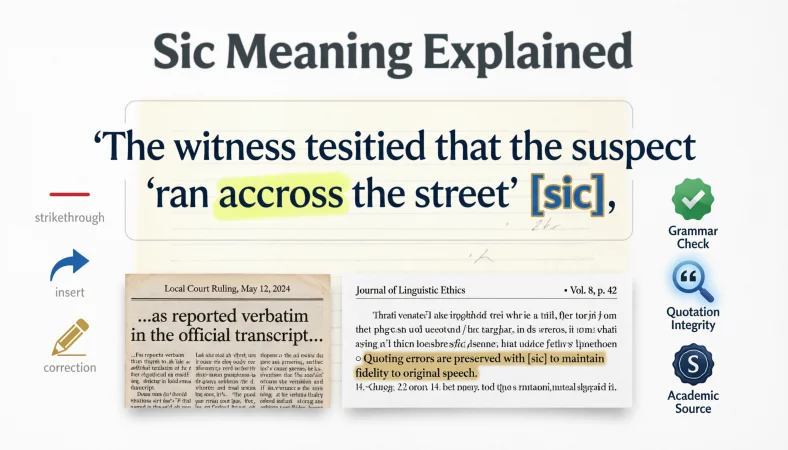

Sic meaning: “Sic” is a Latin word meaning “thus” or “so.” It is placed in square brackets [sic] within a quotation to show that an error, unusual spelling, grammatical mistake, or odd wording appeared in the original source and has been copied exactly as written.
If you’ve ever seen a quote like “I recieved [sic] your letter yesterday,” you may have wondered why the writer included [sic]. The answer is simple: it tells readers that the mistake was in the original text and was not introduced by the person quoting it.
Understanding the meaning of sic is important for students, journalists, researchers, editors, writers, and anyone who frequently works with quotations. Although the term is short, it plays a significant role in maintaining accuracy, transparency, and credibility in written communication.
In today’s digital world, where screenshots, social media posts, emails, and online comments are often quoted and shared, [sic] meaning remains a valuable tool for preserving the original wording while protecting the person quoting it from being blamed for mistakes. This guide explains everything you need to know about the meaning of sic, its origin, usage, examples, alternatives, and common misunderstandings.
Origin of Sic
The word sic comes directly from Latin.
| Term | Meaning |
|---|---|
| Sic | Thus |
| Sic erat scriptum | Thus was it written |
| Sic transit | Thus it passes |
Historically, scholars and editors used sic when reproducing manuscripts or documents that contained spelling errors, unusual language, or outdated wording.
Over time, the practice became standard in:
- Academic writing
- Journalism
- Legal documents
- Historical research
- Publishing
- News reporting
Today, [sic] is recognized worldwide as a notation that signals fidelity to the original text.
Why Is Sic Used?
The primary purpose of [sic] is to indicate that quoted material appears exactly as it did in the original source.
Without [sic], readers might assume the person quoting the text made the mistake.
Example
Original message:
“Their going to the store.”
Quoted version:
She wrote, “Their [sic] going to the store.”
The writer is showing that “their” was written incorrectly in the original message.
Main Reasons for Using Sic
- Preserve accuracy
- Avoid altering quoted material
- Clarify original errors
- Maintain historical authenticity
- Prevent confusion
How to Use Sic Correctly
The standard format is:
[sic]
Always place it immediately after the word, phrase, or sentence that contains the error.
Correct Example
“I definately [sic] agree.”
Incorrect Example
“[sic] I definately agree.”
The notation should appear directly after the problematic word.
Sic Meaning in Writing and Editing
Editors often face a dilemma when quoting someone who made a mistake. Should they fix it or leave it alone?
When accuracy matters, the quote should remain unchanged and include [sic] where necessary.
Example
Original statement:
“We has completed the project.”
Quoted version:
The spokesperson stated, “We has [sic] completed the project.”
This tells readers that the grammatical error belongs to the original speaker.
Sic Meaning in Journalism
Journalists frequently use [sic] when quoting public figures, official statements, social media posts, or documents.
Example
News quote:
The candidate posted, “I am proud of are [sic] achievements.”
By using [sic], reporters accurately reproduce the statement without correcting the mistake.
This helps maintain journalistic integrity and transparency.
Sic Meaning in Academic Writing
In research papers and scholarly publications, accuracy is essential.
When quoting historical texts or source material containing errors, scholars use [sic] to preserve the original wording.
Example
The manuscript reads, “The kinge [sic] arrived at dawn.”
The unusual spelling may be historically accurate, so it is retained.
Sic Meaning in Legal Documents
Legal professionals often reproduce statements exactly as they appear in evidence, witness testimony, contracts, or official records.
Example
The letter stated, “I did not recieve [sic] the package.”
Because legal documents require precision, changing the wording could alter meaning or create disputes.
Common Sic Examples
Example Table
| Original Text | Quoted Version |
|---|---|
| I recieved your email. | I recieved [sic] your email. |
| Their going to school. | Their [sic] going to school. |
| We was ready. | We was [sic] ready. |
| The adress is incorrect. | The adress [sic] is incorrect. |
| Your welcome. | Your [sic] welcome. |
Sic Examples by Tone
Friendly Context 😊
“I cant wait for the party!”
Quote:
Sarah texted, “I cant [sic] wait for the party!”
The use here is neutral and informative.
Professional Context
Email:
“Please send the report by tommorow.”
Quote:
The email requested that we send the report by tommorow [sic].
This preserves accuracy.
Potentially Negative or Dismissive Context 😬
Some writers overuse [sic] to highlight another person’s mistakes.
Example:
He claimed he was a “genious [sic]” investor.
Although technically correct, excessive use can come across as mocking or condescending.
For this reason, many editors recommend using [sic] only when necessary.
When Should You Use Sic?
Use [sic] when:
The Error Matters
“The meeting is on Fryday [sic].”
You Must Preserve Original Wording
Historical documents
Legal records
Research papers
The Mistake Could Cause Confusion
“The company lost there [sic] biggest client.”
When You Should Avoid Using Sic
Not every typo requires [sic].
Avoid using it when:
- The error is obvious and unimportant
- It distracts readers
- It appears overly critical
- You can paraphrase instead
Example
Instead of:
“I am very hapy [sic] today.”
You might simply write:
The person said they were very happy.
Is Sic Rude?
This is one of the most common questions about the term.
Short Answer
No, [sic] is not inherently rude.
However, context matters.
Neutral Usage
Used to preserve accuracy.
Negative Usage
Used repeatedly to draw attention to someone’s mistakes.
Professional Tip
Ask yourself:
Does the reader genuinely need to know the original contained an error?
If the answer is no, consider paraphrasing instead.
Sic vs Similar Terms
Sic vs [Emphasis Added]
| Feature | [sic] | [Emphasis Added] |
|---|---|---|
| Shows original error | Yes | No |
| Adds emphasis | No | Yes |
| Preserves wording | Yes | Yes |
| Editorial note | Yes | Yes |
Sic vs Corrected Quote
| Approach | Example |
|---|---|
| Using sic | “I recieved [sic] it.” |
| Correcting | “I received it.” |
| Paraphrasing | The person said they received it. |
Sic vs Ellipsis (…)
| Sic | Ellipsis |
|---|---|
| Indicates original error | Indicates omitted text |
| Written as [sic] | Written as … |
| Editorial note | Omission mark |
Common Mistakes When Using Sic
Using It Too Often
Bad:
He said his “adress [sic]” was on “Main Stret [sic]” near the “libary [sic].”
This can make writing look petty.
Correcting the Error and Adding Sic
Wrong:
“I received [sic] your letter.”
There is no error anymore, so [sic] is unnecessary.
Forgetting the Brackets
Correct:
[sic]
Incorrect:
sic
The brackets are an important part of the notation.
Alternate Meanings of Sic
Although sic most commonly refers to the editorial notation, it can occasionally have other meanings.
Latin Meaning
- Thus
- So
- In this manner
Rare Modern Uses
In some contexts, people may use sic jokingly online to imitate editorial style, but this is far less common than the traditional usage.
Sic Meaning on Social Media
You may occasionally see [sic] in:
- Reddit discussions
- X (Twitter) posts
- Facebook comments
- Blog articles
- Online debates
Example:
He wrote, “Your [sic] wrong.”
The poster is pointing out that the original writer used the wrong version of “you’re.”
Because social media tends to be informal, [sic] can sometimes appear sarcastic, depending on tone.
Professional Alternatives to Sic
Sometimes alternatives work better.
Paraphrase the Quote
Instead of:
“I recieved [sic] the package.”
Use:
The person stated that they received the package.
Use a Clarifying Note
Example:
The original message contained spelling errors.
Use Brackets for Clarification
Example:
“He arrived in York [New York].”
This clarifies information without highlighting mistakes.
Quick Reference Guide
| Question | Answer |
|---|---|
| What does sic mean? | Thus or so |
| Where does it come from? | Latin |
| Why use it? | To preserve original wording |
| How is it written? | [sic] |
| Is it rude? | Not usually, but it can seem rude if overused |
| Is it used in journalism? | Yes |
| Is it used in academic writing? | Yes |
| Should every typo get sic? | No |
FAQ
What does sic mean in a quote?
It means the quoted text appears exactly as it did in the original source, including any mistakes or unusual wording.
Why do writers use [sic]?
They use it to show that an error originated in the source material rather than in their own writing.
Is sic an acronym?
No. Sic is a Latin word, not an abbreviation or acronym.
Does sic mean there is a typo?
Usually, yes. It often signals a spelling, grammar, punctuation, or factual error in the original text.
Is it rude to use [sic]?
Not inherently. However, frequent use can seem sarcastic or critical if it unnecessarily highlights someone’s mistakes.
Do journalists still use sic?
Yes. Many journalists, editors, and publishers continue to use [sic] when accuracy requires preserving original wording.
Can I use sic in emails?
You generally shouldn’t use it in everyday emails unless you’re quoting text and need to preserve an error for accuracy.
What language does sic come from?
Sic comes from Latin and means “thus” or “so.”
Conclusion
Understanding the sic meaning is essential for anyone who reads, writes, edits, or quotes information. The term [sic] serves a simple but important purpose: it tells readers that a mistake, unusual spelling, or odd wording existed in the original source and has been reproduced exactly.
Used correctly, [sic] promotes accuracy, transparency, and credibility in journalism, academic writing, legal documents, and professional communication. However, it should be used thoughtfully. Overusing it can distract readers and sometimes create an unnecessarily critical tone.
When deciding whether to use [sic], ask yourself whether preserving the original error genuinely helps readers understand the quote. If it does, [sic] is the right tool. If not, paraphrasing or clarification may be a better option.
By mastering this small but powerful editorial notation, you’ll be able to quote sources accurately while maintaining professionalism and trustworthiness in your writing.
Discover More Articles About:
- CMP Meaning in Text: What Does CMP Mean in Texting, Chat & Social Media For 2026
- GFN Meaning in Text: What It Really Means in Texting, Chat and Social Media For 2026