Definition:
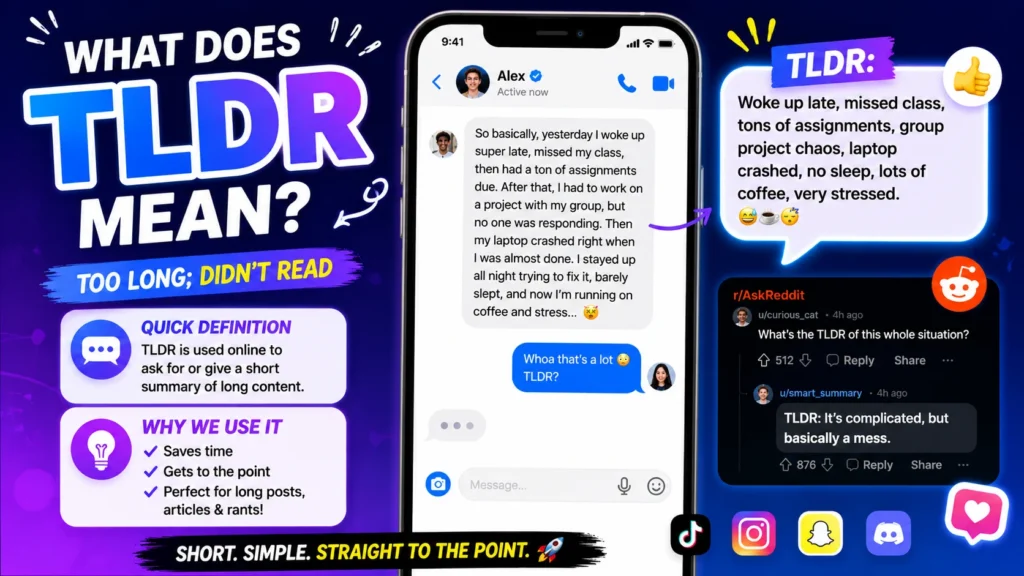
TLDR stands for “Too Long; Didn’t Read.” It is commonly used online to summarize long content or to say that a message was too lengthy to read completely. Depending on the context, it can sound helpful, funny, neutral, or slightly dismissive.
If you spend time on social media, Reddit, work emails, forums, or texting apps, you have probably seen the term “TLDR” appear at the beginning or end of a long message. It is one of the most widely used internet abbreviations and has become part of modern online communication.
Whether you are trying to understand a Reddit comment, shorten a work email, or improve your online communication skills, this article covers everything you need to know about TLDR meaning.
What Does TLDR Mean?
TLDR means:
Too Long; Didn’t Read
People use it in two main ways:
- To say that a piece of writing is too long
- To provide a short summary of a longer message
Today, TLDR is often written as:
- TLDR
- tl;dr
- TL;DR
- tldr
All versions mean the same thing.
Simple TLDR Meaning in Chat
In online conversations, TLDR usually means:
- “Here is the short version”
- “Quick summary”
- “I skipped the long explanation”
- “This message is too long”
Example:
Long message:
“I spent three hours fixing my laptop, reinstalling software, updating drivers, and finally realized the charger was broken.”
TLDR:
“My charger was the problem.”
Origin of TLDR
TLDR originated during the early internet forum era in the late 1990s and early 2000s. It became especially popular on:
- Internet forums
- Blog comment sections
- Gaming communities
- Social media platforms
Originally, people used it sarcastically to complain about long posts. Over time, the meaning evolved. Now many writers use TLDR helpfully by adding a quick summary at the beginning or end of an article or email.
Example:
TLDR: The meeting has been moved to Friday at 2 PM.
This modern usage is considered practical rather than rude.
Why Is TLDR So Popular?
TLDR became popular because internet users prefer quick and easy communication. People often scroll quickly and may not want to read large blocks of text.
Here are some reasons for its popularity:
| Reason | Explanation |
|---|---|
| Saves time | Gives readers a quick summary |
| Easy to understand | Short and memorable abbreviation |
| Common online slang | Frequently used across platforms |
| Fits internet culture | Fast communication style |
| Useful in work and school | Helps summarize long information |
Today, TLDR is common on:
- Discord
- X formerly Twitter
- TikTok captions
- YouTube comments
- Emails
- Blogs
- Text messages
How TLDR Is Used Online
TLDR can appear in several different ways depending on the situation.
1. As a Summary
This is the most common modern usage.
Example:
TLDR: We are canceling tomorrow’s event because of weather conditions.
Tone: Helpful and neutral
2. To Say Something Is Too Long
Example:
TLDR bro 😭
Tone: Informal and slightly dismissive
This usage can sometimes sound rude depending on the relationship between people.
3. At the End of Long Posts
Many writers include a TLDR section after explaining details.
Example:
TLDR: Buy the cheaper model because the expensive one offers very little improvement.
Tone: Friendly and informative
4. In Funny or Sarcastic Ways
Example:
TLDR: I made terrible life decisions 😂
Tone: Humorous
TLDR Meaning in Text Messages
In texting, TLDR often means:
- “Please summarize”
- “That was too long”
- “Here’s the quick version”
Example conversation:
Person 1:
“I had the craziest day at work because the manager forgot the presentation and then…”
Person 2:
“TLDR?”
Meaning: “Can you shorten the story?”
TLDR Tone Explained
The tone of TLDR changes depending on context.
| Usage Style | Tone |
|---|---|
| Summary in articles | Helpful |
| Work emails | Professional and efficient |
| Reply to long messages | Can sound rude |
| Funny social posts | Humorous |
| Reddit discussions | Casual |
Is TLDR Rude?
TLDR is not always rude, but it can sound dismissive if used carelessly.
When It Is Fine
- Summarizing long information
- Helping readers quickly understand content
- Casual conversations with friends
When It May Sound Rude
- Replying to emotional messages
- Interrupting someone’s story
- Dismissing detailed explanations
“TLDR. Nobody cares.”
“TLDR: The project deadline changed to Monday.”
Examples of TLDR in Real Conversations
Friendly Example
“TLDR: The movie was amazing and you should watch it!”
Tone: Friendly
Neutral Example
“TLDR: Sales increased by 12 percent this quarter.”
Tone: Professional
Slightly Negative Example
“That paragraph is TLDR 😅”
Tone: Informal and slightly dismissive
Funny Example
“TLDR: Never trust online recipes.”
Tone: Humorous
TLDR Examples Table
| Situation | Example | Tone |
|---|---|---|
| Reddit post | “TLDR: Don’t update your phone yet.” | Helpful |
| Text message | “TLDR please?” | Casual |
| “TLDR: Meeting moved to 4 PM.” | Professional | |
| Social media | “TLDR: My vacation was chaos 😂” | Funny |
| Gaming chat | “TLDR bro” | Informal |
How to Use TLDR Correctly
If you want to use TLDR naturally, follow these tips:
Use It for Summaries
Good example:
TLDR: The product works well but the battery life is weak.
Keep the Summary Short
A TLDR should usually be:
- One sentence
- Quick to understand
- Easy to scan
Avoid Using It Aggressively
Instead of saying:
“TLDR nobody reading that.”
Try:
“Can you summarize it?”
This sounds much more polite.
TLDR in Professional Communication
Interestingly, TLDR is now used in workplaces too, especially in tech companies and remote work environments.
Professionals often include:
TLDR: Main action points below.
This helps busy coworkers quickly understand important details.
However, avoid overly casual or sarcastic uses in formal settings.
Professional Alternatives to TLDR
Sometimes you may want a more polished alternative.
| Alternative | Best Use |
|---|---|
| In summary | Formal writing |
| Quick recap | Casual professional |
| Briefly | Emails |
| Key takeaway | Business communication |
| Short version | Friendly conversations |
| Executive summary | Corporate reports |
Example:
Instead of:
“TLDR: Budget approved.”
You could write:
“Quick recap: The budget has been approved.”
Comparison With Similar Internet Slang
TLDR is often confused with other abbreviations.
| Term | Meaning | Difference |
|---|---|---|
| TLDR | Too Long Didn’t Read | Summary or complaint about long text |
| IMO | In My Opinion | Shares opinions |
| FYI | For Your Information | Provides information |
| ICYMI | In Case You Missed It | Shares missed updates |
| BRB | Be Right Back | Temporary absence |
| BTW | By The Way | Adds extra information |
TLDR vs Summary
Although similar, they are not exactly the same.
| TLDR | Summary |
|---|---|
| Internet slang | Formal term |
| Informal tone | Neutral tone |
| Often very short | Can be detailed |
| Used online frequently | Used everywhere |
Alternate Meanings of TLDR
While “Too Long; Didn’t Read” is the most common meaning, TLDR can occasionally have other niche interpretations online. However, these are rare and context-specific.
In almost every online conversation, text message, forum, or social media platform, TLDR means:
Too Long; Didn’t Read
How Brands and Content Creators Use TLDR
Modern content creators use TLDR sections because readers prefer quick answers.
You may see:
- TLDR boxes in blog posts
- Quick summaries in newsletters
- Social media recaps
- YouTube description summaries
This improves:
- Readability
- User engagement
- SEO performance
- Featured snippet chances
Even large companies now use short summary sections in reports and updates.
Should You Use TLDR in Articles?
Yes, when used correctly.
Benefits include:
- Better reader experience
- Faster understanding
- Improved mobile readability
- Higher engagement
Many SEO experts recommend adding short summaries because users often skim content before fully reading it.
Common Mistakes People Make With TLDR
Using It Rudely
Avoid using TLDR to mock someone’s message.
Making the Summary Too Long
A TLDR should stay concise.
Using It in Very Formal Situations
Some business settings may prefer:
- Executive summary
- Overview
- Key points
instead of internet slang.
Best Places to Use TLDR
TLDR works best on:
- Discord
- Blogs
- Emails
- Online forums
- Social media captions
- Team chats
- Long explanations
When Not to Use TLDR
Avoid it in:
- Serious emotional conversations
- Academic essays
- Legal documents
- Highly formal business writing
- Sensitive discussions
Examples of Good TLDR Summaries
Example 1
TLDR: The app is free but premium features cost extra.
Example 2
TLDR: We reached our sales target early.
Example 3
TLDR: The restaurant looks nice but the food was disappointing.
How Gen Z Uses TLDR
Younger internet users often use TLDR humorously or casually.
Examples:
- “TLDR I failed spectacularly 💀”
- “TLDR school is exhausting”
- “TLDR don’t trust him 😂”
This style is common on:
- TikTok
- Snapchat
- Discord
- X
- Meme pages
SEO Importance of TLDR Sections
From an SEO perspective, TLDR sections can help:
- Increase readability
- Improve time on page
- Answer user intent faster
- Support featured snippets
- Improve mobile experience
Google often rewards content that quickly answers user questions.
FAQs:
What does TLDR stand for?
TLDR stands for “Too Long; Didn’t Read.” It is used to summarize long content or comment that something is too lengthy.
Is TLDR rude?
Not always. It depends on tone and context. Using it as a helpful summary is fine, but replying “TLDR” to someone’s message may sound dismissive.
What does TLDR mean in texting?
In texting, TLDR usually means “give me the short version” or “that message was very long.”
How do you pronounce TLDR?
Most people say the letters individually:
“T-L-D-R”
Some people jokingly pronounce it as “til-der.”
What is the difference between TLDR and summary?
TLDR is informal internet slang, while “summary” is more professional and formal.
Is TLDR used professionally?
Yes, especially in tech companies, remote work communication, and internal emails where quick summaries are helpful.
Where should I place a TLDR section?
Most writers place TLDR sections:
- At the beginning for quick scanning
- At the end after detailed explanations
Is TLDR still popular in 2026?
Yes. TLDR remains extremely common across social media, forums, blogs, and workplace communication.
Conclusion
TLDR is one of the internet’s most recognizable abbreviations. It started as a sarcastic way to complain about long posts but evolved into a practical tool for summarizing information quickly.
Today, TLDR is widely used in:
- Text messages
- Reddit discussions
- Social media posts
- Emails
- Blogs
- Workplace communication
The key to using TLDR effectively is understanding tone and context. In friendly or professional summaries, it can be extremely helpful. But when used carelessly, it may sound dismissive or rude.
If you want to communicate more clearly online, adding a short TLDR summary can save readers time and improve engagement.