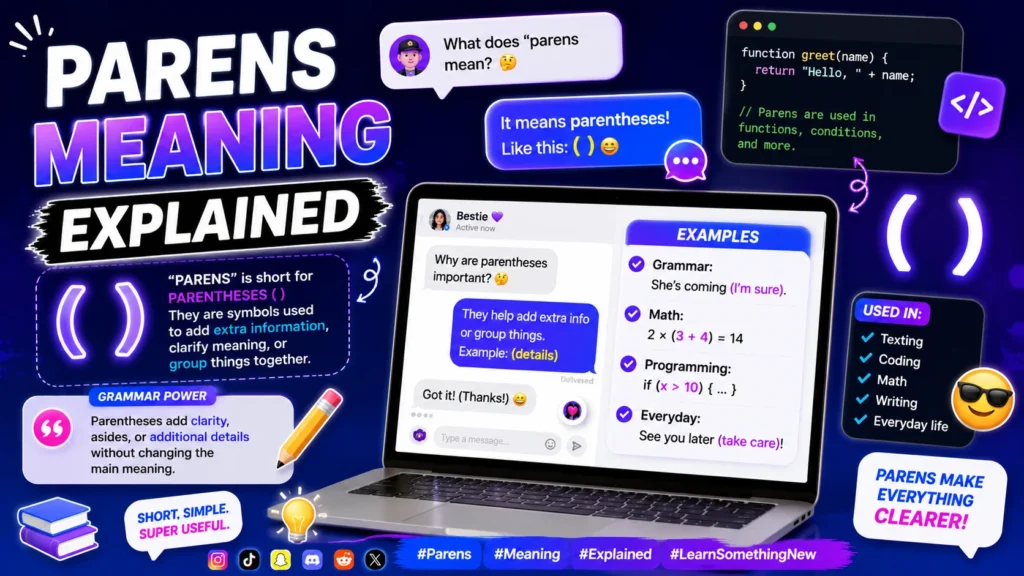
Parens meaning: “Parens” is a casual abbreviation for “parentheses,” the curved punctuation marks
( )used to add extra information or side comments in writing, texting, coding, and online communication.
Parens meaning refers to the shortened form of the word parentheses. Parens is commonly used in writing, texting, programming, editing, and online conversations to refer to the curved punctuation marks ( ). If you want to define parens, it simply means the abbreviated term for parentheses, which are used to add extra information, clarification, or side comments within a sentence. In casual internet slang, parens may also describe extra information added within parentheses or joking side comments inserted into a sentence.
Understanding the parens meaning is useful because the term appears in grammar discussions, coding tutorials, academic writing, texting, and social media conversations. Whether someone says “put that in parens” or “too many parens,” the meaning usually relates to parentheses and how they are used to provide additional detail, clarification, or tone.
This guide explains the parens meaning, how to define parens, where the word comes from, how people use parens online and offline, examples with tone explanations, comparisons with similar punctuation terms, alternate meanings, and professional alternatives.
What Does “Parens” Mean?
The word “parens” is an informal shortened version of “parentheses.”
Parentheses are the punctuation marks:
( )They are used to include additional information, side comments, clarifications, or explanations in writing.
How “Parens” Is Used in Real Life
People use “parens” in several different situations:
- Grammar discussions
- Academic writing
- Social media posts
- Text messaging
- Programming and coding
- Editing and proofreading
- Online forums
For example:
- “Put the citation in parens.”
- “Your sentence has too many parens.”
- “I added a joke in parens 😂”
- “Check the function inside the parens.”
In most cases, the term sounds casual, practical, and conversational.
Origin of the Word “Parens”
The word “parens” developed as a shortened slang form of “parentheses.”
“Parentheses” comes from the Greek word parentithenai, meaning “to insert beside.” Over time, English speakers shortened the long technical word into the easier and faster term “parens.”
The abbreviation became especially popular in:
- Journalism
- Editing communities
- Internet forums
- Programming culture
- Casual workplace communication
Today, many people naturally say “parens” instead of “parentheses” because it is quicker and more informal.
Why “Parens” Became Popular Online
The internet helped popularize shorter forms of language. Just like people say:
- “Pics” instead of photographs
- “Apps” instead of applications
- “Info” instead of information
People started saying “parens” instead of “parentheses.”
The term became common because:
| Reason | Explanation |
|---|---|
| Faster typing | Easier than writing “parentheses” |
| Casual communication | Fits texting and online chats |
| Programming culture | Frequently used in coding discussions |
| Social media trends | Informal shorthand became normal |
| Editing shorthand | Editors and writers use it regularly |
Different Meanings of “Parens”
Although the primary meaning refers to punctuation marks, “parens” can have slightly different uses depending on context.
1. Literal Meaning
The actual punctuation symbols ( ).
Example:
“Add the reference in parens.”
Meaning:
Put the reference inside parentheses.
2. Side Comment or Extra Thought
Sometimes people use “parens” to refer to a side note added into a sentence.
Example:
“She always writes funny little parens in her posts.”
Meaning:
She adds side comments inside parentheses.
3. Coding and Programming Usage
In programming, “parens” refers to parentheses used in code.
Example:
print("Hello")A programmer may say:
“You forgot the closing parens.”
Meaning:
The closing parenthesis is missing.
Examples of “Parens” in Sentences
Here are some real-world examples with tone explanations.
| Sentence | Tone | Meaning |
|---|---|---|
| “Put your sources in parens.” | Neutral | Add citations inside parentheses |
| “Too many parens make the post messy.” | Slightly critical | Overusing parentheses |
| “I love your sarcastic parens 😂” | Friendly/playful | Funny side comments |
| “You missed a closing parens in the code.” | Technical | Missing punctuation |
| “The joke in parens made me laugh.” | Positive | Extra funny comment |
| “Stop using dramatic parens lol.” | Teasing | Overly emotional side notes |
Examples of Parentheses in Writing
Casual Texting Example
“I’m coming later (traffic is terrible 😩).”
The parentheses add extra context.
Professional Example
“The meeting will begin at 2 PM (subject to schedule changes).”
The parentheses provide clarification.
Funny Social Media Example
“I totally didn’t eat the entire pizza (I absolutely did).”
The parentheses create humor and sarcasm.
Tone and Emotional Impact of Parens
Parentheses often affect the emotional tone of writing.
Friendly Tone
Parentheses can make writing feel more personal and conversational.
Example:
“Thanks for helping me today (seriously, you saved me).”
Humorous Tone
People often use parentheses for jokes or self-aware comments.
Example:
“I cleaned my room (kind of).”
Dismissive or Passive-Aggressive Tone
Sometimes parentheses can sound sarcastic or passive-aggressive.
Example:
“Sure, that was a ‘great’ idea (not really).”
Softening Tone
Parentheses can make corrections or extra information feel gentler.
Example:
“You may want to revise paragraph two (just a suggestion).”
“Parens” in Social Media and Texting
On social media, parentheses are often used to:
- Add sarcasm
- Include side thoughts
- Make jokes
- Clarify emotions
- Create relatable content
Common Social Media Style
“Me pretending to be productive (while scrolling TikTok for 3 hours).”
This writing style feels casual and relatable.
“Parens” in Programming and Coding
In coding, “parens” is extremely common terminology.
Programmers use parentheses in:
- Functions
- Equations
- Conditions
- Mathematical expressions
Example
if (x > 5) {
  console.log("Hello");
}
A developer might say:
“Check your parens.”
Meaning:
Make sure all parentheses open and close correctly.
Comparison: Parens vs Similar Terms
Many people confuse parentheses with other punctuation marks. Here is a simple comparison.
| Term | Symbol | Purpose |
|---|---|---|
| Parentheses (Parens) | ( ) | Extra information |
| Brackets | [ ] | Editorial notes or technical use |
| Braces | { } | Coding and grouped items |
| Angle Brackets | < > | HTML tags or placeholders |
| Dashes | — | Interruptions or emphasis |
| Commas | , | Small pauses or lists |
Parens vs Brackets
People often mix these up.
Parentheses ( )
Used for:
- Extra comments
- Clarifications
- Side notes
Example:
“The concert starts at 8 PM (doors open at 7).”
Brackets [ ]
Used for:
- Editorial corrections
- Added explanations in quotes
Example:
“He said he was ‘[extremely] excited.’”
Is “Parens” Formal or Informal?
“Parens” is considered informal.
Appropriate Situations
✅ Casual conversations
✅ Online chats
✅ Programming discussions
✅ Workplace shorthand
✅ Editing conversations
Less Appropriate Situations
❌ Formal academic papers
❌ Official business reports
❌ Legal documents
In formal writing, it is usually better to say “parentheses.”
Professional Alternatives to “Parens”
If you want a more formal or polished tone, use these alternatives:
| Casual Word | Professional Alternative |
|---|---|
| Parens | Parentheses |
| Put it in parens | Place it in parentheses |
| Missing parens | Missing parentheses |
| Weird parens | Unclear parenthetical comment |
Common Mistakes People Make With Parens
1. Using Too Many Parentheses
Too many side comments can confuse readers.
❌ Example:
“The meeting (which was delayed) started late (because traffic was bad) and everyone (especially Mark) was annoyed.”
✅ Better Version:
“The delayed meeting started late because of traffic, and everyone was annoyed, especially Mark.”
2. Forgetting Closing Parentheses
Example:
❌ “I love pizza (especially pepperoni.”
✅ “I love pizza (especially pepperoni).”
3. Overusing Them in Professional Writing
Formal writing should stay clean and direct.
Alternate Meanings of “Parens”
Although rare, “parens” may occasionally appear in different contexts.
Medical or Biological Context
In some scientific terminology, “parens” may refer to parents or ancestral organisms in Latin-based terminology.
However, this use is uncommon in everyday English.
Internet Humor
Online users sometimes jokingly refer to “parens” as:
- Dramatic side commentary
- Inner thoughts
- Secret opinions
Example:
“Twitter users love emotional parens 😂”
Should You Use Parentheses in Text Messages?
Yes, but moderation matters.
Parentheses can:
- Add humor
- Make messages softer
- Clarify tone
- Show personality
Good Example
“I’m running late (again 😅).”
Too Many Parentheses Example
“I’m late (because traffic was awful) and tired (didn’t sleep much) and hungry (forgot breakfast).”
This can feel cluttered.
SEO and Writing Benefits of Parentheses
Writers sometimes use parentheses strategically because they:
- Add conversational tone
- Include quick explanations
- Improve readability
- Create humor
- Add personality
However, excessive parentheses can hurt clarity and readability.
When You Should Avoid Using Parens
Avoid heavy use of parentheses in:
- Academic essays
- Legal writing
- Formal reports
- Professional proposals
- Serious announcements
Too many parenthetical comments may make writing seem less confident or overly casual.
Quick Usage Tips for “Parens”
Best Practices
- Use them sparingly
- Keep side comments short
- Make sure parentheses close properly
- Avoid nesting multiple parentheses
- Use them to improve clarity, not distract readers
FAQ About Parens Meaning
What does “parens” mean in texting?
In texting, “parens” means parentheses ( ) or side comments added inside them for extra context, humor, or clarification.
Is “parens” a real word?
Yes. “Parens” is an accepted informal abbreviation of “parentheses.”
What are parens used for?
Parens are used to add extra information, side notes, explanations, clarifications, or jokes in writing and coding.
Is “parens” formal?
No. It is mostly informal. Formal writing usually uses the full word “parentheses.”
What is the difference between parens and brackets?
Parens are ( ) while brackets are [ ]. They serve different grammatical and technical purposes.
Why do programmers say “parens”?
Programmers use “parens” as quick shorthand for parentheses used in coding syntax.
Can parentheses change tone?
Yes. Parentheses can make writing feel humorous, softer, sarcastic, casual, or conversational depending on context.
Are parens common on social media?
Yes. Social media users frequently use parentheses for jokes, side thoughts, sarcasm, and relatable commentary.
Conclusion
The term “parens” is a simple but widely used shorthand for “parentheses.” While the word may seem casual, it appears everywhere from texting and social media to coding and professional editing.
People use parens to:
- Add extra details
- Insert side comments
- Create humor
- Clarify meaning
- Soften tone
- Improve conversational flow
Understanding how parens work can improve both your writing and your online communication style. Whether you are chatting with friends, writing social posts, coding software, or editing documents, knowing when and how to use parentheses effectively makes your communication clearer and more engaging.
The key is balance. A well-placed parenthetical comment can add personality and clarity, but overusing parens may distract readers or clutter your message.
Discover More Articles About:
- CMP Meaning in Text: What Does CMP Mean in Texting, Chat & Social Media For 2026
- GFN Meaning in Text: What It Really Means in Texting, Chat and Social Media For 2026

Caleb Foster is a professional content creator at RepllyNova.com, recognized for producing clear, engaging and insightful articles. He is committed to making complex topics understandable, interesting and accessible for all audiences.