
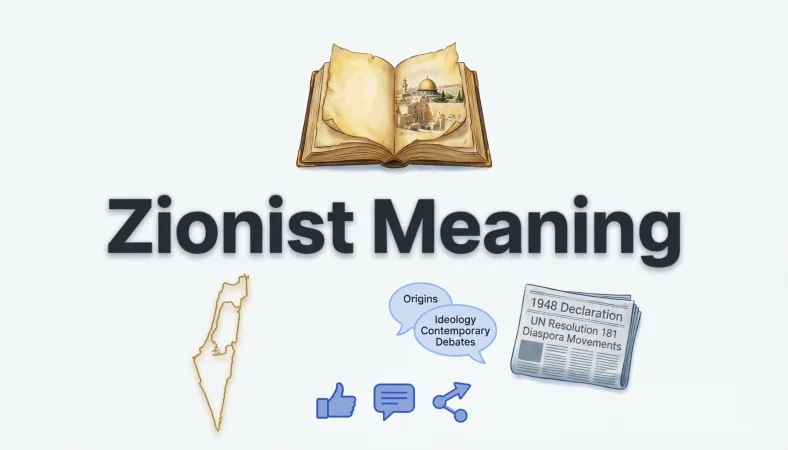
Definition: A Zionist is a person who supports or believes in Zionism, a political and national movement that originally aimed to establish and support a Jewish homeland in the historic land of Israel. Today, the term can refer broadly to people who support the existence and continuation of the State of Israel.
The meaning of “Zionist” can vary depending on historical, political, religious, or social context. Some people use the term neutrally while others use it emotionally or critically in political debates.
The term “Zionist” is one of the most discussed and misunderstood political and historical words in modern conversation. You may see it used in news reports, social media debates, history books, or political discussions. Because the term often appears in emotional or controversial contexts, many people search for the true Zionist meaning and how it is used correctly.
Origin of the Word “Zionist”
The word “Zionist” comes from “Zion”, a biblical term referring to Jerusalem and the Land of Israel.
Historical Background
The modern Zionist movement began in the late 19th century when many Jewish communities in Europe faced:
- Discrimination
- Violence
- Anti-Jewish persecution
- Lack of national self-determination
A journalist and political thinker named Theodor Herzl is widely considered the founder of modern political Zionism. In 1897, he organized the First Zionist Congress in Switzerland.
The main goal was to create a safe national homeland for Jewish people.
Why the Movement Started
Supporters believed Jewish people needed:
- Security
- National identity
- Self-governance
- Protection from persecution
This eventually led to the establishment of the State of Israel in 1948.
What Is Zionism?
To understand “Zionist meaning,” it helps to first understand Zionism.
Simple Definition of Zionism
Zionism is:
- A political movement
- A nationalist movement
- A cultural movement for Jewish self-determination
Originally, it focused on creating a Jewish homeland in historic Israel.
Today, Zionism can mean different things depending on the person using the term.
Different Types of Zionism
Not all Zionists think alike. Over time, several branches of Zionism developed.
| Type of Zionism | Meaning |
|---|---|
| Political Zionism | Focused on establishing a Jewish state |
| Religious Zionism | Combines Jewish religious beliefs with support for Israel |
| Cultural Zionism | Emphasizes Jewish culture and identity |
| Labor Zionism | Connects Zionism with socialist ideals |
| Revisionist Zionism | More nationalist and security-focused approach |
This variety is important because people often assume all Zionists share the same political opinions, which is not accurate.
Zionist Meaning in Modern Usage
Today, the word “Zionist” is used in many different ways online and offline.
Neutral Usage
In neutral contexts, “Zionist” simply describes someone who supports Israel’s existence as a Jewish state.
Example
- “My grandfather was a Zionist who believed Jewish people needed a homeland.”
Tone: Neutral and historical
Political Usage
In political discussions, the term may be used to discuss:
- Middle Eastern politics
- Israeli government policies
- National identity
- International relations
Example
- “The debate focused on Zionist political movements in the 20th century.”
Tone: Academic or political
Negative or Dismissive Usage
Sometimes the word is used negatively in heated debates or online arguments.
Example
- “People on social media used the term as an insult during political discussions.”
Tone: Negative or confrontational
Because the term is politically sensitive, context matters a lot.
Is “Zionist” a Religious Term?
Not exactly.
Many people assume Zionism is purely religious, but it is primarily:
- Political
- Historical
- National
Some Zionists are religious while others are secular.
Similarly:
- Not all Jewish people identify as Zionists
- Not all Zionists are Jewish
This distinction is important for accurate understanding.
Zionist vs Jewish: What’s the Difference?
One of the biggest misunderstandings online is confusing “Jewish” with “Zionist.”
| Term | Meaning |
|---|---|
| Jewish | Refers to an ethnic group, religion, or cultural identity |
| Zionist | Refers to support for Zionism or Israel’s existence |
A person can be:
- Jewish and Zionist
- Jewish and not Zionist
- Non-Jewish and Zionist
The two words are related but not identical.
Zionist vs Israeli
Another common confusion involves the terms “Israeli” and “Zionist.”
| Term | Meaning |
|---|---|
| Israeli | A citizen of Israel |
| Zionist | Someone who supports Zionism |
Not every Israeli publicly identifies as Zionist, and many Zionists live outside Israel.
How the Word Is Used Online
On social media platforms, “Zionist” often appears in:
- Political posts
- News commentary
- Activist discussions
- Debate threads
- Hashtags
Because online discussions move quickly, the term is sometimes oversimplified or misused.
Common Online Examples
| Phrase | Tone |
|---|---|
| “He identifies as a Zionist.” | Neutral |
| “Zionist movement in history.” | Academic |
| “They used Zionist as an insult.” | Negative |
| “The article discussed Zionist ideology.” | Informative |
Why the Term Can Be Controversial
The word “Zionist” carries strong emotional and political meaning because it is connected to:
- Israeli-Palestinian conflict
- National identity
- Religion
- Human rights debates
- International politics
Different groups may interpret the word differently.
For some:
- It represents Jewish self-determination and safety
For others:
- It may symbolize political disagreement or criticism of Israeli policies
Because of this, using the term carefully and accurately is important.
Is It Offensive to Call Someone a Zionist?
It depends on:
- Context
- Tone
- Intent
- How the individual identifies
Neutral Context
Calling someone a Zionist is not automatically offensive if it accurately describes their beliefs.
Negative Context
Using the term as an insult or stereotype can become offensive or inflammatory.
Best Practice
If discussing sensitive political topics:
- Avoid assumptions
- Use respectful language
- Focus on policies or ideas rather than labels
Examples of Zionist in Sentences
Neutral Examples
- “The book explains the origins of the Zionist movement.”
- “She studied Zionist history in university.”
Historical Examples
- “Early Zionists organized political conferences in Europe.”
- “The movement gained momentum in the early 1900s.”
Political Examples
- “The debate included Zionist and anti-Zionist perspectives.”
Online Conversation Example
- “People often argue about the meaning of Zionist on social media.”
Tone and Context Guide
| Usage Style | Example | Tone |
|---|---|---|
| Historical | “Zionist leaders met in Europe.” | Informative |
| Political | “Zionist ideology shaped policy debates.” | Analytical |
| Social Media | “People argued over the term online.” | Emotional |
| Academic | “The professor discussed Zionism historically.” | Neutral |
Related Terms and Concepts
Anti-Zionist
An anti-Zionist opposes Zionism or certain ideas associated with it.
People may oppose Zionism for:
- Political reasons
- Religious reasons
- Ideological beliefs
Pro-Israel
“Pro-Israel” generally means supportive of Israel.
A person can be:
- Pro-Israel without strongly identifying as Zionist
- Zionist and critical of some Israeli government policies
Nationalism
Zionism is often described as a form of nationalism because it supports national self-determination for Jewish people.
Alternate Meanings of Zionist
The term mainly has one dominant political and historical meaning. However, people may use it differently in:
- Religious discussions
- Academic debates
- Online activism
- Media commentary
There is no major slang or unrelated alternate definition.
Professional or Polite Alternatives
In sensitive discussions, people sometimes use more specific wording instead of broad labels.
Alternatives Include
- “Supporter of Israel”
- “Supporter of Zionism”
- “Israeli nationalist”
- “Advocate for Jewish self-determination”
These alternatives may sound more precise depending on context.
Common Misconceptions About Zionism
Misconception 1: All Jewish people are Zionists
False. Jewish communities hold many different political views.
Misconception 2: All Zionists agree politically
False. Zionists may disagree strongly on policies and ideology.
Misconception 3: Zionism is only religious
False. The movement began largely as a political and nationalist movement.
Misconception 4: Zionist always means extremist
False. The term itself does not automatically imply extremism.
Why People Search “Zionist Meaning”
Search interest has increased because the term appears frequently in:
- Global news
- Political debates
- University discussions
- Social media trends
- International conflict coverage
Many users want:
- A simple definition
- Historical background
- Clear context
- Non-biased explanations
Zionist Meaning in Pop Culture and Media
The term may appear in:
- Documentaries
- Political speeches
- News interviews
- Books
- Social media discussions
Because public figures sometimes use the term differently, media literacy and context are important.
FAQs
What does Zionist mean in simple words?
A Zionist is someone who supports the idea of a Jewish homeland in Israel and generally supports the existence of Israel as a Jewish state.
Is Zionism a religion?
No. Zionism is mainly a political and nationalist movement, though some religious groups also support it.
Is every Jewish person a Zionist?
No. Jewish people have diverse political and religious beliefs, and not all identify as Zionists.
What is the difference between Zionist and Israeli?
An Israeli is a citizen of Israel. A Zionist is someone who supports Zionism or Israel’s existence.
Is Zionist a political term?
Yes. The term is strongly connected to politics, nationalism, and Middle Eastern history.
Can non-Jewish people be Zionists?
Yes. Some non-Jewish individuals and groups support Zionism.
Why is the term controversial?
It is tied to historical events, national identity, and ongoing political conflicts, especially involving Israel and Palestine.
Is calling someone a Zionist offensive?
Not necessarily. It depends on context, tone, and intent. The term can be neutral, descriptive, or politically charged depending on usage.
Conclusion
Understanding the true Zionist meaning requires looking at history, politics, culture, and context together. At its core, a Zionist is someone who supports Zionism and the idea of a Jewish homeland in Israel. However, modern usage has become more complex because the term is deeply connected to international politics and social debate.
The word can be used:
- Historically
- Politically
- Academically
- Emotionally online
Because of this, context matters more than ever. Whether reading news articles, joining online discussions, or studying history, understanding the term accurately helps create more informed and respectful conversations.
When discussing sensitive topics like Zionism:
- Avoid stereotypes
- Focus on facts and context
- Respect differing perspectives
- Use precise language whenever possible
That approach leads to clearer and more productive communication.

Caleb Foster is a professional content creator at RepllyNova.com, recognized for producing clear, engaging and insightful articles. He is committed to making complex topics understandable, interesting and accessible for all audiences.