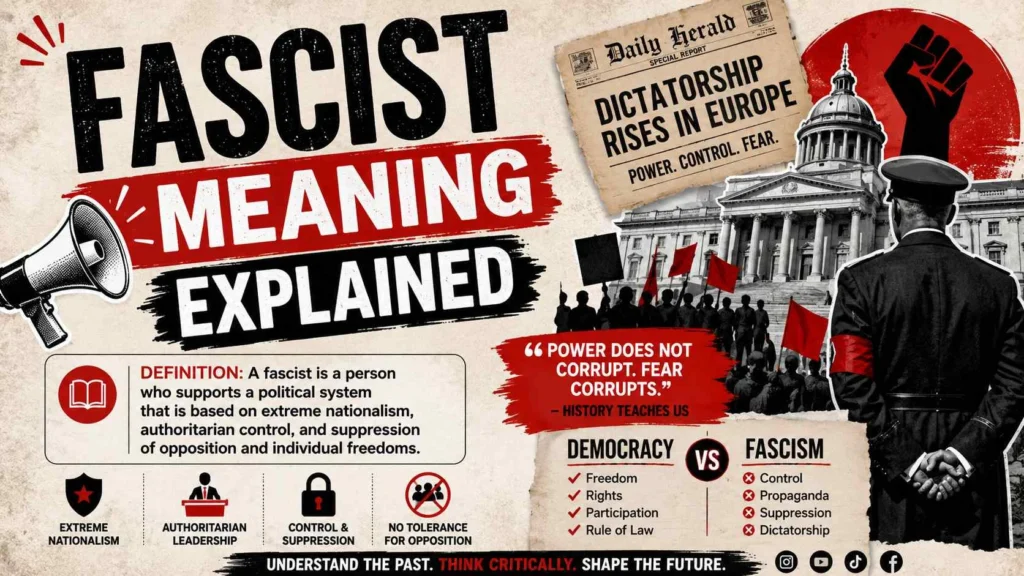
A fascist is a person who supports or promotes fascism, an authoritarian political ideology that emphasizes extreme nationalism, centralized power, strict social control, and limited political opposition. The term is often associated with dictatorial governments and suppression of freedoms.
The word “fascist” is one of the most powerful and controversial political terms used in conversations, media, and history discussions today. You may hear it in debates, news coverage, social media arguments, or even casual conversations. But what does it actually mean?
Understanding the true meaning of “fascist” matters because the word is frequently used both accurately and incorrectly. In modern conversations, it can describe historical political systems, criticize authoritarian behavior, or sometimes be used as an insult in heated arguments.
This guide explains the full meaning of fascist, its historical origins, modern usage, examples, tone, related terms, and professional alternatives in a clear and reader-friendly way.
What Does Fascist Mean?
A fascist is someone connected to or supportive of fascism, a political ideology characterized by:
- Strong authoritarian leadership
- Extreme nationalism
- Strict government control
- Suppression of opposition
- Limited individual freedoms
- Militarism and political conformity
The term is commonly linked to historical regimes such as those led by Benito Mussolini in Italy and Adolf Hitler in Germany during the 20th century.
Today, the word is also used more broadly in discussions about politics, power, censorship, or controlling behavior.
Simple Meaning of Fascist in Everyday Language
In simpler terms, calling someone “fascist” often means:
- They are seen as overly controlling
- They support strict authority
- They oppose political freedom
- They try to silence disagreement
However, in casual conversations, people sometimes exaggerate the word and use it loosely during arguments.
Example:
“People online started calling the new policy fascist because it restricted protests.”
Origin of the Word Fascist
The term comes from the Italian word “fascismo.” It originated in the early 1900s and became widely associated with Italian dictator Benito Mussolini.
The root word comes from the Latin “fasces,” a bundle of wooden rods with an axe that symbolized authority and power in ancient Rome.
Historical Timeline
| Year | Event |
| Early 1900s | Fascism develops in Italy |
| 1922 | Benito Mussolini rises to power |
| 1930s–1940s | Fascist movements spread in Europe |
| World War II | Fascism becomes globally condemned |
| Modern Era | Word used politically and socially |
What Is Fascism?
To understand “fascist,” you first need to understand fascism.
Fascism is a political system that generally includes:
- One powerful leader
- National unity above individual rights
- Strong military influence
- Government control over society
- Suppression of critics and opposition groups
Fascist governments often reject democratic systems and prioritize obedience to the state.
Key Characteristics of Fascist Ideology
1. Authoritarian Leadership
Power is concentrated in one ruler or ruling group.
2. Extreme Nationalism
The nation is treated as superior to others.
3. Political Suppression
Opposition parties and critics are often silenced.
4. Militarism
Military power and aggression are emphasized.
5. Propaganda
Governments use media and messaging to shape public opinion.
6. Limited Personal Freedoms
Individual rights may be reduced in favor of state control.
Real-World Historical Examples of Fascism
Benito Mussolini’s Italy
Mussolini established one of the earliest fascist governments in Italy during the 1920s.
Nazi Germany
Adolf Hitler’s regime in Germany adopted many fascist principles along with racial ideology and totalitarian control.
Francisco Franco’s Spain
Franco ruled Spain under an authoritarian nationalist government for decades.
These governments are often studied in history classes as examples of fascist or fascist-like systems.
How the Word Fascist Is Used Today
Modern usage varies depending on context.
Political Discussions
The term may describe authoritarian or anti-democratic behavior.
Social Media Arguments
People sometimes use “fascist” as an insult during heated debates.
Cultural Commentary
The word can appear in articles discussing censorship, government power, or nationalism.
Is Fascist Always a Political Term?
Mostly yes, but not always.
Sometimes people use “fascist” jokingly or exaggeratedly to describe someone who is overly strict or controlling.
Casual Example
“My coach is a total fascist about practice schedules.”
This use is informal and often hyperbolic rather than literal.
Tone and Connotation of Fascist
The word almost always carries a strong negative tone.
Tone Breakdown
| Tone | Meaning |
| Negative | Most common usage |
| Political | Serious ideological discussions |
| Dismissive | Used as criticism or insult |
| Hyperbolic | Exaggerated casual use |
Because of its historical connection to oppressive governments and war, the word can feel emotionally charged.
Examples of Fascist in Sentences
Historical Context
“The fascist regime controlled newspapers and political speech.”
Political Debate
“Critics accused the policy of having fascist tendencies.”
Casual Exaggeration
“My teacher is fascist about late assignments 😅”
News Commentary
“The article examined whether the movement showed fascist characteristics.”
When People Use Fascist Incorrectly
The term is often overused online.
Not every strict rule or political disagreement is fascism. Calling someone fascist without understanding the ideology can weaken meaningful discussion.
Common Misuses
- Calling any authority figure fascist
- Using it during simple disagreements
- Equating all conservative views with fascism
- Using it as a generic insult
Difference Between Fascist and Authoritarian
These words are related but not identical.
| Term | Meaning |
| Fascist | Specific political ideology tied to nationalism and authoritarian rule |
| Authoritarian | Any system emphasizing strict authority and limited freedom |
| Dictator | A ruler with absolute power |
| Totalitarian | Government seeking total control over public and private life |
All fascist systems are authoritarian, but not all authoritarian systems are fascist.
Fascist vs Nazi
Many people confuse these terms.
Fascist
- Focuses on authoritarian nationalism
- Originated in Italy
- Can exist without racial ideology
Nazi
- Based on fascism
- Included extreme racism and antisemitism
- Associated specifically with Hitler’s Germany
Related Political Terms
Here are some related concepts often discussed alongside fascism:
| Term | Meaning |
| Nationalism | Strong loyalty to one’s nation |
| Dictatorship | Rule by one person |
| Totalitarianism | Total state control |
| Militarism | Emphasis on military power |
| Extremism | Radical political beliefs |
Alternate Meanings or Informal Uses
While the primary meaning is political, people occasionally use “fascist” informally to describe:
- Overly controlling behavior
- Strict management styles
- Excessive rule enforcement
Example
“My roommate is fascist about kitchen cleanliness.”
This is usually not meant literally.
Why the Word Fascist Is So Controversial
The term carries emotional and historical weight because of:
- World War II history
- Human rights abuses
- Dictatorships
- Political polarization
- Modern social media culture
Because of this, accusations of fascism often spark strong reactions.
How to Use Fascist Correctly
Before using the word, consider:
Ask Yourself:
- Is the discussion political?
- Does the behavior involve authoritarian control?
- Is nationalism or suppression involved?
- Am I using the term accurately or emotionally?
Using the word carefully helps maintain respectful and informed discussions.
Professional or Polite Alternatives
Sometimes less inflammatory language works better.
Alternatives to Fascist
| Alternative | Best Use |
| Authoritarian | Formal political discussions |
| Controlling | Everyday situations |
| Oppressive | Criticizing harsh systems |
| Strict | Neutral description |
| Heavy-handed | Workplace or policy criticism |
Example
Instead of:
“The manager is fascist.”
You could say:
“The manager has a very controlling leadership style.”
Fascist in Media and Pop Culture
The term frequently appears in:
- Political documentaries
- History books
- Social media debates
- Movies about World War II
- News analysis
Because it attracts attention, the word is sometimes used dramatically for emphasis.
Why Fascist Trends Online
Search interest in “fascist meaning” increases during:
- Elections
- Political protests
- Controversial government policies
- Viral debates on social media
- Discussions about censorship or nationalism
Many users search the term because they hear it online and want the accurate definition.
Common Phrases Related to Fascist
Frequently Seen Expressions
- Fascist regime
- Fascist ideology
- Fascist government
- Fascist tendencies
- Anti-fascist movement
- Neo-fascist group
Example Table: Fascist Usage by Context
| Context | Example Sentence | Tone |
| Historical | “The fascist government censored newspapers.” | Serious |
| Political | “Opponents called the law fascist.” | Critical |
| Casual | “My dad is fascist about bedtime.” | Humorous/Exaggerated |
| Academic | “The professor discussed fascist ideology.” | Neutral |
| Online Debate | “People started throwing around the word fascist.” | Emotional |
Should You Avoid Using the Word Casually?
Usually yes.
Because the term has serious historical significance, using it casually may:
- Escalate arguments
- Sound disrespectful
- Reduce meaningful discussion
- Create misunderstandings
Professional communication generally benefits from more precise wording.
Fascist Meaning on Social Media
On platforms like X, Reddit, TikTok, and Instagram, the word is often used:
- During political disagreements
- To criticize authority
- As hyperbole
- In memes and jokes
However, online usage is not always historically accurate.
Frequently Asked Questions:
What is the simple meaning of fascist?
A fascist is someone who supports authoritarian and nationalist political ideas associated with fascism.
Is fascist an insult?
Often yes. In modern conversation, the term is usually negative and critical.
What is the difference between fascist and dictator?
A dictator is a ruler with total power, while fascism is a broader political ideology involving nationalism and authoritarian control.
Can fascist be used casually?
People sometimes use it casually to describe strict behavior, but this can sound exaggerated or insensitive.
What does fascist mean in politics?
In politics, it refers to support for authoritarian government systems that suppress opposition and emphasize nationalism.
Is fascism left-wing or right-wing?
Historically, fascism is generally classified as a far-right political ideology.
Why do people call others fascist online?
People may use the term to criticize controlling, authoritarian, or anti-democratic behavior, though it is often overused.
What are signs of fascist ideology?
Common signs include extreme nationalism, suppression of opposition, centralized authority, propaganda, and limited freedoms.
Conclusion
The term “fascist” has deep historical and political significance. At its core, it describes someone connected to fascism, an authoritarian ideology centered on nationalism, centralized power, and suppression of opposition.
While the word is still important in political discussions and historical analysis, it is also frequently used loosely online and in everyday arguments. Understanding its true meaning helps people communicate more accurately and responsibly.
Key takeaways:
- Fascist refers to supporters of fascism or authoritarian nationalist systems
- The word has strong negative historical associations
- It is often misused in casual arguments
- Context matters when using the term
- Professional alternatives may work better in everyday communication
Knowing the proper meaning of fascist can help you better understand political discussions, historical events, and modern media conversations.

Caleb Foster is a professional content creator at RepllyNova.com, recognized for producing clear, engaging and insightful articles. He is committed to making complex topics understandable, interesting and accessible for all audiences.