
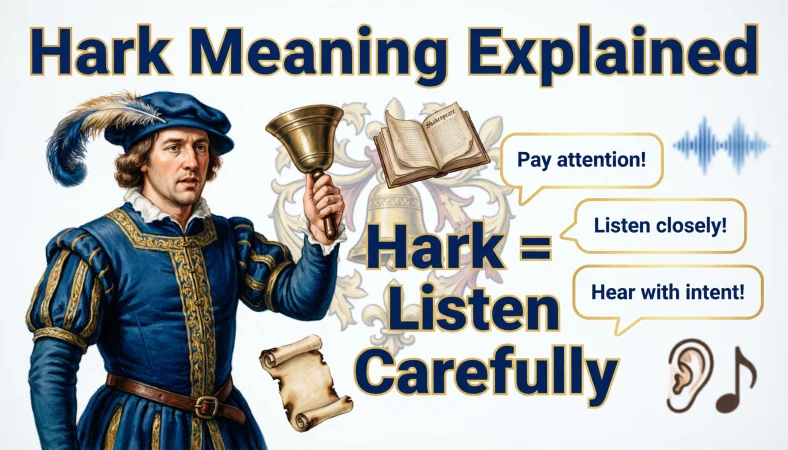

Hark is an old fashioned English verb that means “listen carefully,” “pay attention,” or “hear.” It is commonly used in literature, poetry, religious texts, and classic expressions to direct someone’s attention to a sound, message, or important information.
Language constantly evolves, but some words survive for centuries because of their strong expressive power. Hark is one of those words. Although it is not commonly used in everyday conversation today, it remains recognizable thanks to literature, music, historical writings, and famous holiday songs.
If you’ve ever wondered what does hark mean, the simple answer is that it is an old English word used to tell someone to listen carefully or pay close attention. Understanding the hark meaning helps readers appreciate classic English texts and recognize how older words continue to influence modern language. Knowing the hark definition also makes it easier to understand its appearance in Shakespeare, poetry, religious writings, and traditional songs.
Whether you’re reading classic literature, studying English vocabulary, or simply curious about unusual words, learning the meaning and usage of “hark” can add depth to your understanding of the language.
In this guide, you’ll discover the definition, origin, examples, tone, alternatives, and modern relevance of the word hark, along with practical usage tips and frequently asked questions.
Hark Definition & Meaning Explained
At its core, hark means:
- Listen carefully
- Pay close attention
- Hear what is being said or sounded
- Take notice of something important
The word is often used as an exclamation:
“Hark! I hear footsteps approaching.”
In this sentence, the speaker is telling others to listen carefully because something important can be heard.
Simple Definition
| Word | Meaning |
| Hark | Listen carefully; pay attention |
| Hark! | An exclamation meaning “Listen!” or “Hear this!” |
Origin of the Word Hark
The word hark has deep historical roots.
It comes from the Old English word “heorcnian,” which meant “to listen” or “to hear attentively.” Over time, the term evolved into harken and eventually hark.
The related word hearken still exists today and carries a very similar meaning.
Historical Timeline
| Period | Development |
| Old English | Heorcnian (to listen) |
| Middle English | Herken or Harken |
| Modern English | Hark |
The word became especially common in:
- Medieval literature
- Religious texts
- Poetry
- Shakespearean plays
- Traditional songs and hymns
Because of its long history, many people associate “hark” with formal, poetic, or dramatic language.
Why Is Hark Still Popular Today?
Even though the word is centuries old, it remains familiar because of cultural references.
Common Places You May Encounter “Hark”
Christmas Carols
The most famous example is:
“Hark! The herald angels sing.”
This line has helped keep the word alive for generations.
Literature
Classic authors frequently used “hark” to create dramatic moments.
Example:
“Hark! What noise comes from the forest?”
Fantasy and Historical Fiction
Modern writers often use “hark” to create an old-world atmosphere.
Example:
“Hark, traveler! The king requests your presence.”
Humorous Modern Usage
Sometimes people use “hark” jokingly to sound overly dramatic.
Example:
“Hark! The pizza delivery has arrived!”
How to Use Hark in a Sentence
The word is usually used as an exclamation or command.
Structure 1: Hark!
Hark! Someone is knocking at the door.
Structure 2: Hark to
This means to listen carefully to something or someone.
Hark to the wisdom of your elders.
Structure 3: Hark Back
A modern expression meaning to return mentally to an earlier time.
The design harks back to the 1980s.
Hark Examples with Different Tones
Friendly Tone 😊
Hark! I think the ice cream truck is coming.
Hark, friends, the concert is about to begin!
Neutral Tone
Hark to the announcement before entering the building.
Hark to the instructions provided by the guide.
Dramatic Tone 🎭
Hark! A cry echoes through the night.
Hark! The enemy approaches.
Humorous Tone 😄
Hark! The Wi-Fi has finally returned.
Hark! My online order has arrived.
Example Usage Table
Everyday and Literary Examples
| Sentence | Meaning |
| Hark! I hear thunder. | Listen carefully to the thunder. |
| Hark to my advice. | Pay attention to my advice. |
| The movie harks back to classic westerns. | Reminds people of older western films. |
| Hark! The bell rings. | Listen to the bell. |
| Hark, traveler, and hear my tale. | Listen to my story. |
What Does “Hark Back” Mean?
One of the most common modern uses of the word is in the phrase “hark back.”
Hark Back Meaning
Hark back means:
- To remind someone of the past
- To refer to an earlier time
- To bring back memories
Examples
The architecture harks back to ancient Rome.
Her fashion style harks back to the 1990s.
The game harks back to classic arcade titles.
In modern English, people are far more likely to hear “hark back” than the standalone word “hark.”
Hark vs Hear vs Listen vs Hearken
Many learners confuse these similar words.
Comparison Table
| Word | Meaning | Modern Usage |
| Hark | Listen carefully | Rare |
| Hear | Perceive sound | Very common |
| Listen | Pay attention to sound | Very common |
| Hearken | Listen attentively | Rare and formal |
Examples
Hear
I hear music.
Listen
Listen to the music.
Hearken
Hearken to the teacher’s words.
Hark
Hark! I hear music.
The main difference is that hark actively calls attention to something.
Is Hark Formal or Informal?
The answer depends on context.
Formal Usage
In literature, speeches, and historical writing:
Hark to the voice of reason.
Informal Usage
Often humorous or playful:
Hark! My coffee is finally ready.
Tone Overview
| Context | Tone |
| Literature | Formal |
| Poetry | Artistic |
| Religion | Reverent |
| Humor | Playfully dramatic |
| Daily Speech | Uncommon |
Alternate Meanings of Hark
While the primary meaning is “listen” or “pay attention,” the word may appear in a few related forms.
Hark Back
To refer to the past.
Harken
A variation meaning to listen attentively.
Hearken Back
An older variation meaning to remember or return mentally to an earlier time.
In modern dictionaries, these meanings all connect to the core idea of attention and listening.
Polite and Professional Alternatives to Hark
Since “hark” can sound old-fashioned, many people prefer modern alternatives.
Professional Alternatives
- Please listen carefully
- Pay attention
- Take note
- Consider
- Observe
- Be aware
- Kindly note
Examples
Instead of:
Hark to my advice.
You can say:
Please consider my advice.
Or:
Pay attention to the recommendations.
Alternative Comparison Table
| Hark Expression | Modern Alternative |
| Hark! | Listen! |
| Hark to this announcement. | Please pay attention to this announcement. |
| Hark to my words. | Consider my words. |
| Hark back to the past. | Recall the past. |
Why Writers and Speakers Use Hark
Writers often choose “hark” because it creates a specific feeling.
Benefits of Using Hark
- Adds drama
- Creates historical atmosphere
- Sounds poetic
- Grabs attention
- Makes dialogue memorable
For example:
Listen! The storm approaches.
is clear and modern.
But:
Hark! The storm approaches.
feels more dramatic and theatrical.
This is why fantasy novels, period dramas, and poetry frequently use the word.
Common Mistakes When Using Hark
Mistake 1: Using It in Everyday Business Writing
❌ Hark to the attached report.
✅ Please review the attached report.
Mistake 2: Confusing It with Hear
❌ I hark music from outside.
✅ I hear music from outside.
Mistake 3: Overusing It
Because the word sounds dramatic, using it repeatedly can make writing seem unnatural.
Use it sparingly for maximum effect.
Hark Meaning in Popular Culture
The word appears in:
- Christmas songs
- Fantasy novels
- Historical dramas
- Shakespeare-inspired works
- Role-playing games
- Medieval-themed entertainment
Its association with old English speech gives it a timeless quality that many creators still enjoy using today.
Frequently Asked Questions
1. What does hark mean?
Hark means to listen carefully, pay attention, or hear something important.
2. Is hark an old-fashioned word?
Yes. It is considered archaic or old-fashioned in everyday speech but remains common in literature and traditional expressions.
3. What does “hark back” mean?
“Hark back” means to refer to, resemble, or remind someone of an earlier time.
4. Is hark the same as listen?
They are similar, but hark usually carries a stronger sense of paying special attention.
5. Why is hark used in Christmas songs?
Many Christmas carols were written centuries ago when the word was more common in English.
6. Can I use hark in modern conversation?
Yes, but it is usually used humorously, dramatically, or playfully.
7. What is the difference between hark and hearken?
Both mean “listen carefully.” Hearken is simply a longer historical variation.
8. Is hark a positive or negative word?
Neither. It is generally neutral and simply directs attention to something.
Conclusion
The hark meaning is simple yet historically rich: to listen carefully, pay attention, or hear something important. Although the word is no longer common in everyday conversation, it continues to thrive in literature, religious texts, songs, fantasy stories, and playful modern expressions.
If you encounter “hark!”, think of it as a more dramatic version of “listen!” When you see “hark back,” remember that it refers to something that recalls or references the past.
Understanding this classic English term can help you better appreciate literature, historical texts, and many expressions still used in modern English.
Discover More Articles About:
- CMP Meaning in Text: What Does CMP Mean in Texting, Chat & Social Media For 2026
- GFN Meaning in Text: What It Really Means in Texting, Chat and Social Media For 2026