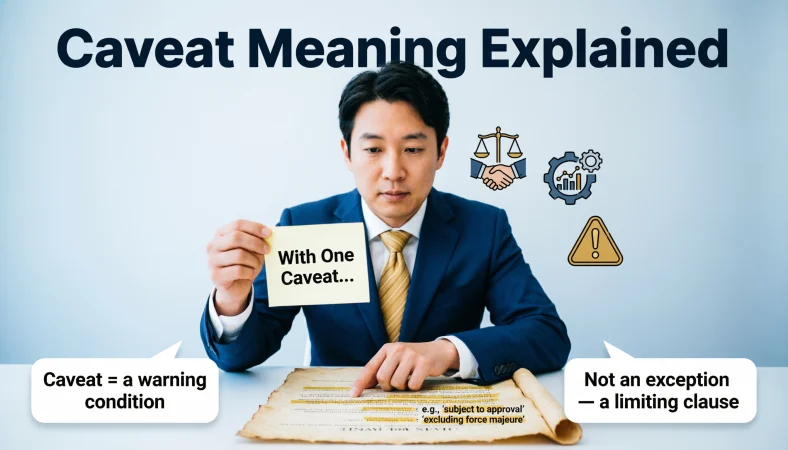
Definition: A caveat is a warning, qualification, or condition that limits or modifies a statement, agreement, recommendation, or situation. It alerts people to important exceptions or potential issues they should consider.
Caveat meaning: A caveat is a warning, caution, condition, or important limitation that someone should know before accepting information, making a decision, or agreeing to something.
If you’ve ever heard someone say, “I recommend this product, but with one caveat,” they’re introducing an important warning or condition before you make your final judgment.
In today’s world of contracts, business discussions, online reviews, and everyday conversations, the word caveat appears frequently because it helps people communicate limitations clearly and responsibly. Understanding the meaning of caveat can improve your communication skills, help you interpret professional documents, and make you sound more precise when expressing concerns or conditions.
Origin of the Word Caveat
The word caveat comes from the Latin word cavēre, meaning “to beware” or “to take caution.”
Historically, the term was used in legal contexts as a formal warning or notice intended to prevent certain actions from taking place without prior consideration.
Over time, the meaning expanded beyond law and entered everyday English, where it now commonly refers to:
- Warnings
- Conditions
- Qualifications
- Limitations
- Important exceptions
The original idea of “beware” remains at the heart of the word today.
Why Is Caveat So Popular?
The word has become increasingly popular because people often need a concise way to introduce exceptions without completely rejecting an idea.
For example:
- Business professionals use caveats in reports.
- Lawyers use caveats in legal documents.
- Reviewers use caveats when recommending products.
- Teachers use caveats when explaining rules.
- Friends use caveats when giving advice.
Instead of saying:
“I agree, but there are several important things you should know first.”
“I agree, with one caveat.”
This makes communication clearer and more efficient.
Caveat Meaning in Everyday Language
In everyday conversation, a caveat is usually an important condition attached to a statement.
Example
“You can borrow my car, but there’s one caveat—you need to refill the gas tank.”
Here, the caveat is the condition that must be followed.
Another example:
“The vacation package is affordable, with the caveat that flights aren’t included.”
The warning or limitation is that airfare must be paid separately.
How Caveat Is Used in Different Situations
Business Usage
Businesses frequently use caveats when discussing plans, projections, or recommendations.
Example:
“Sales are expected to increase next quarter, with the caveat that market conditions remain stable.”
The caveat introduces a limitation to the prediction.
Academic Usage
Researchers often include caveats to explain limitations in their findings.
Example:
“The study supports the theory, with the caveat that the sample size was relatively small.”
Legal Usage
In law, a caveat can be a formal notice requesting that certain actions not be taken without informing the person who filed it.
Example:
“A caveat was lodged against the property transfer.”
This is one of the more specialized legal meanings of the word.
Everyday Conversation
People commonly use caveat to express conditions politely.
Example:
“I’ll help you move this weekend, but my caveat is that we start early.”
Caveat Examples in Context
The meaning of caveat becomes easier to understand when viewed in real situations.
Friendly Tone 😊
“I’ll join the road trip, but with one caveat—I get to pick the music sometimes.”
Neutral Tone
“The proposal looks strong, with the caveat that additional funding may be required.”
Professional Tone
“We recommend proceeding with the project, subject to the caveat outlined in the risk assessment.”
Warning Tone ⚠️
“The investment has high potential returns, but the caveat is significant market volatility.”
Academic Tone
“The results are encouraging, though several caveats should be considered before drawing conclusions.”
Caveat Example Table
| Situation | Statement | Caveat |
|---|---|---|
| Product Review | “This laptop is excellent.” | Battery life may be shorter under heavy use. |
| Job Offer | “The salary is attractive.” | Relocation is required. |
| Travel Package | “The trip is affordable.” | Flights are not included. |
| Business Deal | “The partnership looks promising.” | Approval from investors is needed. |
| Academic Study | “The findings are significant.” | Sample size was limited. |
| Personal Favor | “You can use my car.” | Return it with a full tank. |
Common Phrases Using Caveat
You may encounter these frequently:
With One Caveat
Meaning: With one condition or warning.
Example:
“You can stay at my apartment, with one caveat: no parties.”
Important Caveat
Meaning: A significant warning or limitation.
Example:
“There’s an important caveat to these statistics.”
Major Caveat
Meaning: A serious condition that affects the overall situation.
Example:
“The offer sounds great, but there’s a major caveat.”
Subject to a Caveat
Meaning: Limited by a condition.
Example:
“Approval is granted, subject to a caveat regarding safety compliance.”
Is Caveat Positive or Negative?
A caveat is not inherently positive or negative.
It simply introduces additional information that affects how a statement should be understood.
Positive Example
“You get a bonus, with the caveat that performance targets must be met.”
Neutral Example
“The software is free, with the caveat that premium features require payment.”
Negative Example
“The job seems ideal, but the caveat is frequent weekend work.”
The tone depends entirely on the context.
Caveat vs Similar Words
Many people confuse caveat with other terms. Here’s how they differ.
Caveat vs Warning
| Caveat | Warning |
|---|---|
| Often attached to a statement | Usually alerts to danger |
| Can be neutral | Usually negative |
| Introduces conditions | Highlights risks |
Example:
Caveat: “The deal is good, but delivery may take longer.”
Warning: “Do not touch the hot surface.”
Caveat vs Condition
| Caveat | Condition |
|---|---|
| A qualification or limitation | A requirement that must be met |
| Often informational | Often mandatory |
Example:
Caveat: “Results may vary.”
Condition: “Payment must be received first.”
Caveat vs Disclaimer
| Caveat | Disclaimer |
|---|---|
| Brief warning or qualification | Formal statement limiting responsibility |
| Common in speech | Common in legal and business documents |
Caveat vs Exception
| Caveat | Exception |
|---|---|
| Qualifies a statement | Excludes something from a rule |
| Warning-oriented | Rule-oriented |
Alternative Words for Caveat
Depending on the situation, these alternatives may work:
- Warning
- Qualification
- Limitation
- Condition
- Restriction
- Exception
- Provision
- Reservation
- Note
- Precaution
- Stipulation
- Advisory
Example
Instead of:
“There’s one caveat.”
You could say:
“There’s one condition.”
Or:
“There’s one important limitation.”
Professional Alternatives to Caveat
In formal communication, these phrases can sound polished:
- Subject to certain conditions
- Please note that
- An important consideration is
- One limitation is
- It should be noted that
- With the following qualification
- Under the condition that
- A key consideration is
Example
Instead of:
“The caveat is that approval isn’t guaranteed.”
You might write:
“A key consideration is that approval is not guaranteed.”
Alternate Meanings of Caveat
Although the everyday meaning is a warning or qualification, caveat can also have a legal meaning.
Legal Caveat
A legal caveat is a formal notice filed with a court or government authority to prevent certain actions from occurring without notification.
For example:
- Property disputes
- Probate proceedings
- Estate matters
This legal usage is less common in everyday conversation but remains important in law.
Tips for Using Caveat Correctly
Use It When Introducing a Limitation
✅ Correct:
“The software works well, with one caveat.”
Don’t Use It as a Synonym for Problem
❌ Incorrect:
“The caveat broke yesterday.”
A caveat is not an issue or object.
Keep It Relevant
The caveat should meaningfully affect the statement.
✅ Good:
“The event is free, with the caveat that registration is required.”
Common Mistakes People Make
Thinking Caveat Means Danger
Not every caveat signals danger.
Sometimes it’s simply additional information.
Assuming It’s Always Negative
Many caveats are neutral conditions.
Using It Without Context
A caveat should clarify or modify a statement.
Saying:
“There’s a caveat.”
without explaining it leaves listeners confused.
Why Understanding Caveat Matters
Knowing the meaning of caveat helps you:
- Understand contracts better
- Interpret reviews more accurately
- Communicate professionally
- Recognize limitations in studies
- Make informed decisions
- Avoid misunderstandings
Whether you’re reading a business proposal or listening to a friend’s recommendation, caveats provide valuable context that can influence your choices.
FAQs
What is the simple meaning of caveat?
A caveat is a warning, condition, or limitation that someone should consider before accepting a statement, offer, or recommendation.
Is caveat a warning?
Yes, but not always a severe warning. It often introduces a condition or qualification rather than a danger.
How do you use caveat in a sentence?
Example:
“I support the plan, with one caveat—it must stay within budget.”
What does “with one caveat” mean?
It means there is one important condition, limitation, or exception that should be considered.
Is caveat a legal term?
Yes. In legal contexts, a caveat can be a formal notice requesting that certain actions not occur without prior notification.
Is caveat positive or negative?
Neither inherently. It can be positive, neutral, or negative depending on the context.
What is another word for caveat?
Common alternatives include warning, qualification, condition, limitation, restriction, and stipulation.
Why do people use caveat?
People use caveat to clearly communicate exceptions, conditions, or limitations without rejecting an idea entirely.
Conclusion
The caveat meaning centers on a simple but powerful idea: an important warning, condition, qualification, or limitation that should be considered before making a decision. Originally derived from Latin meaning “beware,” the word remains highly relevant in modern communication, business, law, education, and everyday conversations.
When someone introduces a caveat, they are providing additional context that helps you understand the full picture. Rather than viewing caveats as negative, think of them as useful information that promotes clarity and informed decision-making.
The next time you hear someone say, “with one caveat,” you’ll know they’re not rejecting the idea—they’re simply highlighting an important detail you shouldn’t overlook.

Caleb Foster is a professional content creator at RepllyNova.com, recognized for producing clear, engaging and insightful articles. He is committed to making complex topics understandable, interesting and accessible for all audiences.