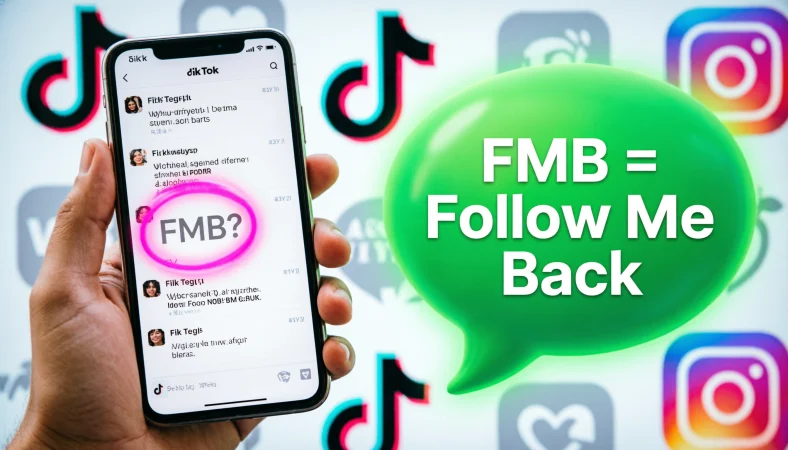
definition: FMB in text messaging and social media primarily stands for “Follow Me Back.” Users employ this acronym as a shorthand request asking someone to return a follow on platforms like TikTok, Instagram, or Twitter/X. It signals a desire for mutual connection and is commonly seen in comments, direct messages, or captions.
You’re scrolling through TikTok or Instagram, enjoying some quality content, when you spot it in the comments: “FMB.” Maybe someone posted it on your latest video or slid into your DMs with it. If you’ve found yourself staring at these three letters like they’re written in a secret code, you’re not alone.
In the fast-moving world of online communication, new acronyms pop up faster than you can type “LOL.” But unlike some slang that fades away, FMB has become a staple for a specific type of social interaction.
Here’s the thing FMB actually has more than one meaning floating around the internet. But depending on where you see it, there’s one primary meaning you’ll encounter most often.
The internet is a strange and wonderful place, full of its own rules, etiquette, and languages. Let’s unpack exactly what FMB means, where it came from, how to use it (and when to avoid it), and what it really says about modern digital interaction.
The Origin and Popularity of FMB in Text
To understand why FMB is everywhere, we need to talk about the “economy” of social media. For creators, influencers, and even casual users, the follower count is a metric of influence, reach, and sometimes even social status. On platforms like TikTok and Instagram, a larger following usually means more visibility, more engagement, and for some, more income.
This creates a culture where users constantly look for opportunities to grow their audience. “Follow trains” or “follow-for-follow” threads became highly popular spaces where users band together to boost each other’s numbers. A “follow train” is essentially a comment section or a dedicated post where everyone agrees to follow each other. In these scenarios, it would be incredibly tedious to type “Please follow me back” to every single person. That’s where the acronym FMB comes in handy. It saves valuable seconds and gets straight to the point.
While “Follow Me Back” is the most common meaning in social media, it’s worth mentioning that FMB in texting can sometimes mean “Fast Money Boys” or “Fast Money”—a term that has roots in street culture and refers to making quick (sometimes illegal) cash. This usage is much older and comes from a different cultural context entirely, often referenced in music and certain online subcultures. In the context of TikTok or Instagram, however, the intent is almost always about social growth, not financial hustle.
How to Use “FMB” in Different Contexts
Context is everything. The way you use FMB can come across as friendly, a little desperate, or simply neutral. Here’s a breakdown of how this acronym is deployed in the wild.
1. The Comment Section
Example: “🔥 Great video! FMB?”
Tone: Friendly and Supportive.
Explanation: This is a common tactic in the comment sections of popular posts. You engage with the content (by leaving a compliment or emoji) and then request a follow-back. It’s a soft approach that aims to create a connection while asking for something in return.
2. The Direct Message (DM)
Example: “Hey! Just followed you. FMB!”
Tone: Direct and Neutral.
Explanation: When you follow someone new, especially a creator, it’s common to send a DM about it. This is a much more direct way of ensuring they see your name pop up and (hopefully) click that “follow back” button.
3. The Caption or Story
Example: “Posting every day this week! FMB if you want to see the rest.”
Tone: Engaging and Enticing.
Explanation: Using FMB in a post caption or a story creates a call to action. You’re offering a benefit (more content) in exchange for that follow-back. It can also be used as a general broadcast: “I’m following back everyone who follows me today.”
FMB in Text: Examples with Tone Indicators
Sometimes an acronym needs a little extra context to clarify the vibe. Here is how FMB might look in the wild, complete with tone analysis.
Friendly and Casual
- “Just found your page, love the vibes! FMB plz 💕”
- Indicators: Use of “love the vibes,” the “plz” (please), and a heart emoji soften the request.
- “Liked your last 3 posts, you’re hilarious. FMB 😂🤞”
- Indicators: “Liked your last 3 posts” shows a high level of genuine engagement.
Neutral and Standard
- “FMB? 🙏”
- Indicators: This is the most common and neutral use of the acronym. It is polite but very utilitarian.
- “Followed you! FMB!”
- Indicators: Simple, direct, and to the point. Nothing aggressive, just stating the facts and the expected reciprocal action.
Dismissive or Confrontational (Rare)
- “FMB, I followed you first.”
- Indicators: “I followed you first” implies frustration. The user feels ignored or that a social contract has been broken.
- “FMB or unfollow.”
- Indicators: This is aggressive and pushy. It reeks of entitlement and usually doesn’t result in a lasting connection. It’s generally bad social media etiquette to demand follows like this.
Interpretations with Emojis
- FMB?? : The double question mark can convey urgency, impatience, or mild passive aggression.
- FMB 💀: The “Skull” emoji is often used to indicate something is funny (dying of laughter) or an inside joke. It might suggest the user is joking about the follow-back, testing the waters without being too serious.
- FMB ✨: Sparkles add a positive, aesthetic vibe, often used by creators in fashion, art, or lifestyle niches.
FMB vs. Other Social Media Acronyms
One of the best ways to understand an acronym is to see how it stacks up against its “cousins.” Here is a breakdown of how FMB relates to similar terms.
| Acronym | Meaning | Context & Usage |
|---|---|---|
| FMB | Follow Me Back | Direct Request: Asking a specific person or followers to return a follow. Used as a polite (or sometimes pushy) comment or DM. |
| F4F | Follow For Follow | Mutual Agreement: A general offer or request for a mutual follow. “F4F” often implies a transaction you follow me, I follow you. |
| L4L | Like For Like | Engagement Swap: Similar to F4F, but specifically about content engagement. “I’ll like your posts if you like mine.” |
| RT | Retweet | Reposting: Common on Twitter/X. It means you are sharing someone else’s content to your timeline. |
| OOTD | Outfit Of The Day | Content Focus: Not an engagement request at all; just a tag for fashion content. |
A Practical Comparison
To see the difference in action, imagine you are an influencer named “Alex.”
- You might post a video with the caption: “FMB to see more!”
- If a user replies to your post with “F4F? ” they are offering a general transactional follow rather than explicitly asking you to follow them back specifically.
- If a fan comments “FMB? ” they are specifically asking you to follow them back because they just followed you.
The difference is subtle but important. FMB often refers to a direct, one-on-one request between two specific users, whereas F4F is a broader practice of trading follows with multiple people.
Other Meanings of FMB (The “Real World” Context)
While “Follow Me Back” is the most likely meaning in a digital space, it’s important to know that FMB stands for many things in the real world. If you are using this in a professional context, you might get some odd looks.
- Finance and Business: FMB often stands for “Financial Management Board” or “First Midwest Bank” in financial circles.
- Construction and Real Estate: You might hear “Federation of Master Builders” in the UK.
- Sports: In motorsports, it could be “Freeride Mountain Biking” or “Fédération Motocycliste de Belgique.”
- Music: The famous bluegrass song “Foggy Mountain Breakdown” is occasionally abbreviated as FMB.
- Aviation and Nautical: It refers to “Fort Myers Beach” in Florida (a common vacation destination) and is also the IATA code for Page Field airport in Florida.
The Golden Rule: If you are at work or talking to a financial advisor, don’t use FMB to ask them to follow you back on Instagram. Stick to the context clues. If you’re scrolling through TikTok, it’s “Follow Me Back.” If you’re in a boardroom, it’s probably “Financial Management.”
Alternatives to FMB: Polite and Professional Options
Maybe you want to grow your audience, but “FMB” feels a bit too aggressive or casual for your brand. Perhaps you find the acronym a bit gauche. You have options.
1. Direct and Informal
- “Follow back?”
- “Would you mind following me back?”
2. Value-Driven (The Best Option)
Instead of asking for a follow, focus on why they should follow you.
- “I post daily tips on [topic], follow along!”
- “If you enjoyed this, I’d love to have you join the community.”
- “Swipe up to follow for more content like this!”
3. Subtle Social Proof
- “My page is growing fast, and I love meeting new people. Follow back and say hi!”
- “Following all mutuals back today!”
Why Value-Driven is Better
Asking “FMB” is a bit like saying, “I bought you a coffee, buy me one back.” It feels transactional. By offering value first (e.g., “I share free recipes daily”), you inspire a natural, organic follow that is far more likely to result in actual engagement (likes, comments, shares) rather than a dead follower who just wants to boost their own numbers.
FAQs
1. What does FMB mean in texting?
In texting and social media, FMB most commonly stands for “Follow Me Back.” It is used to ask a user you have followed to return the favor and follow your account.
2. What does FMB mean on TikTok?
On TikTok, FMB means “Follow Me Back.” Users often comment or DM it to request a mutual follow, especially on “follow trains” or content from smaller creators trying to grow.
3. What does FMB mean on Instagram?
On Instagram, FMB is a shorthand term for “Follow My Back.” It is used in comments, Stories, and DMs to ask other users to reciprocate a follow.
4. Is FMB a rude acronym?
It depends on the tone. It is usually neutral or friendly. However, demanding “FMB” or adding pressure like “or unfollow” can come across as rude, entitled, or pushy.
5. What is a “follow train” on TikTok?
A “follow train” is a comment section on a video where users leave their usernames and agree to follow each other. Acronyms like FMB (Follow Me Back) and F4F (Follow For Follow) are heavily used in these threads.
6. What does FMB mean in a business or professional context?
In a professional context, FMB usually stands for “Financial Management Board,” “Federation of Master Builders,” or refers to a bank like “First Midwest Bank.” It is rarely used to mean “Follow Me Back” in business settings.
7. How do I ask for follows professionally?
Instead of using FMB, focus on the value of your content. Use phrases like, “Follow for more tips,” “Join our community,” or “Subscribe to see the latest updates.”
8. Are there other meanings for FMB?
Yes! Depending on the context, FMB can mean Fast Money Boys, Freeride Mountain Biking, Foggy Mountain Breakdown (song), or Fort Myers Beach. Always check the context—if you are on social media, it’s “Follow Me Back.”
Conclusion:
Navigating the world of internet acronyms can feel like learning a new dialect. With FMB in text, you are dealing with a piece of social currency. At its core, FMB stands for “Follow Me Back” , a simple, efficient request for reciprocity in the bustling digital marketplace.
But understanding the acronym is just the first step. The key to success on social media and in life is understanding the tone behind the words. While FMB is a shortcut, we’ve seen that it can come across as transactional or even desperate if not used carefully.