
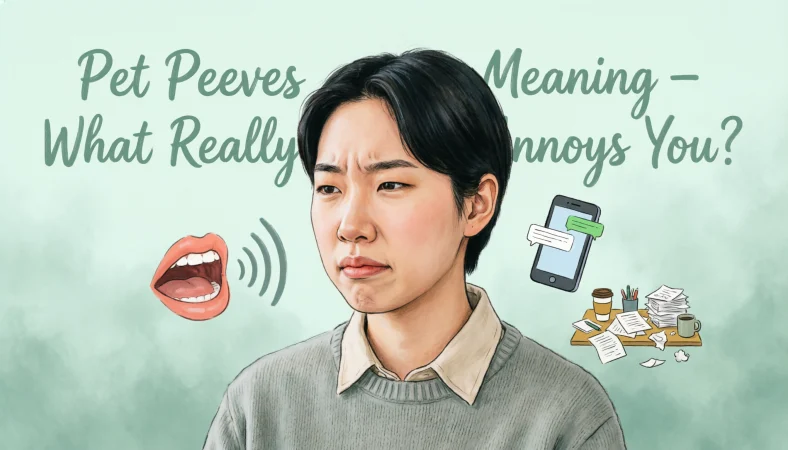

Pet peeves are minor annoyances or behaviors that particularly irritate an individual. These personal triggers often seem insignificant to others but can cause strong negative reactions in those who experience them. Common examples include loud chewing, tardiness, and leaving empty containers in the refrigerator.
The keyword “pet peeves” combines two distinct elements:
- “Pet” – indicating something personal, cherished, or characteristic to you
- “Peeves” – derived from the archaic word “peevish,” meaning irritable or fretful
Everyone has small things that instantly test their patience, such as loud chewing, leaving messages on read, interrupting people, or walking slowly in a busy hallway. These little annoyances may not seem serious, but they can feel surprisingly frustrating when they happen again and again. That is exactly what people mean when they talk about their “pet peeves.”
A pet peeve is a specific behavior, habit, or situation that annoys someone more than it may annoy other people. This guide explains the pet peeves meaning in simple language, with everyday examples and clear context. The information reflects common English usage and trusted dictionary-style definitions, helping you understand when to use the phrase naturally in conversations, texts, social media posts, and writing.
The Origin and Evolution of the Phrase
Understanding the origin of pet peeves meaning helps us appreciate why this concept resonates so deeply with people.
Historical Roots
The term “peevish” dates back to the 14th century, meaning “fretful” or “irritable.” The modern usage of “pet peeve” emerged in the early 20th century, likely as American slang. The phrase gained popularity in the 1940s and 1950s when newspapers began running columns inviting readers to share their personal pet peeves.
Why We Use the Word “Pet”
The inclusion of “pet” in the phrase is particularly interesting:
- It suggests something personal and intimate
- It implies a unique ownership of that particular annoyance
- It indicates the annoyance is consistently present (like a pet that follows you around)
From Slang to Mainstream
Today, the pet peeves definition has become universally understood across English-speaking cultures. The phrase appears in:
- Workplace training and HR materials
- Personality assessments
- Relationship advice columns
- Popular culture and social media
- Self-improvement and mindfulness resources
The popularity of discussing pet peeves reflects a broader cultural interest in understanding personal triggers and improving communication. In an increasingly connected world, knowing what bothers others—and what bothers ourselves—has become essential social intelligence.
The Psychology Behind Pet Peeves
Why do minor annoyances trigger such strong reactions? Understanding the psychological mechanisms behind pet peeves reveals fascinating insights about human nature and emotional regulation.
The Role of Values and Expectations
Most pet peeves stem from mismatched expectations between what we believe is “correct” behavior and what actually occurs. Consider these connections:
| Pet Peeve Category | Underlying Value | Psychological Trigger |
| Loud chewing | Table manners, respect | Perceived disregard for others |
| Excessive lateness | Time respect, organization | Feeling devalued or dismissed |
| Interrupting | Communication respect | Invalidated or unheard |
| Messy common areas | Cleanliness, cooperation | Lack of consideration for others |
| Unsolicited advice | Autonomy, competence | Feeling undermined or infantilized |
The Sensitivity Factor
Everyone has a different threshold for irritation. Research suggests that:
- Highly sensitive people experience more pet peeves and stronger reactions
- Anxiety-prone individuals may be more bothered by unpredictable behaviors
- Perfectionists often have numerous pet peeves related to order and precision
What Your Pet Peeves Say About You
Your specific types of pet peeves often reflect your core personality traits:
- Methodical people may be irritated by disorganization or unclear plans
- Empathetic individuals might be bothered by rude or dismissive behavior toward others
- Assertive personalities may dislike indecisiveness or passivity
- High achievers often find laziness or lack of ambition frustrating
Understanding what your personal pet peeves reveal about you can lead to greater self-awareness and more effective relationship management.
Common Examples of Pet Peeves (With Context and Tone)
Examples help clarify the pet peeve definition and illustrate how these annoyances manifest in everyday life.
Friendly and Neutral Examples
Scenario: You’re at a café with a friend who’s been glued to their phone throughout your conversation.
- Friendly framing: “I notice you’ve been checking your phone a lot. Is everything okay, or shall we focus on our conversation?”
- Neutral observation: “It can feel disconnecting when someone uses their phone during a face-to-face conversation.”
Scenario: Someone leaves the toilet seat up.
- Friendly framing: “Would you mind making sure the seat goes down? It’s just one of those little things I’m particular about. 😊”
- Neutral observation: “Toilet seat positioning is a surprisingly common household pet peeve.”
More Irritated or Negative Examples
Scenario: A colleague consistently arrives 15 minutes late to meetings.
- Irritated tone: “It’s incredibly disrespectful when people can’t manage basic punctuality. We all have schedules to keep.”
- Dismissive tone: “Some people apparently believe their time is more valuable than everyone else’s. 🙄”
Scenario: A neighbor plays loud music at 2 AM.
- Exasperated: “I’m genuinely baffled by people who show zero consideration for others’ sleep schedules. The lack of basic awareness is astounding.”
- Flat-out annoyed: “If I hear one more bass drop at 3 AM, I’m going to lose my mind! 😤”
Why Tone Matters
When discussing pet peeves, tone is everything. The same behavior can be described in ways that invite understanding or create conflict. The pet peeves definition inherently involves personal reaction, and how we express that reaction determines whether we build bridges or walls.
Pet Peeves vs. Related Concepts
Understanding the distinctions between related terms helps clarify the exact pet peeve meaning.
Pet Peeves vs. Dealbreakers
| Aspect | Pet Peeve | Dealbreaker |
| Severity | Minor annoyance | Major, often relationship-ending issue |
| Frequency | Can be occasional or consistent | One occurrence may be enough |
| Flexibility | Can often be overcome with communication | Typically non-negotiable |
| Examples | Loud eating, grammar errors | Infidelity, dishonesty, abuse |
| Resolution | Simple conversation usually helps | Often requires fundamental change |
Pet Peeves vs. Irritants
| Aspect | Pet Peeve | Irritant |
| Personal nature | Highly personal and specific | More universal |
| Reaction intensity | Disproportionate response | Proportional response |
| Example | Someone touching your computer screen | Loud traffic noise |
Pet Peeves vs. Triggers
| Aspect | Pet Peeve | Trigger |
| Emotional response | Annoyance, frustration | Often more severe: anxiety, panic, trauma response |
| Underlying cause | Personal preference, values | Frequently tied to past experiences |
| Clinical significance | Generally not clinical | May be clinically significant |
| Example | People standing too close | Certain sounds (misophonia) |
Pet Peeves vs. OCD Symptoms
While there may be superficial similarities, the distinction is crucial:
- Pet peeves are conscious preferences you can usually articulate
- Obsessive-compulsive disorder involves clinically significant distress and impairment
Additional Meanings and Alternative Interpretations
While the primary pet peeve definition relates to personal annoyances, the phrase has some related applications.
In Psychology and Self-Development
The term sometimes appears in therapeutic contexts when discussing:
- Emotional triggers that signal unmet needs
- Projection patterns where our irritation with others reflects our own issues
- Boundary-setting opportunities disguised as minor frustrations
In Cultural Contexts
Different cultures have unique pet peeves:
- In Japan, eating on public transportation is a common cultural pet peeve
- In many European countries, loud conversations in public spaces may be frowned upon
- In South American cultures, extreme punctuality might be seen as less critical
In Internet Culture
Social media has popularized the phrase:
- “Pet peeves” is a common hashtag across platforms
- Pet peeve lists are viral content on TikTok and Instagram
- Online communities dedicated to sharing specific pet peeves have emerged
Historical Evolution
While the origin of pet peeves meaning is rooted in 20th-century American culture, similar concepts exist in many languages:
- German: “Lästiger Umstand” (annoying circumstance)
- French: “Petite manie” (little personal quirk)
- Spanish: “Manía” (personal annoying habit)
Polite and Professional Alternatives to Expressing Pet Peeves
Effective communication about pet peeves requires tact. Learning to express your annoyances in professional and diplomatic ways improves relationships and reduces conflict.
Professional Phrases for Workplace Settings
| Instead of saying… | Try this more professional alternative… |
| “I can’t stand when people arrive late.” | “I value punctuality as it helps us respect everyone’s time and schedule.” |
| “It drives me crazy when meetings go overtime.” | “I find it most productive when meetings start and end as scheduled.” |
| “People who interrupt are so frustrating.” | “I appreciate when everyone gets a chance to speak without interruption.” |
| “This clutter is so annoying.” | “A tidy workspace helps me focus and stay organized.” |
Friendly Alternatives for Personal Relationships
| Instead of saying… | Try this more relationship-friendly approach… |
| “Your eating is so loud.” | “Would you mind chewing a bit more quietly? It’s just something I’m sensitive to.” |
| “You’re always on your phone.” | “I love connecting with you—could we put our phones away for a bit?” |
| “Why is the trash always left there?” | Let’s try to remember to take the trash out—it really helps me feel relaxed at home.” |
Alternative Phrasings for Different Situations
When discussing your own pet peeves:
- “I’ve realized I’m particularly sensitive to…”
- “I’ve noticed I feel frustrated when…”
- “This is probably silly, but I’m really bothered by…”
When responding to others’ pet peeves:
- “I appreciate you sharing that with me.”
- “Thanks for letting me know—I’ll try to be more mindful.”
- “I didn’t realize that bothered you. I’ll do my best to be considerate.”
Why Alternatives Matter
Using diplomatic language when describing your pet peeve reduces:
- Defensive reactions
- Relationship strain
- Unnecessary conflict
- Misunderstandings
The pet peeve definition may imply frustration, but how we communicate that frustration dramatically impacts outcomes.
Pet Peeves in Different Settings
Understanding how pet peeves manifest across environments helps us navigate various social contexts more effectively.
Workplace Pet Peeves
Common workplace frustrations include:
- Colleagues who reply-all to unnecessary emails
- People who microwave fish in the shared kitchen
- Unnecessarily long meetings
- Poor time management
- Taking phone calls in common areas
- Not taking responsibility for mistakes
- Gossip and office politics
Professional solution: Address these through clear policies, communication guidelines, and respectful dialogue.
Relationship Pet Peeves
In romantic partnerships, common pet peeves include:
- Leaving clothes on the floor
- Loading the dishwasher “incorrectly”
- Not putting the cap back on the toothpaste
- Taking too long to get ready
- Forgetting special occasions
Relationship solution: Discuss these as opportunities to learn about each other, not as personal failures.
Social Pet Peeves
In social settings, frustrations often center on:
- People who are perpetually late
- Interrupters and overtalkers
- “One-uppers” who always need to have a better story
- People who don’t respect personal space
- Loud phone conversations in public spaces
Social solution: Set social expectations clearly and model the behavior you’d like to see.
Digital Pet Peeves
In the online world, common annoyances include:
- Texting during in-person conversations
- Leaving people on “read”
- Voice messages that are really just awkward voice notes
- Excessive emoji usage
- Poor grammar and spelling
- “Reply all” disasters
- Non-responsive communicators
Digital solution: Communicate clear boundaries and expectations for digital communication.
The Positive Side of Pet Peeves
Surprisingly, pet peeves can be beneficial when understood and managed effectively.
Self-Discovery Opportunities
Your pet peeves offer valuable insights into:
- What you genuinely value and prioritize
- Your personal boundaries
- Areas where you might need to practice patience
- Your communication style preferences
- Your stress triggers
Relationship Strengthening
When handled well, discussing pet peeves can:
- Deepen intimacy and understanding
- Create opportunity for compromise
- Establish clearer expectations
- Improve communication
- Build mutual respect
Professional Growth
In the workplace, acknowledging your pet peeves can:
- Help you identify compatible work environments
- Guide your career choices
- Improve your leadership style
- Make you a more empathetic manager
- Reduce workplace conflicts
Communication Enhancement
Learning to articulate your pet peeves teaches:
- Emotional intelligence
- Conflict resolution skills
- Assertive communication
- Perspective-taking abilities
- Self-regulation
Examples of Pet Peeves in Different Situations
Table: Pet Peeves Across Settings
| Setting | Common Pet Peeve | Why It’s a Pet Peeve | Example Reaction |
| Office | Microwave fish | Strong smell disrupts workspace | “Who microwaved salmon in the break room again?!” |
| Restaurant | Loud chewing | Disrupts dining enjoyment | “Can you hear that? That guy’s chewing is driving me insane.” |
| Movie Theater | Phone use during the movie | Distracts from the experience | “I can’t believe they’re scrolling through Instagram during the climax.” |
| Home | Not replacing the toilet paper roll | Small but constant annoyance | “You know what really gets me? When people don’t change the TP roll.” |
| Social Media | Overuse of emojis | Feels juvenile or excessive | “Do they really need seventeen crying-laughing emojis?” |
| Meeting | People talking over each other | Lack of respect and poor flow | “It’s like a battle of egos in there sometimes.” |
Real-Life Pet Peeve Examples with Context
Example 1: The Workplace Chronic Latecomer
“My biggest pet peeve is people who waltz into meetings 10 minutes late with a coffee in hand, like they’re doing us a favor. It’s not about the time—it’s about the message it sends. ‘My time is more valuable than yours.’ 😤”
Example 2: The Social Media Oversharer
“When people post every single meal they eat on Instagram, I just… I can’t. It’s a personal pet peeve. Like, I get it, you had avocado toast. You had it yesterday too. And the day before. 💁♀️”
Example 3: The Grammar Police
“I know it’s a total pet peeve, but when people mix up ‘your’ and ‘you’re,’ it makes me twitch. I don’t say anything—I just judge silently and move on. 📝”
Example 4: The Personal Space Invader
“People who stand too close in line at the grocery store—why?! It’s my top pet peeve. There’s literally a whole six feet of space behind them. Back up!”
How to Manage Your Pet Peeves
Practical strategies for dealing with personal annoyances can significantly improve your quality of life and relationships.
Self-Awareness Strategies
- Identify your triggers: What specifically about the situation bothers you?
- Understand the underlying need: Is it about respect, order, consideration, or something else?
- Consider your response: How do you typically react, and is that reaction productive?
- Reframe your thinking: Is this a real problem, or a personal preference?
Communication Strategies
| Situation | What to Do | What to Avoid |
| Someone doing something that’s your pet peeve | Approach with “I” statements; explain clearly and calmly | Accusatory language; voicing the complaint passively |
| Someone telling you about their pet peeve | Listen without being defensive; ask clarifying questions | Dismissing or invalidating their concern; making jokes |
| When multiple pet peeves arise | Prioritize the most important one; address one issue at a time | Complaining about everything at once; building resentment |
Healthy Coping Mechanisms
- For minor annoyances: Let it go—not every irritation deserves attention
- For recurring issues: Have a calm, clear conversation
- For particularly intense pet peeves: Ask yourself why this affects you so strongly—therapy can help
- When others express a pet peeve: Listen with an open mind and decide if you can make a reasonable accommodation
When to Compromise
Many pet peeves can be resolved with mutual understanding and flexibility:
- Recognize that others may have different standards
- Accept that some things won’t change
- Find creative solutions (e.g., separate bathrooms, designated “quiet time”)
When to Push Back
Some pet peeves are worth addressing more firmly:
- When they affect others beyond yourself
- When they represent genuine disrespect
- When they impact safety or well-being
- When they occur in professional settings
The Psychological Benefits of Understanding Pet Peeves
Beyond simply defining the term, understanding pet peeves offers meaningful psychological benefits:
Enhanced Emotional Intelligence
Recognizing what triggers you and why develops:
- Better self-regulation
- Improved empathy for others’ frustrations
- More nuanced understanding of human behavior
- Enhanced capacity for perspective-taking
Relationship Wisdom
People who understand their own and others’ pet peeves tend to:
- Enjoy more harmonious relationships
- Experience less conflict
- Communicate more effectively
- Show greater compassion for others
Professional Advantage
In the workplace, pet peeve awareness offers:
- Better team dynamics
- Reduced workplace friction
- More effective leadership
- Improved employee retention
Personal Growth
Working with your pet peeves facilitates:
- Greater self-awareness
- Increased patience
- Better stress management
- Expanded tolerance for human differences
FAQs
What is the exact definition of a pet peeve?
A pet peeve is a specific habit, behavior, or situation that annoys someone more than it may annoy others.
What are the most common pet peeves people have?
Common pet peeves include loud chewing, interrupting, lateness, messy spaces, phone use during conversations, and poor manners.
Where did the term “pet peeve” come from?
The phrase became popular in early 20th-century American English, combining “pet” with “peeve,” meaning irritation.
What is the difference between a pet peeve and a pet hate?
A pet peeve usually means a minor personal annoyance, while a pet hate can describe a stronger dislike.
Why do some people have many pet peeves?
Stress, personal values, sensitivity, routines, and high expectations can make certain behaviors feel more irritating.
What are pet peeve examples in relationships?
Examples include poor communication, being late, leaving messes, excessive screen time, and not listening carefully.
How do you say “pet peeve” professionally?
You can say “personal preference,” “a personal dislike,” or “something I’m particular about.”
What does pet peeve mean for kids?
A pet peeve is a small thing that especially annoys you, even if it does not bother everyone else.
Conclusion
Understanding the pet peeves meaning is about more than just vocabulary it’s about gaining insight into yourself, improving your relationships, and navigating social situations with greater ease.
Key Takeaways
- Pet peeves are personal: What bothers you may not bother others, and vice versa
- They reveal your values: Your pet peeves often point to what you truly care about
- Communication is key: How you express your pet peeves determines their impact on relationships
- They’re manageable: With awareness and strategy, you can reduce the negative impact of pet peeves
- They offer insight: Understanding your pet peeves can lead to meaningful personal growth
Practical Tips for Daily Life
- Practice patience: Not every pet peeve needs to be voiced
- Choose your battles: Focus on the most important pet peeves
- Communicate kindly: Use “I” statements and choose your moment wisely
- Offer grace: Remember, you probably have habits that others find annoying too
- Laugh sometimes: A sense of humor about your own quirks can lighten the mood
Whether you’re trying to understand your own reactions or make conversations smoother with colleagues, friends, or family, recognizing and managing pet peeves is a valuable life skill. After all, everyone has them—the key is not to let them control you.
Remember this: The goal isn’t to eliminate every pet peeve, but to understand them well enough that they don’t diminish your happiness or damage your relationships.