
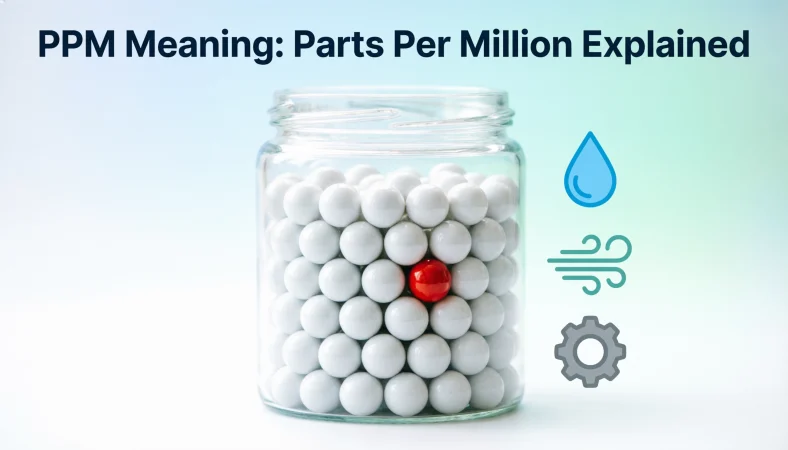

PPM stands for Parts Per Million, a unit of measurement that expresses the concentration of one substance within a larger mixture. It represents the ratio of one part of a substance to one million parts of the total solution or mixture.
For example, 1 PPM means that for every million particles, one particle is the substance being measured. This measurement is widely used in environmental science, chemistry, manufacturing, and water quality testing to quantify trace amounts of substances.
You may have seen “PPM” in a text, work email, science lesson, water-quality report, or social media post and wondered what it means. Unlike many internet abbreviations, PPM can have several meanings, so the right definition depends on where you found it. In most technical settings, PPM means parts per million, a measurement used to describe very small amounts of a substance in air, water, soil, food, and other materials.
This guide explains the most common PPM meanings in simple language, including its use in texting, business, science, and everyday conversations. The information is based on widely used communication and measurement standards, with practical examples to help you understand the abbreviation accurately. Whether you are checking a pool test, reading a workplace report, or decoding a message, knowing the context makes it easier to understand what PPM means.
What Is PPM? A Clear Definition and Explanation
Let’s start with the basics. PPM stands for Parts Per Million. It’s a way of expressing extremely small concentrations of a substance within another substance. Here’s a breakdown:
The Mathematics Behind PPM
In mathematical terms, PPM is calculated as:
PPM = (Mass of Solute / Mass of Solution) × 1,000,000
Or for gases:
PPM = (Volume of Gas / Volume of Air) × 1,000,000
This means that if you have a solution with 1 PPM of a substance, there is exactly 1 unit of that substance for every 1,000,000 units of the total solution.
Real-World Examples of PPM
To help you visualize what PPM actually looks like in practice:
| Example | PPM Value | Visualization |
|---|---|---|
| 1 drop of ink in 13 gallons of water | ~1 PPM | Hardly visible but detectable with instruments |
| 1 teaspoon of sugar in 2,000 cups of coffee | ~1 PPM | You wouldn’t taste it, but it’s there |
| Carbon monoxide concentration that can cause health effects | 9 PPM | Invisible and odorless but measurable |
| Maximum arsenic allowed in US drinking water | 10 PPM | A tiny amount that requires advanced testing to detect |
Friendly Tone Example:
“Imagine you have 999,999 tiny jellybeans in a jar, and you add just one special red jellybean. That red jellybean represents 1 PPM of the total. It’s not much, is it? But when we’re talking about things like lead in drinking water or pollutants in the air, even that one tiny jellybean can be a big deal!” 🍬
Neutral Tone Example:
“When performing quality control checks, manufacturers routinely test for PPM levels of contaminants. A reading of 5 PPM means that out of every million particles in the product, only 5 are contaminants.”
Negative/Dismissive Tone Example:
“Oh, you think that’s a high concentration? Please, that’s only 5 PPM. You’d need ten times that amount to even register on our equipment. Come back when you have real data.” 😒
The Origin and History of PPM
Understanding where PPM comes from helps us appreciate why it’s so important today.
Early Scientific Roots
The concept of measuring substances in relation to a million parts has been around since the mid-19th century, but it became particularly important during the Industrial Revolution. As factories began pumping unprecedented amounts of chemicals into the air and water, scientists needed a way to quantify just how much of these substances were present.
Environmental Awakening
The 1960s and 1970s marked a turning point for PPM. Rachel Carson’s “Silent Spring” (1962) and the growing environmental movement created a demand for precise measurement of pollutants. Regulatory agencies like the Environmental Protection Agency (EPA) began establishing safety standards using PPM measurements.
Modern Applications
Today, PPM has evolved from a niche scientific term to a mainstream measurement used in:
- Environmental monitoring: Air quality, water testing, soil contamination
- Manufacturing: Quality control, chemical mixing, pharmaceutical production
- Food and beverage: Nutritional content, contamination monitoring
- Health and safety: Workplace exposure limits, medical testing
- Consumer products: Cosmetic ingredients, supplement dosage, water filters
The popularity of PPM grew alongside our increasing ability to detect smaller and smaller amounts of substances. What was once invisible is now measurable with incredible precision.
How PPM Is Used in Different Industries and Contexts
PPM is truly a universal measurement with applications across numerous fields. Let’s explore how different industries and professions use PPM.
1. Water Quality and Environmental Testing 🏞️
This is probably where most people encounter PPM. Water quality reports, water filter advertisements, and fish tank testing all use PPM measurements.
Common PPM measurements in water testing:
| Contaminant | Safe Level (PPM) | Health Concern |
|---|---|---|
| Lead | ≤ 0.015 | Brain damage, developmental issues |
| Arsenic | ≤ 0.010 | Various cancers |
| Fluoride | 0.7 – 1.2 | Dental health (beneficial at certain levels) |
| Nitrates | ≤ 10 | Blue baby syndrome (in infants) |
| Total Dissolved Solids (TDS) | < 500 | Taste, quality, potential contaminants |
Example in context:
Your home’s water system has been checked for safety. With contaminant levels all below the EPA’s 10 PPM standard, your water is well within safe ranges for consumption.” ✅
2. Air Quality and Pollution Monitoring 🌫️
When you hear about air quality alerts or see the Air Quality Index (AQI), PPM is working behind the scenes.
Common air quality PPM measurements:
- Carbon monoxide: 0-9 PPM is generally safe, while 70-150 PPM can cause headaches and disorientation
- Carbon dioxide: Indoor levels of 400-1,000 PPM are acceptable, while above 2,000 PPM can cause drowsiness
- Ozone: 0.05-0.08 PPM is considered safe for outdoor air
3. Manufacturing and Industrial Quality Control 🏭
Precision is everything in manufacturing. A 1% mistake might seem small, but when you’re producing millions of products, even a tiny error rate can be costly.
PPM in manufacturing often refers to:
- Defect rates: How many units fail quality standards per million produced
- Chemical concentrations: Ensuring product consistency
- Impurity levels: Meeting safety and quality standards
4. Medical and Laboratory Testing 🧬
In medical labs, PPM helps quantify substances in blood, urine, and other biological samples.
Examples:
- Blood alcohol content: 0.08% or 800 PPM is the legal limit in many countries
- Heavy metal testing: Low levels of mercury or lead in blood are measured in PPM
- Pharmaceutical quality: Active ingredients are measured in PPM to ensure correct dosage
5. Agriculture and Food Production 🌾
Farmers and food manufacturers use PPM to monitor everything from pesticide residues to nutrient content.
Examples:
- Pesticide residues on produce: Measured in PPM to ensure safety
- Nutrient content: Fertilizer concentrations in soil and water
- Food additives: Safe usage limits set in PPM
PPM vs. PPB vs. PPT: Understanding the Difference
When you’re working with extremely small concentrations, PPM is just the beginning. Here’s how PPM compares to other measurement units:
Quick Comparison Table
| Unit | Abbreviation | Equivalent | Example |
|---|---|---|---|
| Parts Per Million | PPM | 1 in 1,000,000 | One drop of ink in 13 gallons of water |
| Parts Per Billion | PPB | 1 in 1,000,000,000 | One drop of ink in 13,000 gallons of water |
| Parts Per Trillion | PPT | 1 in 1,000,000,000,000 | One drop of ink in 13 million gallons of water |
When to Use Each Unit
Use PPM when:
- Substances are detectable by standard equipment
- Concentrations are relatively high (in the millionths range)
- Common environmental standards use PPM (like TDS in water)
- You’re talking about industrial defect rates
Use PPB when:
- Measuring very sensitive pollutants
- Dealing with highly toxic substances
- Water testing for certain contaminants (like mercury or lead)
Use PPT when:
- Measuring ultra-trace contaminants
- Conducting cutting-edge environmental research
- Testing for the most minute amounts of substances
Real-World Example
Let’s say you’re testing water for contamination. Arsenic is measured in PPB because even tiny amounts can be dangerous. The legal limit is 10 PPB, which is 0.01 PPM. If you confused PPM and PPB, you’d think 10 PPM of arsenic was acceptable—but that’s actually 1000 times higher than the limit! 😱
Different Contexts and Tones When Using PPM
The way you talk about PPM depends entirely on your audience. Here are examples of how PPM might be used in different contexts:
Professional/Technical Context
“The HPLC analysis reveals a contaminant concentration of 45 PPM (±3 PPM margin of error). Further testing will be required to confirm these values meet our Q3 compliance requirements.”
Consumer-Facing Context
“Don’t worry! Our triple-filtered water has only 15 PPM of total dissolved solids—far below the EPA’s recommended maximum of 500 PPM. That means you’re getting clean, great-tasting water!” 🚰
Educational Context
“Think of PPM like a measuring cup on a massive scale. If you had a million marbles, and just one of them was red, you’d have 1 PPM of red marbles.”
Urgent/Alert Context
“⚠️ AIR QUALITY ALERT: Carbon monoxide levels have reached 150 PPM in the building. Evacuate immediately!”
Casual Context
“Yeah, I check the PPM of my fish tank water every week. The shrimp are super sensitive—anything above 0.5 PPM of nitrites and they’re toast.” 🐠
Common Mistakes When Interpreting PPM
Even professionals can misunderstand PPM if they’re not careful. Here are common pitfalls to avoid:
1. Confusing PPM With Percentage
Mistake: Thinking 100 PPM equals 100%
Reality: 100 PPM = 0.01%
Tip: Divide PPM by 10,000 to get a percentage
2. Ignoring Temperature and Pressure
Many measurements change with temperature and pressure. A reading of 100 PPM at sea level might be different at higher altitudes.
3. Mixing Mass and Volume PPM
There are two types of PPM:
- Mass-to-mass: Used for liquids and solids (e.g., 1 mg of substance per 1 kg of solution)
- Volume-to-volume: Used for gases (e.g., 1 mL of gas per 1 L of air)
Make sure you know which one you’re using!
4. Assuming All PPM Are Created Equal
Different substances have different effects at the same PPM. For example:
- 100 PPM of carbon dioxide is harmless
- 100 PPM of chlorine would be dangerous
- 100 PPM of Vitamin C might be beneficial
5. Not Calibrating Equipment
PPM measurements are only as good as the equipment used to measure them. Regular calibration is essential.
Professional and Polite Alternatives to PPM
Sometimes, PPM might not be the right term to use. Here are alternative ways to express the same concept:
Alternative Phrases
| Instead of | Use this |
|---|---|
| “PPM of contaminants” | “Concentration level of contaminants” |
| “High PPM reading” | “Elevated concentration level” |
| “PPM levels” | “Trace amounts” or “Minor concentrations” |
| “Toxic PPM” | “Potentially unsafe concentration” |
| “PPM data” | “Detailed concentration measurements” |
When to Use Alternatives
- In formal reports: Use “concentration” or “parts per million” (spelled out)
- In friendly emails: PPM is fine if your audience understands it
- In public communications: Define PPM first, then use it
- With non-experts: Use analogies before introducing the term
Case Study Example: Understanding PPM Through a Real-World Scenario
Sample Water Quality Report
| Parameter | Result (PPM) | Safe Range (PPM) | Status |
|---|---|---|---|
| Calcium | 45.2 | 40-60 | ✅ Normal |
| Magnesium | 12.8 | 10-20 | ✅ Normal |
| Sodium | 18.5 | < 200 | ✅ Safe |
| Chloride | 22.0 | < 250 | ✅ Safe |
| Sulfate | 26.3 | < 250 | ✅ Safe |
| Total Hardness | 165.0 | < 200 | ✅ Good |
| TDS (Total Dissolved Solids) | 124.0 | < 500 | ✅ Excellent |
| Lead | 0.004 | < 0.015 | ✅ Safe |
| Arsenic | 0.001 | < 0.010 | ✅ Safe |
| Nitrate | 2.3 | < 10 | ✅ Safe |
| Fluoride | 0.8 | 0.7-1.2 | ✅ Optimal |
Interpretation
This water quality report shows that all parameters fall within safe ranges. The total hardness (165 PPM) means the water is moderately hard but acceptable. The TDS level of 124 PPM indicates excellent water quality with good taste.
Practical Tips for Working With PPM
For Home Users
- Test your water: If you’re concerned about water quality, get a PPM meter (often called a TDS meter). They’re affordable and easy to use.
- Know your baseline: Test your water regularly and note the PPM levels. A sudden increase might indicate a problem.
- Understand your filter: If you use a water filter, check how many PPM of contaminants it claims to remove. Quality filters should list this information.
For Professionals
- Calibrate regularly: Your equipment needs regular calibration to maintain accurate PPM readings.
- Document everything: Keep detailed records of PPM measurements, calibration dates, and environmental conditions.
- Know your limits: Different regulations and contexts have different acceptable PPM levels. Know which ones apply to your work.
For Students and Researchers
- Practice conversions: Get comfortable with converting PPM, PPB, and PPT, as well as PPM to percentages and vice versa.
- Use analogies: When explaining PPM to others, use real-world analogies to make the concept stick.
- Check your work: Always double-check your PPM calculations, especially when working with dangerous substances.
The Future of PPM Measurement
As technology improves, our ability to measure even smaller concentrations continues to advance. Some cutting-edge applications include:
- Quantum sensors: Detecting single molecules in PPM ranges
- Real-time monitoring: Continuous PPM measurement in factories and cities
- AI-powered analysis: Machine learning predicting PPM trends based on environmental data
- Nano-sensors: Measuring PPM at the cellular level
The future of PPM is about going smaller, faster, and more accurately. But for now, PPM remains the most practical and widely-used measurement for the concentrations that affect our daily lives.
FAQs
1. What does PPM stand for and how is it measured?
PPM means parts per million and is calculated by dividing the substance amount by the total amount, then multiplying by 1,000,000.
2. Is higher PPM better or worse?
It depends on the substance, since high contaminant PPM is usually bad while certain nutrient levels can be beneficial.
3. Is 500 PPM safe for drinking water?
A TDS level around 500 PPM is generally acceptable, but safety still depends on which dissolved substances are present.
4. What is the difference between PPM and PPB?
PPM means parts per million, while PPB means parts per billion and measures much smaller concentrations.
5. How do you convert PPM to percent?
Divide PPM by 10,000 to get a percentage, so 500 PPM equals 0.05%.
6. What is a safe PPM level for total dissolved solids?
For drinking water, TDS below 500 PPM is commonly considered acceptable for taste and general quality.
7. Is there a difference between PPM and mg/L?
For water-like liquids, 1 PPM is approximately equal to 1 mg/L.
8. Do I need to worry about PPM in everyday life?
Usually no, unless you are dealing with contaminated water, chemicals, or unusually high exposure levels.
Conclusion:
We’ve covered a lot of ground, from the basic PPM definition to real-world applications, from common mistakes to future possibilities. Let’s wrap up with the key takeaways:
- PPM is a measurement of concentration—one part of a substance per million parts of the whole.
- It’s all about scale—PPM allows us to measure incredibly small amounts that are still important for health and safety.
- Different contexts matter—What’s safe in one situation (fluoride in water) might be dangerous in another (lead in water).
- Understanding PPM empowers you—Whether you’re reading a water report or evaluating a product, knowing PPM helps you make informed decisions.
- The trend is toward lower PPM—As regulations tighten and technology improves, acceptable PPM levels continue to decrease for many contaminants.
Final Practical Tip 💡
When you see a PPM number, ask yourself three questions:
- What’s being measured? (Is it a contaminant, nutrient, or something else?)
- Is this value high or low compared to safety standards?
- What are the implications? (Health? Safety? Quality?)
Remember, PPM is just a tool—but it’s a powerful one. Understanding it gives you insight into the invisible world of tiny concentrations that affect our health, our environment, and our daily lives. The next time you see PPM on a water bottle label or an environmental report, you’ll know exactly what it means and why it matters. 🌎