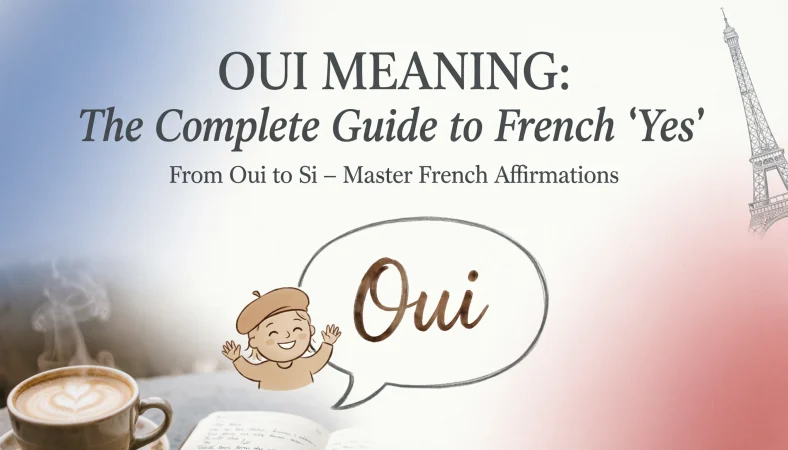
Definition: Oui is the French word for “yes” a positive affirmation used to agree with statements, answer questions affirmatively, express consent, and indicate approval in French-speaking contexts.
Have you ever found yourself watching a French film, hearing a character respond with a simple “Oui,” and wondering if there’s more to that two-syllable word than just a translation of “yes”? You’re not alone. While it might seem like one of the most straightforward words in the French language, the oui meaning carries layers of cultural significance, tonal variation, and conversational weight that most language learners overlook.
Here’s the fascinating thing: in French, you don’t just say “yes” – you say it differently depending on who you’re talking to, what you’re agreeing to, and even how you feel about the question. And if you’re thinking “Well, that’s just French for yes, end of story,” you might be surprised to learn about its history, its cousins like “si” and “ouais,” and how it functions in modern French-speaking cultures.
Let’s dive into everything you need to know about oui, from its ancient roots to its modern-day usage, complete with examples, comparisons, and a few surprises along the way. 🇫🇷
Oui Meaning:
Oui (pronounced “wee”) is the standard French word for “yes.” It’s used to affirm statements, answer questions positively, express agreement, and indicate consent. As one of the most frequently used words in the French language, it appears in virtually every type of conversation, from casual chats to formal business meetings.
But here’s the nuance that many resources miss: oui meaning isn’t just about translation. It’s about understanding that this simple word operates differently in French culture than “yes” does in English. In French, the choice between “oui,” “si,” “ouais,” and “oui, oui” can completely change the tone and meaning of your response.
The Origin and History of Oui
From Ancient Roots to Modern French
The oui meaning has traveled an impressive linguistic journey. The word traces its roots back to the Latin “hoc ille,” which meant “that is it.” Over centuries, this phrase transformed through Old French (“oïl”) before finally settling into the modern “oui” we use today.
Here’s a fascinating historical tidbit: in medieval France, there were actually two competing words for “yes” – “oïl” in the north and “oc” in the south. This linguistic divide was so significant that it influenced the very naming of regions in France. Today, the French language uses “oui,” but the older “oc” still survives in the name of the southern region Occitanie.
The evolution of oui meaning reflects broader cultural shifts in French society. What started as a simple affirmation has become a word that carries cultural identity, social nuance, and even political significance.
Why French Speakers Are So Particular About Yes
You might wonder why French speakers have multiple ways to say “yes” when English speakers get by with just one. The answer lies in the French approach to communication itself. French culture values precision, clarity, and social grace in conversation. Having different forms of “yes” allows speakers to:
- Match the formality level of their conversation
- Express enthusiasm or reluctance
- Correct misunderstandings
- Show respect for their conversation partner
- Navigate complex social situations with grace
Understanding the oui meaning in this cultural context is key to using it naturally.
How to Use Oui in Real Conversations
The Basic Usage
When you’re first learning French, oui is typically one of the first words you encounter. And in its most basic form, it’s exactly as simple as it seems:
- Q: “Tu veux du café ?” (Do you want coffee?)
- A: “Oui, merci.” (Yes, thank you.)
- Q: “Vous êtes français ?” (Are you French?)
- A: “Oui, je suis français.” (Yes, I’m French.)
In these straightforward situations, the oui meaning is transparent and direct. You’re simply affirming a question or statement with a positive response.
The “Oui, Oui” Phenomenon
One of the more charming aspects of French conversation is the occasional use of “oui, oui” (yes, yes). This repetition isn’t just for emphasis – it serves several important functions:
- Showing enthusiasm – “Tu veux aller au cinéma ?” “Oui, oui, j’aimerais beaucoup !” (Yes, yes, I’d really like that!)
- Confirming understanding – “N’oublie pas d’appeler ta mère.” “Oui, oui, je vais l’appeler.” (Yes, yes, I’ll call her.)
- Acknowledging while moving on – It can be a polite way to show you’re listening without derailing the conversation.
However, be cautious with “oui, oui” – in certain contexts, it can sound dismissive or impatient, similar to saying “yeah, yeah” in English when you’re not really paying attention.
The Soft “Oui” vs. The Emphatic “Oui”
The oui meaning can shift dramatically based on how you say it. A soft, gentle “oui” suggests agreement that might be somewhat reluctant or thoughtful. Meanwhile, an enthusiastic, strong “oui” shows excitement and wholehearted agreement.
Examples:
- Soft “oui”: “Oui… je suppose que tu as raison.” (Yes… I suppose you’re right.) – Shows some hesitation or reservation.
- Emphatic “OUI !”: “OUI ! C’est une excellente idée !” (YES! That’s an excellent idea!) – Shows enthusiasm and strong agreement.
The French also use oui in conjunction with facial expressions and body language that English speakers might not naturally associate with saying “yes.
Oui in Different Tones and Contexts
The Friendly Oui
In casual, friendly contexts, oui can be warm and inviting:
“Ça te dit de venir dîner ce soir ?” (Would you like to come to dinner tonight?)
“Oui, avec plaisir !” (Yes, with pleasure! 😊)
The Neutral Oui
In more neutral, everyday situations, it’s straightforward and professional:
“Est-ce que vous avez reçu mon email ?” (Did you receive my email?)
“Oui, je l’ai bien reçu.” (Yes, I received it.)
The Dismissive Oui
Here’s a cautionary note about the oui meaning in dismissive contexts. When a French speaker responds with a curt “oui” accompanied by a particular intonation, it might mean “fine, whatever” or “not really, but I’ll say yes to end this conversation”:
“Tu penses qu’on devrait acheter cette voiture ?” (Do you think we should buy this car?)
“Oui…” (A flat, unenthusiastic “yes” that actually means “not really, but I’m tired of discussing it.”)
This is where understanding oui meaning becomes crucial – the same word can indicate genuine agreement or surface-level compliance depending on delivery and context.
The Big Comparison: Oui vs. Si
Understanding the Crucial Difference
One of the most common confusions for French learners is the difference between oui and si. Both mean “yes,” but they’re used in different situations.
Here’s the rule: Use si when you’re answering “yes” to a negative question.
Examples:
- Question: “Tu n’as pas faim ?” (You’re not hungry?)
- Answer using “oui” incorrectly: “Oui.” ❌ (This would suggest “Yes, I don’t have hunger,” which is confusing.)
- Answer using “si” correctly: “Si.” ✅ (This means “Yes, I am hungry” contradicting the negative assumption.)
In English, we would say “Yes, I am hungry” to this question. In French, “si” handles this specific contradiction scenario. This is a crucial part of oui meaning that many language resources overlook.
Another Example:
- Question: “Elle n’est pas venue à la fête ?” (She didn’t come to the party?)
- Answer: “Si, elle est venue.” (Yes, she came.)
The si here directly contradicts the negative assumption in the question. Use oui when the question is positive, and si when contradicting a negative question or statement.
Oui vs. Ouais vs. Ouaip
The Casual Alternatives to Oui
Just as English has “yeah,” “yep,” and “yup” alongside “yes,” French has casual alternatives to oui:
| Word | Formality Level | Pronunciation | When to Use |
|---|---|---|---|
| Oui | Standard/Formal | “wee” | Most situations, especially professional settings |
| Ouais | Casual | “way” | Among friends, informal settings |
| Ouaip | Very casual | “wape” | Very relaxed situations, similar to “yep” |
Understanding these alternatives gives you flexibility in matching the tone of your conversation. The oui meaning in a professional meeting is standard and appropriate, while “ouais” with friends shows your comfort and cultural awareness.
Example:
- Formal: “Êtes-vous d’accord avec cette proposition ?” → “Oui, tout à fait.” (Yes, absolutely.)
- Informal: “T’es d’accord ?” → “Ouais, carrément !” (Yeah, totally!)
Professional and Polite Alternatives to Oui
When “Oui” Isn’t Enough
Sometimes, especially in professional or formal contexts, simply saying oui might feel insufficient. French speakers often use more elaborate affirmations that add nuance to the basic oui meaning:
- “Oui, bien sûr” – Yes, of course
- “Absolument” – Absolutely
- “Tout à fait” – Quite so/Exactly
- “Certainement” – Certainly
- “Volontiers” – With pleasure
- “Oui, je suis d’accord” – Yes, I agree
- “Effectivement” – Indeed
- “Exactement” – Exactly
These alternatives show that the oui meaning can be expanded upon to convey various shades of agreement, enthusiasm, and formality.
Cultural Tip
In French business culture, sometimes a simple oui might be viewed as too abrupt or lacking in thoughtfulness. Adding a qualifier shows you’ve considered the question seriously.
The Many Meanings of “Oui” in Different French-Speaking Regions
Beyond Metropolitan France
While the standard oui meaning is consistent across French-speaking regions, subtle variations exist:
In Quebec: Quebecers use oui similarly to France, but they’re more likely to use “ouais” in casual speech. You might also hear “mmhmm” as a very casual affirmation.
In Belgium and Switzerland: The word “si” is sometimes used differently. In some contexts, Belgians might use “si” instead of “oui” in situations that aren’t negative contradictions. However, standard French usage is understood everywhere.
In African French: Many African French speakers maintain the standard oui meaning but might incorporate local language influences or unique intonations that add regional flavor.
In Louisiana: Louisiana French speakers maintain many older French terms and might use oui in ways that reflect the historical development of the language in isolation from European French.
Common Expressions with “Oui”
How Oui Appears in French Sayings and Phrases
The oui meaning extends into various fixed expressions and sayings:
- “Oui, mais” – “Yes, but” – Used to agree partially while introducing a caveat.
- “Je ne dis pas non” – “I’m not saying no” – A way of saying “yes” without committing fully.
- “Dis oui !” – “Say yes!” – An encouraging phrase, often in playful contexts.
- “Oui ou non ?” – “Yes or no?” – A direct question demanding a clear answer.
- “Pourquoi pas ?” – “Why not?” – An affirmative response that shows openness rather than enthusiasm.
Example Sentences:
“Oui, mais c’est cher.” (Yes, but it’s expensive.)
“Tu veux venir avec nous ?” “Pourquoi pas !” (Do you want to come with us? “Why not!”)
Alternate Meanings and Acronyms
“OUI” Beyond French “Yes”
While the primary oui meaning is “yes” in French, the letters “OUI” have other meanings in different contexts:
In technology: OUI stands for “Organizationally Unique Identifier” – the first 24 bits of a MAC address that identifies the manufacturer of a network device.
In legal contexts: In some jurisdictions, “OUI” can stand for “Operating Under the Influence” (similar to DUI).
In environmental terms: OUI can mean “Oil Unloading Interconnection” in industrial contexts.
In education: Some institutions use OUI as an acronym for various administrative functions.
These alternate meanings are completely unrelated to the French oui meaning, but they’re good to know when you see “OUI” in non-French contexts.
Understanding the Pronunciation of “Oui”
Perfecting Your “Oui”
The pronunciation of oui is relatively straightforward for English speakers, but there are nuances:
- Standard pronunciation: “wee” – like the English word “we”
- In liaison: When followed by a vowel sound, the “i” might become slightly more pronounced
- Regional variations: Some regions might have a slightly more closed or open “u” sound
Pro tip for English speakers: Avoid pronouncing the “i” like the “i” in “sit.” The French “i” is more closed and forward in the mouth. Also, resist the temptation to add a “y” sound as in “we” – it should be a smooth “wee.”
Oui in Digital Communication
Texting and Emojis with “Oui”
The oui meaning has adapted beautifully to digital communication:
- Texting abbreviation: Sometimes shortened to “ou” in very casual texts (though this is uncommon)
- Emoji accompaniment: A “oui” response might be paired with a thumbs-up 👍, a smiley 😊, or, increasingly, the French flag 🇫🇷 to emphasize the language context
- In memes and internet culture: “Oui” is often used humorously by non-French speakers to convey a French flavor to their response, sometimes paired with “baguette” or other French stereotypes
Examples:
“Can you send me the file?” → “Oui 👍”
“Who’s coming to the meeting?” → “Oui 😊” (Using “oui” playfully in an English context)
Why Oui Matters for Language Learners
The Importance of Mastering “Oui”
While oui seems like one of the simplest words in French, mastering its usage is actually a sign of advanced proficiency. Here’s why:
- Native-sounding speech: Using the right form of “yes” (oui, si, ouais) at the right time makes you sound more natural.
- Social grace: Understanding when to use “si” vs. “oui” prevents awkward misunderstandings.
- Confidence booster: Once you master these nuances, you’ll feel more confident in conversations.
- Cultural understanding: The subtleties of oui meaning reflect broader French communication styles.
Many language learners plateau at “intermediate” level because they don’t pick up on these subtle distinctions. If you’re learning French, pay attention to how native speakers say “yes” in different contexts.
The Emotional Weight of “Oui”
When “Yes” Means So Much More
The oui meaning in French carries emotional weight that’s worth understanding. French speakers often use “yes” with greater intention than English speakers:
- In romance: A “oui” to a marriage proposal (“Veux-tu m’épouser ?”) carries the same weight as in any language.
- In negotiations: A “oui” in French business can mean a clear agreement – but watch for the other person’s tone and body language.
- In disagreements: Sometimes a French speaker says “oui” while meaning “I hear you” rather than “I agree with you.”
Understanding these emotional layers is part of truly grasping oui meaning.
Labeled Example Table: Oui in Different Contexts
| Context | French Example | English Translation | Tone |
|---|---|---|---|
| Formal | “Acceptez-vous ce poste ?” “Oui, avec grand plaisir.” | “Do you accept this position?” “Yes, with great pleasure.” | Professional, enthusiastic |
| Informal | “Tu veux un café ?” “Ouais, grave !” | “You want coffee?” “Yeah, definitely!” | Casual, friendly |
| Contradicting Negative | “Tu n’as pas sommeil ?” “Si, je suis fatigué.” | “You’re not sleepy?” “Yes, I am tired.” | Corrective, clear |
| Dismissive | “Tu penses qu’il a raison ?” “Oui, si tu veux.” | “Do you think he’s right?” “Yes, if you want.” | Reluctant, uncertain |
| Emphatic | “C’est une bonne idée ?” “OUI !!” | “Is it a good idea?” “YES!!” | Enthusiastic, excited |
| Soft/Thoughtful | “Tu es d’accord ?” “Oui… peut-être.” | “Do you agree?” “Yes… maybe.” | Hesitant, thoughtful |
| Polite | “Vous désirez ?” “Oui, je voudrais de l’aide.” | “You want something?” “Yes, I would like help.” | Courteous, requesting |
| Business | “Le projet est terminé ?” “Oui, tout à fait.” | “The project is finished?” “Yes, absolutely.” | Professional, confirming |
Common Mistakes When Using “Oui”
What to Avoid
Even advanced French learners make mistakes with oui from time to time. Here are common pitfalls:
Mistake 1: Using “oui” instead of “si”
❌ “Tu n’es pas allé au travail ?” “Oui.” (Confusing – does this mean yes, I didn’t go, or yes, I did go?)
✅ “Tu n’es pas allé au travail ?” “Si.” (Clearly means “Yes, I did go” – contradicting the negative question)
Mistake 2: Overusing “oui, oui”
While charming, using “oui, oui” too frequently can sound like you’re not really engaged. Use it sparingly, especially in professional settings.
Mistake 3: Sounding too casual in formal settings
Using “ouais” with a boss or client is generally inappropriate. Stick with oui in professional contexts.
Mistake 4: Missing the emotional nuance
A flat “oui” without enthusiasm can sound reluctant or dismissive. If you mean “yes” enthusiastically, let your voice and expression show it.
Mistake 5: Using “si” in positive questions
❌ “Tu veux du café ?” “Si.” (Incorrect – “si” is only for contradicting negative questions)
✅ “Tu veux du café ?” “Oui.” (Correct)
Practical Tips for Using “Oui” Naturally
Becoming a Master of “Oui”
Tip 1: Listen to native speakers
The best way to understand oui meaning is to hear how native speakers use it. Watch French movies, listen to French podcasts, and observe how people respond in different contexts.
Tip 2: Practice the “oui” vs. “si” distinction
Make a conscious effort to use “si” when answering negative questions. Practice with a language partner or in your own conversations.
Tip 3: Match your tone to the situation
Use oui for professionalism and general situations, “ouais” for friends and family, and “ouaip” for very casual interactions.
Tip 4: Add emphasis when needed
If you want to show enthusiasm, add “oui, bien sûr” or “absolument” rather than just a flat “oui.”
Tip 5: Pay attention to body language
French communication relies heavily on facial expressions and gestures. A oui with a smile and eye contact carries much more warmth than one delivered without.
Tip 6: Don’t be afraid to ask for clarification
If you’re unsure whether someone expected “oui” or “si,” ask! French speakers appreciate learners who care about getting it right.
Tip 7: Practice with real conversations
The more you use oui in actual conversations, the more natural it will feel. Don’t be afraid to make mistakes – they’re part of the learning process.
FAQs
1. What does “Oui” mean in French?
It simply means “yes.” It’s the standard way to agree, confirm, or answer positively in any French-speaking context.
2. How do you pronounce “Oui”?
Say it like the English word “we.” The *o* and *u* blend into a “w” sound, and the *i* makes a long “e.” Avoid “oy” or “oo-ee.”
3. What’s the difference between “Oui” and “Si”?
Use oui for positive questions (“Tu veux du café?” → “Oui.”). Use si when contradicting a negative question (“Tu n’as pas faim?” → “Si!” meaning “Yes, I am hungry”).
4. When should I use “Oui, oui”?
Use it for enthusiasm (“Oui, oui, j’arrive!”) or to confirm you’ve heard someone. But be careful—it can sound dismissive (like “yeah, yeah”) if your tone is flat.
5. Is “Oui” formal or informal?
It’s completely neutral works in any setting. For casual chats, you’ll hear “ouais” (like “yeah”) or “ouaip” (like “yep”), but save those for friends.
6. Can “Oui” mean “I agree”?
Yes, but it’s often just a simple confirmation. In professional or formal settings, French speakers prefer clearer agreement phrases like “je suis d’accord” or “tout à fait” to avoid ambiguity
Conclusion
The oui meaning might seem simple at first glance – it’s just French for “yes,” right? But as we’ve explored, this two-syllable word carries a remarkable depth of cultural significance, social nuance, and linguistic history. From its ancient Latin roots to its modern usage in digital communication, oui is far more than a simple affirmative.
Understanding the distinctions between oui and si, knowing when to use “ouais” casually versus “oui” professionally, and recognizing the emotional weight behind different deliveries of oui are all signs of true French language proficiency. These nuances separate basic learners from those who genuinely understand French culture and communication styles.

Caleb Foster is a professional content creator at RepllyNova.com, recognized for producing clear, engaging and insightful articles. He is committed to making complex topics understandable, interesting and accessible for all audiences.