
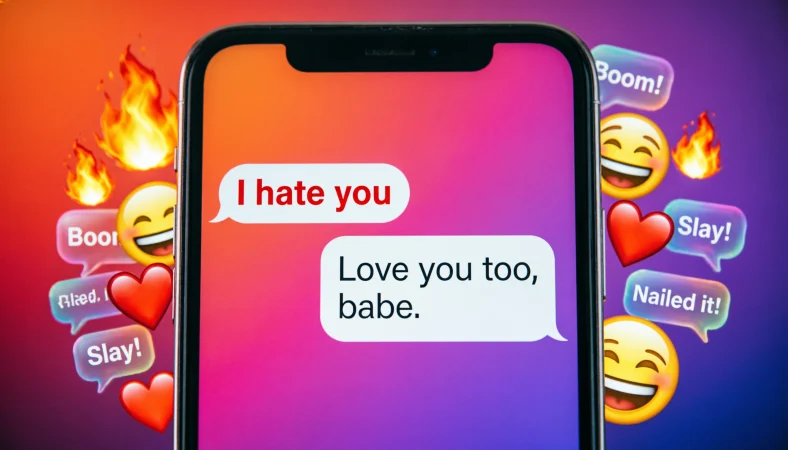

So someone just hit you with “I hate you” and you’re not sure if they’re serious, joking, flirting, or just being dramatic? Whether you want to clap back, flirt back, or keep it cute, these responses are about to save your conversation.
5 top alternatives:
- “I hate you more”
- “And yet, here you are talking to me”
- “Love you too, babe”
- That’s a weird way to say you miss me
- “Good, I was starting to think you actually liked me”
Let’s be honest. I hate you” is one of those phrases that can mean absolutely anything depending on who’s saying it and how they say it. Sometimes it’s playful banter between friends who secretly love each other. Sometimes it’s a flirty way of saying “I’m obsessed with you.” Other times, it’s genuine frustration or even heartbreak. And then there are those moments when it’s a dramatic declaration that’s basically begging for a reaction.
The way you respond to “I hate you” can change the entire dynamic of the conversation. Reply wrong and you might start an actual fight. Reply right and you’ll either make them laugh, make them blush, or make them fall for you even harder. So whether you’re dealing with a friend being dramatic, a crush playing hard to get, or someone who genuinely needs to chill, we’ve got every comeback you’ll ever need. Time to turn that “hate” into something way more interesting.
Funny Responses
1. “I hate you more”
Used when you want to match their energy in the most playful way possible.
Meaning: You’re turning their statement into a fun competition.
2. “And yet, here you are talking to me”
Perfect for when you want to point out the irony of their message.
Meaning: You’re playfully calling out that they’re still engaging with you.
3. “Love you too, babe”
Great for when you want to completely flip the meaning in a funny way.
Meaning: You’re pretending they said something affectionate.
4. “That’s a weird way to say you miss me”
Use this when you want to tease them about their true feelings.
Meaning: You’re suggesting their hate is actually longing.
5. “Good, I was starting to think you actually liked me”
Works when you want to be playfully relieved.
Meaning: You’re joking that you were worried they might be nice to you.
6. “Did you just confess your love in a toxic way?”
Perfect for when you want to be funny and slightly dramatic.
Meaning: You’re teasing them about their “hate” being code for love.
7. “I hate me too, we have so much in common”
Great for when you want to be self-deprecating and funny.
Meaning: You’re joining them in the hate train.
8. “Wow, and I thought I was the dramatic one”
Use this when you want to call out their theatrics playfully.
Meaning: You’re joking about how over-the-top they’re being.
9. “I’m going to print this and frame it”
Works when you want to be absurdly funny about their comment.
Meaning: You’re pretending their hate is a compliment worth saving.
10. “That’s not very nice, but I love it”
Perfect for when you want to be playfully contradictory.
Meaning: You’re acknowledging their meanness while enjoying it.
11. “I hate you too, now we’re even”
Great for when you want to be playfully reciprocal.
Meaning: You’re matching their energy exactly.
12. “Is that your way of asking for a hug?”
Use this when you want to be funny and affectionate.
Meaning: You’re pretending their hate is actually a need for comfort.
13. “I knew you couldn’t resist talking to me”
Works when you want to be confidently funny.
Meaning: You’re suggesting they can’t stay away.
14. “Your obsession is showing”
Perfect for when you want to be playfully teasing.
Meaning: You’re suggesting their hate is actually interest.
15. “I hate you too, let’s get married”
Great for when you want to be absurdly funny and commitment-focused.
Meaning: You’re joking about turning hate into love.
Playful Responses
1. “Aww, I hate you too, bestie”
Used when you want to be playfully affectionate.
Meaning: You’re turning hate into friendship banter.
2. “You’re just saying that because you love me”
Perfect for when you want to tease them about their true feelings.
Meaning: You’re suggesting their hate is a cover for affection.
3. “Hate you? I barely even know you”
Great for when you want to be playfully dismissive.
Meaning: You’re joking that they don’t even have a reason.
4. “I’m sorry you feel that way… not really”
Use this when you want to be playfully unbothered.
Meaning: You’re pretending to apologize but not actually sorry.
5. “Let me guess, you’re having a bad day?”
Works when you want to be playfully understanding.
Meaning: You’re joking that their hate is just bad mood.
6. “I’m going to remember this when you need something”
Perfect for when you want to be playfully petty.
Meaning: You’re joking about holding a grudge.
7. “Did you just wake up and choose violence?”
Great for when you want to be playfully dramatic.
Meaning: You’re joking about their sudden aggression.
8. “I’m telling your mom you said that”
Use this when you want to be playfully threatening.
Meaning: You’re joking about tattling on them.
9. “Rude, but I respect the honesty”
Works when you want to be playfully appreciative.
Meaning: You’re acknowledging their honesty while being funny.
10. “I hate you more, but I still like you”
Perfect for when you want to be playfully contradictory.
Meaning: You’re balancing hate with like.
11. “Let’s agree to disagree… about everything”
Great for when you want to be playfully argumentative.
Meaning: You’re joking about disagreeing on everything.
12. “I’m going to assume that’s your love language”
Use this when you want to be playfully analytical.
Meaning: You’re joking that their hate is actually love.
13. “Wow, and I was just about to compliment you”
Works when you want to be playfully regretful.
Meaning: You’re joking that you were about to be nice.
14. “That’s okay, I still like you anyway”
Perfect for when you want to be playfully stubborn.
Meaning: You’re refusing to return the hate.
15. “I hate you too, but I also want your snacks”
Great for when you want to be playfully honest.
Meaning: You’re prioritizing food over hate.
Flirty Responses
1. “Hate me all you want, you still can’t stop thinking about me”
Used when you want to be confidently flirty.
Meaning: You’re suggesting they’re obsessed despite the hate.
2. “I hate you too, but I’m still looking at you”
Perfect for when you want to be flirty and honest.
Meaning: You’re admitting attraction despite the hate.
3. “If you hate me, why do you keep looking?”
Great for when you want to be challengingly flirty.
Meaning: You’re pointing out their mixed signals.
4. “Hate is just love with extra steps”
Use this when you want to be poetically flirty.
Meaning: You’re suggesting hate is actually love.
5. “I hate you too, but I’d still kiss you”
Works when you want to be bold and flirty.
Meaning: You’re admitting attraction alongside hate.
6. “You say hate, I say passion”
Perfect for when you want to be creatively flirty.
Meaning: You’re reframing hate as intense emotion.
7. “I hate you too, but I like the way you hate me”
Great for when you want to be uniquely flirty.
Meaning: You’re finding their hate attractive.
8. “If you hate me, then why are you smiling?”
Use this when you want to be teasingly flirty.
Meaning: You’re catching them in their own game.
9. “I know you don’t mean that, your eyes say otherwise”
Works when you want to be confidently flirty.
Meaning: You’re suggesting their body language betrays them.
10. “I hate you too, but I’d still hold your hand”
Perfect for when you want to be sweet and flirty.
Meaning: You’re being affectionate despite the hate.
11. “Hate me all you want, I’m still going to flirt with you”
Great for when you want to be determinedly flirty.
Meaning: You’re not letting hate stop you.
12. “You’re cute when you pretend to hate me”
Use this when you want to be teasingly flirty.
Meaning: You’re finding their acting adorable.
13. “I hate you too, but I’d still steal your hoodie”
Works when you want to be cutely flirty.
Meaning: You’re doing domestic things despite hate.
14. “Your hate turns me on, just so you know”
Perfect for when you want to be bold and flirty.
Meaning: You’re finding their intensity attractive.
15. “I hate you too, but I still want you”
Great for when you want to be honestly flirty.
Meaning: You’re admitting desire despite hate.
Savage Responses
1. “I hate you more, and I meant it”
Used when you want to be savagely competitive.
Meaning: You’re outdoing them in the hate game.
2. “And yet, you still don’t matter to me”
Perfect for when you want to be savagely dismissive.
Meaning: You’re suggesting they’re irrelevant.
3. “Congratulations, you’re in a very long line”
Great for when you want to be savagely indifferent.
Meaning: You’re suggesting others also hate you.
4. “I don’t think about you enough to hate you”
Use this when you want to be savagely dismissive.
Meaning: You’re suggesting they’re not important enough to hate.
5. “Good, stay in your lane”
Works when you want to be savagely boundary-setting.
Meaning: You’re telling them to back off.
6. “I hate you too, but I forgot about you immediately”
Perfect for when you want to be savagely forgetful.
Meaning: You’re suggesting they’re not memorable.
7. “If I hated everyone who said that, I’d have no time”
Great for when you want to be savagely busy.
Meaning: You’re suggesting many people say this.
8. “Thank you for your opinion, I’ll file it appropriately”
Use this when you want to be savagely professional.
Meaning: You’re treating their hate like paperwork.
9. “I hate you too, but I don’t think about you at all”
Works when you want to be savagely honest.
Meaning: You’re suggesting they’re not on your mind.
10. “And you look like someone who says that a lot”
Perfect for when you want to be savagely observant.
Meaning: You’re suggesting they’re bitter.
11. “I’m sorry, I don’t speak hate”
Great for when you want to be savagely dismissive.
Meaning: You’re refusing to engage.
12. “You hate me? I’m flattered you care enough”
Use this when you want to be savagely appreciative.
Meaning: You’re suggesting hate requires attention.
13. “I hate me too, but at least I’m interesting”
Works when you want to be savagely self-aware.
Meaning: You’re suggesting you’re still better.
14. “I hate you more than I hate mondays”
Perfect for when you want to be savagely comparing.
Meaning: You’re suggesting they’re the worst.
15. “And I still don’t know your name”
Great for when you want to be savagely forgetful.
Meaning: You’re suggesting they’re not worth remembering.
Polite Responses
1. “I’m sorry you feel that way, I hope you feel better soon”
Used when you want to be kind and unbothered.
Meaning: You’re responding with grace.
2. “I understand, not everyone appreciates my energy”
Perfect for when you want to be understanding and calm.
Meaning: You’re accepting their opinion peacefully.
3. “Thank you for being honest with me”
Great for when you want to be politely appreciative.
Meaning: You’re acknowledging their honesty.
4. “I value your honesty, even if I don’t agree”
Use this when you want to be respectfully disagreeing.
Meaning: You’re accepting their opinion.
5. “I’m sorry to hear that, but I respect your feelings”
Works when you want to be empathetic.
Meaning: You’re acknowledging their emotions.
6. “I appreciate your directness, truly”
Perfect for when you want to be politely grateful.
Meaning: You’re thanking them for being direct.
7. “I understand that I’m not everyone’s cup of tea”
Great for when you want to be self-aware and calm.
Meaning: You’re accepting not everyone likes you.
8. “I’m sorry if I’ve done something to upset you”
Use this when you want to be genuinely apologetic.
Meaning: You’re willing to address their concerns.
9. “I’d like to understand why you feel that way”
Works when you want to be curious and open.
Meaning: You’re inviting conversation.
10. “That’s unfortunate, but I accept your feelings”
Perfect for when you want to be calmly accepting.
Meaning: You’re not fighting their opinion.
11. “I hope you find peace with whatever you’re feeling”
Great for when you want to be kind and supportive.
Meaning: You’re wishing them well.
12. “I’m open to talking if you’d like to explain”
Use this when you want to be inviting and understanding.
Meaning: You’re offering a conversation.
13. “I’m sorry you feel that way, I still wish you well”
Works when you want to be kind despite the hate.
Meaning: You’re maintaining goodwill.
14. “I respect your feelings, even though they hurt”
Perfect for when you want to be emotionally honest.
Meaning: You’re acknowledging the impact.
15. “Thank you for telling me, I’ll think about it”
Great for when you want to be reflective.
Meaning: You’re taking their comment seriously.
Sarcastic Responses
1. “Wow, I’ve never heard that one before. Totally original”
Used when you want to be sarcastically unimpressed.
Meaning: You’re mocking their lack of creativity.
2. “Oh no, my heart is broken. How will I recover?”
Perfect for when you want to be dramatically sarcastic.
Meaning: You’re pretending to be devastated.
3. “You hate me? And here I thought I was your favorite”
Great for when you want to be sarcastically confused.
Meaning: You’re pretending to be shocked.
4. “I’m going to go cry in the corner, thanks”
Use this when you want to be sarcastically dramatic.
Meaning: You’re pretending to be deeply hurt.
5. “Let me just write this down in my diary real quick”
Works when you want to be sarcastically serious.
Meaning: You’re pretending their hate is important.
6. “Oh wow, I’m so hurt, truly devastated”
Perfect for when you want to be sarcastically crushed.
Meaning: You’re pretending to be deeply affected.
7. “I’m going to need therapy now, thanks a lot”
Great for when you want to be sarcastically dramatic.
Meaning: You’re pretending their hate requires professional help.
8. “Should I call a therapist or just get over it?”
Use this when you want to be sarcastically questioning.
Meaning: You’re joking about how to handle their hate.
9. “You hate me? I had no idea, this is shocking”
Works when you want to be sarcastically surprised.
Meaning: You’re pretending to be completely blindsided.
10. “I’ll add you to my list of haters, welcome”
Perfect for when you want to be sarcastically welcoming.
Meaning: You’re treating their hate like a membership.
11. “Let me just find my tiny violin for this”
Great for when you want to be sarcastically sympathetic.
Meaning: You’re playing a sad song for them.
12. “I’m literally shaking right now, you got me”
Use this when you want to be sarcastically scared.
Meaning: You’re pretending to be terrified.
13. “You hate me? And I thought I was being charming”
Works when you want to be sarcastically confused.
Meaning: You’re pretending to misunderstand.
14. “Good, I was worried you might like me”
Perfect for when you want to be sarcastically relieved.
Meaning: You’re pretending you didn’t want their like.
15. “I’m going to need a whole day to recover”
Great for when you want to be sarcastically dramatic.
Meaning: You’re pretending to need recovery time.
Emotional Responses
1. “That actually really hurts to hear”
Used when you want to be emotionally honest.
Meaning: You’re sharing your genuine feelings.
2. “I’m sorry if I’ve made you feel this way”
Perfect for when you want to be emotionally apologetic.
Meaning: You’re taking responsibility.
3. “I care about you, so this stings”
Great for when you want to be vulnerable.
Meaning: You’re admitting they matter to you.
4. “I wish you felt differently, but I respect your feelings”
Use this when you want to be emotionally balanced.
Meaning: You’re accepting while hoping for more.
5. “I hope we can work through whatever this is”
Works when you want to be emotionally hopeful.
Meaning: You’re wanting to repair the relationship.
6. “I didn’t know you felt that way, I’m sorry”
Perfect for when you want to be empathetic.
Meaning: You’re acknowledging their hidden feelings.
7. “I understand that feelings change, and that’s okay”
Great for when you want to be emotionally mature.
Meaning: You’re accepting the evolution of emotions.
8. “I’m sad to hear that, but I appreciate your honesty”
Use this when you want to be emotionally grateful.
Meaning: You’re valuing their honesty despite the hurt.
9. “I’ve always wanted the best for us, but I can’t force it”
Works when you want to be emotionally accepting.
Meaning: You’re letting go of control.
10. “Your words hurt, but I’ll survive”
Perfect for when you want to be emotionally resilient.
Meaning: You’re acknowledging pain while being strong.
11. “I wish you’d talked to me sooner”
Great for when you want to be emotionally regretful.
Meaning: You’re wishing for earlier communication.
12. “I still care about you, even if you hate me”
Use this when you want to be emotionally consistent.
Meaning: Your feelings aren’t changed by their hate.
13. “I’m not going to fight you on this, I respect your feelings”
Works when you want to be emotionally peaceful.
Meaning: You’re choosing peace over argument.
14. “This breaks my heart, but I’ll be okay”
Perfect for when you want to be emotionally honest.
Meaning: You’re admitting hurt while being strong.
15. “I’ll always wish you well, even if you don’t”
Great for when you want to be emotionally generous.
Meaning: You’re offering goodwill regardless.
Witty Responses
1. “Hate is just love wearing a disguise”
Used when you want to be clever and philosophical.
Meaning: You’re reframing hate poetically.
2. “I’m not everyone’s cup of tea, and I’m okay with that”
Perfect for when you want to be witty and self-aware.
Meaning: You’re accepting not everyone likes you.
3. “If you hate me, why do you keep bringing me up?”
Great for when you want to be witty and observant.
Meaning: You’re pointing out their mixed signals.
4. “I’m not here to be liked by everyone”
Use this when you want to be witty and confident.
Meaning: You’re not seeking universal approval.
5. “I’m sorry you can’t handle this much personality”
Works when you want to be witty and self-assured.
Meaning: You’re suggesting you’re too much for them.
6. “You say hate, I say passion. Same energy”
Perfect for when you want to be clever about emotion.
Meaning: You’re suggesting hate is intense passion.
7. “I’m the reason you’re so pressed, and I love that”
Great for when you want to be witty and teasing.
Meaning: You’re suggesting you live in their head.
8. “You hate me? I’m still going to sleep well tonight”
Use this when you want to be witty and unbothered.
Meaning: You’re suggesting their hate doesn’t affect you.
9. “I’m a little too fabulous for your taste, I get it”
Works when you want to be witty and confident.
Meaning: You’re suggesting you’re above their standards.
10. “You hate me because you ain’t me”
Perfect for when you want to be witty and competitive.
Meaning: You’re suggesting they’re jealous.
11. “That’s okay, I’m not for everyone”
Great for when you want to be witty and selective.
Meaning: You’re okay being niche.
12. “I wear my haters as accessories”
Use this when you want to be witty and confidently dismissive.
Meaning: You’re suggesting hate doesn’t matter.
13. “You hate me? Keep talking, I’ll keep winning”
Works when you want to be witty and confident.
Meaning: Their hate doesn’t slow you down.
14. “I’m not here to be tolerated, I’m here to be unforgettable”
Perfect for when you want to be witty and bold.
Meaning: You’re prioritizing being memorable.
15. “Your hate is my favorite compliment”
Great for when you want to be witty and contrary.
Meaning: You’re reframing hate as flattery.
Confident Responses
1. “I know I’m not for everyone, and that’s fine”
Used when you want to be confidently self-aware.
Meaning: You’re okay with not being universally liked.
2. “Hate me all you want, I’m still going to be me”
Perfect for when you want to be confidently authentic.
Meaning: You’re staying true to yourself.
3. “I’m too busy winning to care about your opinion”
Great for when you want to be confidently dismissive.
Meaning: Their opinion doesn’t affect your success.
4. “You hate me? Good, I’m doing something right”
Use this when you want to be confidently contrary.
Meaning: You’re suggesting hate means you’re on the right track.
5. “I’m not everyone’s favorite, and I’m okay with that”
Works when you want to be confidently accepting.
Meaning: You’re okay with your place in their life.
6. “You don’t have to like me, I already like me”
Perfect for when you want to be confidently self-loving.
Meaning: You don’t need their approval.
7. “I’m comfortable being disliked by people like you”
Great for when you want to be confidently selective.
Meaning: You’re okay with their specific dislike.
8. “Your opinion doesn’t pay my bills”
Use this when you want to be confidently dismissive.
Meaning: Their opinion is irrelevant to your life.
9. “I’m doing just fine without your approval”
Works when you want to be confidently independent.
Meaning: You don’t need their validation.
10. “I’m not here to win everyone over”
Perfect for when you want to be confidently realistic.
Meaning: You’re not trying to please everyone.
11. “You hate me? Thanks for the free rent in your head”
Great for when you want to be confidently teasing.
Meaning: You’re suggesting they think about you too much.
12. “I’m comfortable in my own skin, with or without you”
Use this when you want to be confidently self-assured.
Meaning: Your worth isn’t tied to them.
13. “I don’t need everyone to love me, just the right people”
Works when you want to be confidently selective.
Meaning: You value quality over quantity.
14. “Your hate fuels me, honestly”
Perfect for when you want to be confidently contrary.
Meaning: You’re using their hate as motivation.
15. “I’m going to keep shining regardless”
Great for when you want to be confidently radiant.
Meaning: You’re not letting hate dim your light.
Dramatic Responses
1. “How dare you? I am a delight!”
Used when you want to be dramatically offended.
Meaning: You’re pretending to be mortally wounded.
2. “You hate me? But I’m the best thing that ever happened to you”
Perfect for when you want to be dramatically self-important.
Meaning: You’re suggesting they’re wrong.
3. “This is the greatest betrayal I’ve ever experienced”
Great for when you want to be dramatically tragic.
Meaning: You’re treating their hate like a Shakespearean plot.
4. “I’m going to go write poetry about this”
Use this when you want to be dramatically artistic.
Meaning: You’re treating their hate as inspiration.
5. “My heart is shattered into a million pieces”
Works when you want to be dramatically heartbroken.
Meaning: You’re pretending to be devastated.
6. “How could you? After everything we’ve been through?”
Perfect for when you want to be dramatically wounded.
Meaning: You’re pretending they’ve deeply betrayed you.
7. “I’m going to need a whole candlelight ceremony for this”
Great for when you want to be dramatically ceremonial.
Meaning: You’re treating their hate like a major event.
8. “This is the villain origin story I didn’t ask for”
Use this when you want to be dramatically narrative.
Meaning: You’re joking about becoming a villain.
9. “I’ve been betrayed by the one person I trusted”
Works when you want to be dramatically theatrical.
Meaning: You’re acting like they were your only friend.
10. “I’m literally crying right now, you’ve ruined me”
Perfect for when you want to be dramatically crushed.
Meaning: You’re pretending to be destroyed.
11. “This is worse than the time I lost my favorite pen”
Great for when you want to be dramatically comparing.
Meaning: You’re comparing their hate to a tragedy.
12. “I’m going to go mourn this loss”
Use this when you want to be dramatically grieving.
Meaning: You’re treating their hate like a death.
13. “How could you say that to someone as perfect as me?”
Works when you want to be dramatically self-absorbed.
Meaning: You’re acting like you’re above criticism.
14. “This is going to be the plot of my next novel”
Perfect for when you want to be dramatically literary.
Meaning: You’re treating their hate as inspiration.
15. “You’ve killed me, I’m dead, goodbye”
Great for when you want to be dramatically deceased.
Meaning: You’re pretending their hate killed you.
Chill and Casual Responses
1. “That’s cool, I still like you”
Used when you want to be casually unbothered.
Meaning: You’re not affected by their hate.
2. “I’ve heard that before, it’s fine”
Perfect for when you want to be casually experienced.
Meaning: You’re used to it.
3. “Okay, I accept that”
Great for when you want to be casually accepting.
Meaning: You’re not fighting it.
4. “I respect your opinion, even if I don’t agree”
Use this when you want to be casually respectful.
Meaning: You’re acknowledging their perspective.
5. “All good, not everyone vibes with me”
Works when you want to be casually understanding.
Meaning: You’re okay with not being liked.
6. “That’s valid, I get it”
Perfect for when you want to be casually agreeing.
Meaning: You’re acknowledging their feelings.
7. “I’m not mad about it”
Great for when you want to be casually unbothered.
Meaning: You’re not upset.
8. “I still think you’re cool though”
Use this when you want to be casually positive.
Meaning: You’re still nice despite their hate.
9. “I’m okay with that, honestly”
Works when you want to be casually accepting.
Meaning: You’re genuinely unbothered.
10. “I didn’t expect everyone to like me”
Perfect for when you want to be casually realistic.
Meaning: You’re okay with not being universally liked.
11. “It is what it is”
Great for when you want to be casually philosophical.
Meaning: You’re accepting the situation.
12. “I’m still going to be me though”
Use this when you want to be casually authentic.
Meaning: You’re staying true to yourself.
13. “You don’t have to like me, it’s okay”
Works when you want to be casually accepting.
Meaning: You’re not demanding their like.
14. “I’ll still be nice to you anyway”
Perfect for when you want to be casually generous.
Meaning: You’re not reciprocating the hate.
15. “We don’t have to get along, it’s fine”
Great for when you want to be casually neutral.
Meaning: You’re okay with distance.
FAQs
What does “I hate you” actually mean in a conversation?
It completely depends on the context! It could be playful banter between friends, flirty teasing between crushes, genuine anger during a fight, or someone being dramatic for attention. Always consider the tone and relationship.
How can I tell if they’re joking or serious?
Look at the context. Are they laughing or using emojis? Is this a pattern of playful banter? Or is the conversation serious and tense? Trust your gut. If you’re unsure, just ask them directly.
Is “I hate you” sometimes a form of flirting?
Absolutely! Especially when said with a smile, in a teasing tone, or between people who clearly have chemistry. Sometimes “I hate you” is code for “I’m obsessed with you and don’t know how to say it.
How should I respond if they’re genuinely angry?
Don’t fire back with sarcasm or jokes. Be mature. Try something like “I’m sorry you feel that way, can we talk about it?” or “What’s going on? I’d like to understand.” Take the high road.
Can I respond with humor if they’re serious?
Only if you know it’ll land well. If someone is genuinely upset, humor can make things worse. But if you sense they’re being dramatic or playful, a funny comeback can diffuse the tension perfectly.
What if someone says “I hate you” out of nowhere?
Stay calm. Ask them what’s going on. A simple “Did something happen? I’m confused” opens the door for them to explain. Don’t assume the worst.
Is it okay to say “I hate you” back?
It depends on the dynamic. In playful banter, absolutely. In a serious conflict, it’ll probably make things worse. Mirror their energy, but know when to de-escalate.
How do I respond if they’re just being dramatic?
Lean into it! Match their dramatic energy with something over-the-top like “My heart is shattered into a million pieces!” or “How could you?!” This keeps the game going and makes it fun.
What if I actually hurt them and they mean it?
Own it. Apologize sincerely. Say “I’m really sorry I hurt you. I care about you and want to make things right.” No jokes, no sarcasm. Just honesty and accountability.
Can I just ignore it?
Sure! If the comment seems random or attention-seeking, sometimes the best response is no response. Let them sit with their words while you move on with your day.
Conclusion
At the end of the day, “I hate you” is one of the most flexible phrases in the relationship dictionary. It can mean anything from playful teasing to genuine anger, and your response is your chance to steer the conversation exactly where you want it to go. The key is reading the room. If it’s banter, banter back. If it’s flirting, flirt harder. If it’s serious, be serious. And if you’re not sure? Just ask. The best part about having so many options is that you can pick the one that feels right in the moment.
So next time someone drops that “I hate you” bomb on you, you’ll be ready. You’ve got wit, you’ve got sass, and you’ve got the perfect response. Now go own that conversation. And hey, if this guide helped you level up your response game, save it for later or share it with a friend who needs it. You’ve got this!