
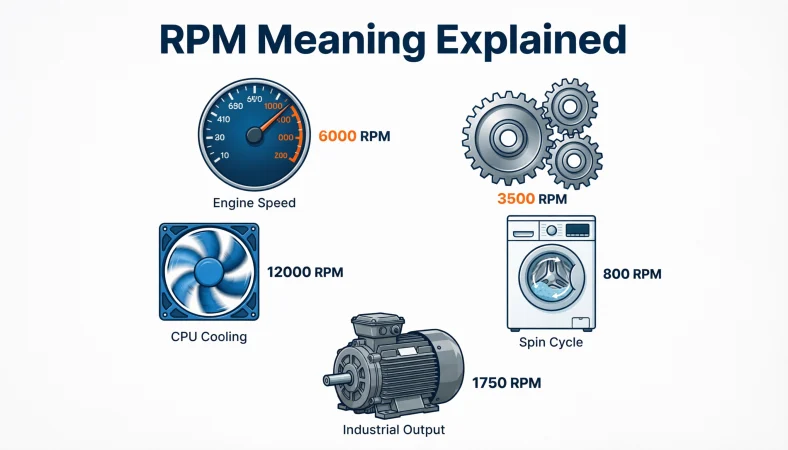

Definition: RPM (Revolutions Per Minute) is a unit that measures how many times a rotating object completes one full revolution in one minute. Higher RPM indicates faster rotation, while lower RPM means slower movement.
manual, computer fan, or online earnings report and wondered what it means? Although the same abbreviation is used in many industries, its meaning changes depending on the context, making it one of the most commonly searched technical terms. Understanding RPM can help you better interpret vehicle performance, machinery operation, and even digital marketing metrics.
This guide provides a clear and reliable explanation of RPM meaning based on established engineering principles, automotive knowledge, and common industry usage. You’ll learn what RPM stands for in different contexts, how it works, why it matters, and practical examples that make this widely used abbreviation easy to understand for beginners and professionals alike.
What Does RPM Mean?
RPM is short for Revolutions Per Minute, which simply measures rotational speed.
Imagine a bicycle wheel spinning. If it completes 100 rotations in one minute, its speed is 100 RPM.
The same concept applies to:
- Car engines
- Motorcycle engines
- Electric motors
- Washing machines
- Hard drives
- Cooling fans
- Industrial machinery
- Turbines
RPM helps engineers and manufacturers understand how fast a machine or component is operating.
Origin of RPM
The concept of measuring rotational speed dates back to the early Industrial Revolution when factories began using rotating machinery powered by steam engines.
As engineering advanced during the 19th century, standardized units became necessary to compare machine performance.
The abbreviation RPM eventually became the universal shorthand for Revolutions Per Minute, and today it is recognized worldwide across automotive, mechanical, industrial, and electronics industries.
Because it is simple and easy to understand, RPM remains one of the most commonly used engineering measurements.
Why RPM Is Important
RPM helps determine how efficiently a machine operates.
For example:
- Higher RPM usually means faster operation.
- Lower RPM generally means slower movement and often better fuel efficiency.
- Extremely high RPM can increase wear and heat generation.
Understanding RPM helps drivers, mechanics, engineers, and even everyday consumers use machines safely and efficiently.
Where Is RPM Used?
RPM appears in many industries and everyday products.
Automotive
Car engines use RPM to show engine speed.
Example:
- Idle: 700–900 RPM
- Normal driving: 1,500–3,000 RPM
- High acceleration: 4,000–6,000 RPM
The tachometer on your dashboard displays RPM.
Electric Motors
Industrial motors often operate at:
- 900 RPM
- 1,200 RPM
- 1,800 RPM
- 3,600 RPM
The required RPM depends on the application.
Computer Fans
CPU and GPU cooling fans rotate at different speeds.
Typical fan RPM:
- Quiet mode: 800 RPM
- Normal use: 1,200–2,000 RPM
- Gaming: 2,500–4,000 RPM
Higher RPM improves cooling but increases noise.
Hard Disk Drives
Traditional HDDs spin at fixed RPM values:
- 5,400 RPM
- 7,200 RPM
- 10,000 RPM
- 15,000 RPM
Higher RPM usually results in faster data access.
Household Appliances
RPM is commonly used for:
- Washing machines
- Mixers
- Blenders
- Ceiling fans
- Vacuum cleaners
For example, a washing machine may spin clothes at 1,200 RPM during drying.
RPM Meaning in Cars
One of the most searched uses of RPM relates to automobiles.
The engine crankshaft rotates while the engine runs.
RPM measures how many times this crankshaft rotates every minute.
Example:
| Driving Situation | Typical RPM |
|---|---|
| Engine Idle | 700–900 RPM |
| City Driving | 1,500–2,500 RPM |
| Highway Driving | 2,000–3,000 RPM |
| Hard Acceleration | 4,000–6,500 RPM |
| Performance Cars | 7,000–9,000+ RPM |
Drivers often shift gears to keep the engine operating in an efficient RPM range.
RPM in Everyday Language
Outside engineering, people usually use RPM only when discussing machines or vehicles.
Examples include:
- “The engine reached 5,000 RPM.”
- “This fan spins at 1,800 RPM.”
- “The washing machine can reach 1,400 RPM.”
- “My hard drive runs at 7,200 RPM.”
Unlike internet slang, RPM usually has a technical meaning rather than an emotional or conversational one.
RPM Example Table
| Situation | RPM Example |
|---|---|
| Car Engine Idle | 800 RPM |
| Highway Driving | 2,300 RPM |
| Gaming PC Fan | 2,800 RPM |
| Washing Machine Spin | 1,200 RPM |
| Blender | 18,000 RPM |
| Hard Drive | 7,200 RPM |
| Industrial Motor | 3,600 RPM |
Real-World Examples
Example 1
“My car stays around 2,000 RPM while cruising.”
Meaning: The engine rotates about 2,000 times every minute.
Example 2
“This ceiling fan runs at 300 RPM.”
Meaning: The blades complete 300 full rotations every minute.
Example 3
“The gaming laptop fan jumped to 4,500 RPM 🔥”
Meaning: The cooling fan sped up significantly to reduce temperature.
Example 4
“The washing machine spins at 1,400 RPM.”
Meaning: The drum rotates 1,400 times each minute during the spin cycle.
Does Higher RPM Mean Better?
Not always.
Higher RPM has advantages:
- Faster operation
- More power output
- Better cooling
- Faster processing (in some devices)
But it also has disadvantages:
- More noise
- Increased wear
- Higher fuel consumption
- Greater heat production
The ideal RPM depends on the machine and its intended use.
RPM vs Related Terms
| Term | Meaning |
|---|---|
| RPM | Revolutions Per Minute |
| RPS | Revolutions Per Second |
| MPH | Miles Per Hour |
| KM/H | Kilometers Per Hour |
| Torque | Rotational force |
| Horsepower | Rate of work output |
RPM measures rotational speed, while torque measures rotational force.
Both work together to determine engine performance.
RPM vs RPS
People often confuse RPM with RPS.
| RPM | RPS |
|---|---|
| Revolutions Per Minute | Revolutions Per Second |
| Larger unit | Smaller time interval |
| Used in vehicles | Often used in engineering and physics |
Example:
- 60 RPM = 1 RPS
- 600 RPM = 10 RPS
Alternate Meanings of RPM
Although Revolutions Per Minute is the most common definition, RPM can also represent other phrases depending on context.
Some alternate meanings include:
- Revenue Per Mille (digital advertising)
- Remote Patient Monitoring (healthcare)
- Red Hat Package Manager (Linux software)
- Records Per Minute (older recording systems)
- Risk Priority Matrix (project management)
Context determines which meaning applies.
Professional Alternatives
Instead of saying RPM informally, professionals may use:
- Rotational speed
- Rotational velocity
- Engine speed
- Shaft speed
- Operating speed
- Motor speed
Example:
Instead of:
“The motor has high RPM.”
You can say:
“The motor operates at a high rotational speed.”
Common Misconceptions About RPM
RPM measures vehicle speed.
False.
RPM measures engine rotation, not road speed.
Higher RPM is always better.
False.
Efficiency depends on the engine and driving conditions.
RPM is only used for cars.
False.
RPM is used across engineering, electronics, household appliances, aviation, manufacturing, and computing.
Tips for Understanding RPM
- Higher RPM means faster rotation.
- RPM doesn’t always indicate higher speed.
- Different machines have different ideal RPM ranges.
- Efficient operation often occurs in moderate RPM zones.
- Always consider torque and power alongside RPM.
FAQs
1. What does RPM mean?
RPM stands for Revolutions Per Minute, measuring how many complete rotations occur in one minute.
2. What is a good RPM for a car?
Most cars operate efficiently between 1,500 and 3,000 RPM during normal driving.
3. Is higher RPM faster?
Yes, higher RPM means faster rotation, but it does not always mean better performance or efficiency.
4. What does RPM mean on a washing machine?
It indicates how many times the drum spins each minute during the spin cycle.
5. What does RPM mean for computer fans?
It measures how fast the cooling fan rotates. Higher RPM generally provides better cooling but creates more noise.
6. What is the difference between RPM and speed?
RPM measures rotational movement, while speed measures travel distance over time.
7. Is RPM important when driving?
Yes. Monitoring RPM helps improve fuel economy, engine longevity, and overall driving efficiency.
8. Can RPM have other meanings?
Yes. It can also stand for Revenue Per Mille, Remote Patient Monitoring, Red Hat Package Manager, and several other technical terms depending on context.
Conclusion
RPM, or Revolutions Per Minute, is one of the most widely used measurements for rotational speed across vehicles, machinery, electronics, and household appliances. It tells us how many complete rotations an object makes in one minute and helps evaluate efficiency, power, and performance.
Whether you’re reading a car dashboard, comparing washing machines, buying a computer fan, or studying engineering concepts, understanding RPM makes it much easier to interpret how equipment works. Remember that higher RPM isn’t always better the ideal value depends on the specific application and operating conditions.
Discover More Articles About:
- IYKYK Meaning: What It Means in Text, Social Media and Online Chats In 2026
- Humility Meaning and the Power of Being Humble In 2026