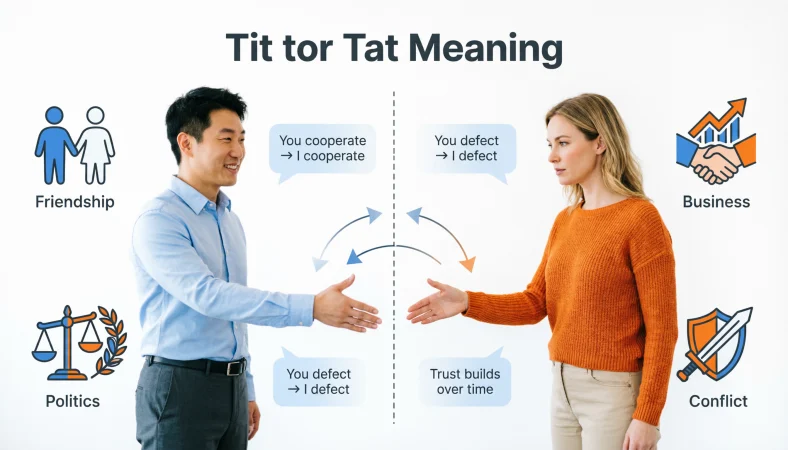
Tit for tat is an English idiom that refers to giving the same treatment in return for what someone else has done, whether positive or negative. It often describes retaliation, revenge, or mutual exchange of similar actions.
Have you ever heard someone say, “It’s just tit for tat,” and wondered what they really mean? Whether it’s returning a favor, matching someone’s behavior, or getting even after being treated unfairly, this common English idiom appears in everyday conversations, news headlines, politics, and even business discussions. Understanding its true meaning can help you communicate more naturally and recognize the subtle tone behind the expression.
The phrase “tit for tat” refers to responding to someone’s action with a similar action in return whether positive or negative. While many people associate it with revenge, it can also describe fairness, reciprocity, and balanced exchanges. In this guide, you’ll learn the tit for tat meaning, its origin, real-life examples, common uses, and the best ways to use it correctly in modern English. The information is based on established English language usage and widely accepted definitions to provide readers with clear, accurate, and trustworthy guidance.
Why “Tit for Tat” Is Such a Popular Expression
Human relationships often involve reciprocity. People naturally respond to kindness with kindness and unfair treatment with similar behavior. The phrase tit for tat perfectly captures this idea, making it one of the most widely recognized idioms in English.
You may hear it in:
- Everyday conversations
- Politics
- Business negotiations
- International relations
- Sports rivalries
- Family disagreements
- Social media discussions
The expression has survived for centuries because it describes a universal human behavior.
Origin of Tit for Tat
The phrase dates back to the 16th century.
Originally, English speakers used the phrase “tip for tap,” meaning one blow for another blow. Over time, pronunciation evolved into “tit for tat,” which became the standard expression.
The idiom reflects the old idea of equal retaliation responding in exactly the same way someone else acted.
Today, it no longer refers only to physical actions. It applies to conversations, business, politics, friendships, relationships, and many everyday situations.
What Does Tit for Tat Mean in Everyday Life?
In modern English, tit for tat usually means:
- Returning someone’s behavior
- Giving equal treatment
- Responding in kind
- Paying someone back
- Matching another person’s actions
It doesn’t always imply revenge. Sometimes it simply means fairness or balance.
For example:
- She bought me lunch, so I bought her coffee. That’s tit for tat in a positive way.
- He spread rumors, so they spread rumors about him. That’s tit for tat in a negative way.
The context determines whether the phrase sounds friendly, neutral, or hostile.
Example Table
| Situation | Example Sentence | Tone |
|---|---|---|
| Friendship | “You helped me move, so I’ll help you next week. Tit for tat!” | Friendly 😊 |
| Family | “My brother hid my shoes, so I hid his backpack.” | Playful |
| Workplace | “Management cut bonuses, and employees reduced overtime.” | Neutral |
| Politics | “The countries imposed tit for tat sanctions.” | Formal |
| Sports | “The teams exchanged goals in a tit for tat match.” | Neutral |
| Relationship | “She ignored him, and he ignored her back.” | Negative |
| Social Media | “One influencer criticized another, leading to tit for tat comments.” | Negative |
| Business | “The rivals launched competing discounts in a tit for tat strategy.” | Professional |
How Is Tit for Tat Used?
The phrase can function as:
- A noun
- An adjective
- Part of a sentence describing reciprocal behavior
Examples:
- “Their argument became tit for tat.”
- “The companies engaged in tit for tat competition.”
- “It turned into a tit for tat exchange.”
It generally describes ongoing back-and-forth actions.
Real-Life Examples of Tit for Tat
Friendly Example
Sarah bought coffee for Emma yesterday.
Today Emma buys lunch for Sarah.
That’s a friendly tit for tat exchange where kindness is returned with kindness.
Family Example
One sibling hides another sibling’s TV remote.
The other sibling hides their charger.
That’s playful tit for tat behavior.
Workplace Example
An employee covers a coworker’s shift.
The coworker later returns the favor.
This shows positive reciprocity.
Negative Example
One neighbor plays loud music late at night.
The other neighbor starts mowing the lawn early every morning.
That’s negative tit for tat retaliation.
International Politics Example
Country A raises tariffs.
Country B responds with similar tariffs.
News reports often describe this as tit for tat trade measures.
Tone of Tit for Tat
The phrase changes meaning depending on context.
Friendly Tone 😊
Used when kindness is returned.
Example:
“She always supports me, so I support her. It’s tit for tat.”
Neutral Tone 😐
Used for equal exchanges.
Example:
“Both companies introduced similar promotions in a tit for tat strategy.”
Negative Tone 😠
Used when describing revenge or retaliation.
Example:
“The online argument became a tit for tat exchange of insults.”
Is Tit for Tat Positive or Negative?
Both.
Positive
- Returning favors
- Mutual cooperation
- Balanced relationships
- Fair exchanges
Negative
- Revenge
- Retaliation
- Endless arguments
- Escalating conflicts
The phrase itself is neutral; the surrounding situation determines whether it sounds positive or negative.
Common Situations Where People Say Tit for Tat
People frequently use this phrase when discussing:
- Relationships
- Marriage
- Politics
- Business competition
- Trade disputes
- Sports rivalries
- Online arguments
- Friendships
- Family conflicts
- International diplomacy
It is especially common in news headlines about political disagreements and economic sanctions.
Comparison with Similar Expressions
| Phrase | Meaning | Difference |
|---|---|---|
| Tit for Tat | Responding with equal treatment | Neutral expression |
| Eye for an Eye | Exact revenge | More severe |
| Payback | Revenge or repayment | More informal |
| Revenge | Intentional retaliation | Strongly negative |
| Return the Favor | Repaying kindness | Positive |
| Give as Good as You Get | Respond equally | Often competitive |
| Reciprocity | Mutual exchange | Formal and positive |
| Retaliation | Responding aggressively | Usually negative |
Alternate Meanings of Tit for Tat
The idiom has very few alternate meanings.
However, it appears in different contexts:
Game Theory
In economics and psychology, Tit for Tat Strategy refers to cooperating first and then copying the opponent’s previous move. It became famous through the Prisoner’s Dilemma experiments.
Business
Companies may engage in tit for tat pricing, where each matches the other’s discounts.
Politics
Governments often impose tit for tat sanctions or diplomatic measures.
Regardless of context, the central idea remains matching another person’s actions.
Polite or Professional Alternatives
Sometimes tit for tat sounds too informal or too negative.
Professional alternatives include:
- Mutual response
- Reciprocal action
- Equal exchange
- Proportional response
- Reciprocal arrangement
- Return gesture
- Balanced approach
- Mutual cooperation
- Corresponding action
- Equivalent response
For example:
Instead of:
“The companies entered a tit for tat battle.”
You could say:
“The companies engaged in reciprocal competitive actions.”
Tips for Using Tit for Tat Correctly
- Use it when actions mirror previous actions.
- It works for both positive and negative situations.
- It usually describes ongoing exchanges.
- Avoid using it in highly formal legal writing.
- Make sure context clearly shows reciprocal behavior.
Correct:
“Their friendship is based on tit for tat generosity.”
Correct:
“The argument became tit for tat.”
Incorrect:
“He won the race tit for tat.”
(The phrase doesn’t fit because no reciprocal action exists.)
Common Mistakes
People sometimes misunderstand the phrase.
Mistake 1
Thinking it only means revenge.
Actually, it can also describe kindness.
Mistake 2
Using it for unrelated actions.
The response should mirror the original action.
Mistake 3
Confusing it with random competition.
It specifically involves matching another person’s behavior.
FAQ
1. What does tit for tat mean?
It means responding to someone’s action with an equal action, whether positive or negative.
2. Is tit for tat always negative?
No. It can describe kindness returned with kindness or retaliation returned with retaliation.
3. Where did the phrase tit for tat come from?
It evolved from the older phrase “tip for tap” during the 1500s and originally referred to one blow returned by another.
4. Can tit for tat be used in business?
Yes. Businesses often use it to describe competitive pricing, advertising, or market responses.
5. Is tit for tat the same as revenge?
Not exactly. Revenge is usually more emotional and negative, while tit for tat simply means responding in the same way.
6. What is a tit for tat strategy?
In game theory, it means cooperating first and then copying the opponent’s previous move.
7. Can tit for tat be positive?
Yes. Returning favors or kindness is also a form of tit for tat behavior.
8. Is tit for tat an idiom?
Yes. It is a common English idiom describing reciprocal actions or equal responses.
Conclusion
The phrase tit for tat is a timeless English idiom that describes responding to someone’s actions with similar actions in return. While many people associate it with revenge or retaliation, it can also refer to positive reciprocity and fairness.
Whether discussing friendships, business competition, politics, or everyday conversations, understanding the meaning and context of tit for tat helps you use the expression naturally and correctly. Remember that the tone depends entirely on the situation it can express kindness, neutrality, or conflict.
Knowing when and how to use this idiom will make your English sound more fluent while helping you better understand news articles, movies, books, and real-life conversations.
Read More Articles About:
- IYKYK Meaning: What It Means in Text, Social Media and Online Chats In 2026
- HVAC Meaning: Definition, Uses, Systems & Why It Matters In 2026