
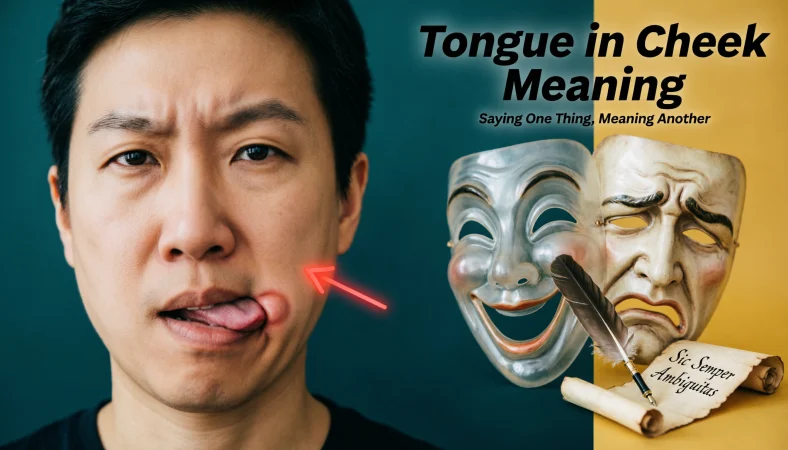
Have you ever read a comment that sounded serious at first but turned out to be a joke? If so, it was probably tongue in cheek. This popular English idiom is often used in conversations, books, movies, social media posts, and news articles to describe humor that is subtle, ironic, or not meant to be taken literally.
Tongue in cheek means expressing something in a humorous, ironic, or sarcastic way while pretending to be serious. The phrase is commonly used to describe jokes, playful remarks, or exaggerated statements that are intended to entertain rather than state facts. Because tone and context are essential, the meaning can sometimes be misunderstood in text-based communication. In this guide, you’ll learn the definition of tongue in cheek, its origin, common examples, and how to recognize and use the expression correctly in everyday English.
Tongue in Cheek Meaning: A Clear and Comprehensive Definition
The meaning of “tongue in cheek” refers to a form of humor or irony where a statement is made in a mocking, playful, or insincere manner, but the speaker delivers it with a completely serious or deadpan expression. The literal meaning of the words is often the opposite of what the speaker actually intends, and the humor relies on the listener recognizing the absurdity or the hidden wink behind the straight face.
The Surprising Origin of the “Tongue in Cheek” Gesture
To truly understand the tongue in cheek meaning, we have to step back in time and look at the literal physical gesture that inspired the phrase.
The Physical Act
Imagine a person who wants to mock someone but doesn’t want to get caught. If you put your tongue against the inside of your cheek, it creates a visible bulge or a slight distortion in your face almost like you’re holding back a laugh or a smirk. Historically, this gesture was a way to signal to an ally that you were joking or being contemptuous without the target of the joke realizing it. It was the 18th-century equivalent of elbowing your friend in the ribs.
Literary Origins
The earliest recorded use of the phrase in print dates back to the 19th century. In 1840, the British novelist and poet Richard Barham wrote in his Ingoldsby Legends about a character who “had a tongue in his cheek.” However, it wasn’t quite the modern meaning we use today. Back then, it often meant expressing contempt or mockery.
By the late 19th and early 20th centuries, the phrase evolved. In 1895, the author Anthony Hope used it in his novel The Prisoner of Zenda. The meaning shifted from a gesture of physical mockery to a descriptor of a tone a way of speaking that was deliberately insincere for humorous effect. By the mid-20th century, it was cemented in the English lexicon as a hallmark of British dry wit and sophisticated comedy.
Real-World Usage and Modern Interpretations
Today, the tongue in cheek meaning has expanded far beyond the physical gesture. It’s a tool used by comedians, politicians, writers, and everyday people to navigate sensitive topics, defuse tension, or just have a bit of fun.
Here is a quick breakdown of how it is used in everyday life:
| Context | Interpretation | Example Sentence |
| Satirical Writing | Mocking a topic while pretending to support it. | “That satirical article about corporate greed was so tongue-in-cheek that half the commenters didn’t realize it was a joke.” |
| Office Banter | Making a lighthearted jab at a colleague without causing offense. | “Oh, absolutely, I love sitting through three-hour budget meetings,” she said, tongue firmly in cheek. |
| Stand-up Comedy | Deadpan delivery of an absurd premise. | The comic’s tongue-in-cheek suggestion that we should all just eat cake for dinner got a huge laugh. |
| Social Commentary | Highlighting hypocrisy by mimicking the opposing view. | His tongue-in-cheek defense of the villain in the movie was a brilliant way to critique the hero’s flaws. |
| Parental/Family Jokes | Teasing kids or siblings without being cruel. | “Sure, you can eat ice cream for breakfast,” Dad said tongue-in-cheek, hoping the kids would catch the joke. |
Examples with Different Tones
Because the tongue in cheek meaning relies so heavily on vocal tone and context, the same sentence can mean totally different things. Let’s break it down.
Neutral/Informational Tone
“When a writer uses a tongue-in-cheek approach, they are relying on the audience’s intelligence to detect the underlying irony. The literal text often contradicts the subtext.”
Friendly/Conversational Tone (with Emojis)
So I told my boss I was ‘definitely feeling motivated’ after the fifth coffee of the day. ☕️ Needless to say, it was totally tongue-in-cheek. We both had a good laugh about it… then I went back to doom-scrolling. 😂”
Playful/Humorous Tone
“Am I a professional chef? Absolutely not. But will I tell my date that I ‘excel at cooking’ while I microwave a frozen pizza? You bet I will. Total tongue-in-cheek move, but hey, it got me a second date! 🍕😉”
Dismissive/Skeptical Tone (The “Just Be Direct” view)
Look, I get that you’re trying to be funny, but all this tongue-in-cheek sarcasm is exhausting. Can you just give me a straight answer for once? I can’t read your mind, and the ‘winking’ isn’t helping.”
Sophisticated/Intellectual Tone
“The director employed a deeply tongue-in-cheek aesthetic, simultaneously celebrating and subverting the tropes of classic film noir, leaving the audience questioning the very nature of cinematic heroism.”
Tongue in Cheek vs. Sarcasm vs. Irony vs. Satire: A Detailed Comparison
This is where things get tricky. The tongue in cheek meaning overlaps heavily with other forms of humor, but the differences are crucial. Knowing the nuance can save you from looking like a jerk.
| Term | Meaning | Emotional Vibe | Target | Is it cruel? |
| Tongue-in-Cheek | Playful irony delivered with a straight face. | Lighthearted, teasing, clever. | The situation or a general idea. | Rarely; usually affectionate. |
| Sarcasm | Bitter or cutting mockery; intended to hurt or criticize. | Sharp, aggressive, bitter. | A specific person or group. | Often yes, it’s meant to sting. |
| Verbal Irony | Saying the opposite of what you mean. | Neutral, factual, can be funny or serious. | The situation. | Depends on the delivery. |
| Satire | Using humor, irony, or exaggeration to expose vices. | Intellectual, critical, scathing. | Society, institutions, politics. | Can be harsh, but aimed at systems, not individuals. |
| Dry Humor | Delivered with a serious expression, often absurd. | Deadpan, factual, unexpected. | The absurdity of life. | Usually harmless. |
The “Sarcasm Trap”
Here is the golden rule: All sarcasm can be tongue-in-cheek, but not all tongue-in-cheek is sarcastic.
- Sarcasm usually has a victim. If you say, “Great job, genius,” after someone makes a mistake, that is sarcasm. It’s mean.
- Tongue-in-cheek usually doesn’t have a victim. If a pilot comes on the intercom and says, “We are currently flying over some clouds. I won’t charge you extra for the view,” that is tongue-in-cheek. It’s a playful, self-aware joke that mocks the situation, not the passengers.
Alternate Meanings and Common Misconceptions
Because the phrase is so nuanced, many people misunderstand the tongue in cheek meaning. Let’s clear up the confusion.
- Misconception: It is just a fancy word for lying.
- Truth: No. When you lie, you intend to deceive. When you speak tongue-in-cheek, you want the listener to eventually catch on. The joy comes from the shared understanding that you’re playing.
- Misconception: You have to physically put your tongue in your cheek.
- Truth: While that was the origin, nobody actually does the physical gesture anymore. It refers to a tone or a style of writing. However, you might see someone wink or hold back a smile to signal it.
- Misconception: It only applies to spoken words.
- Truth: It applies heavily to writing. Authors like Jane Austen and Douglas Adams are masters of the written tongue-in-cheek style. You can tell by the absurdity of the description combined with a very serious, factual tone.
- Misconception: It’s unprofessional.
- Truth: It can be unprofessional if used incorrectly, but when used intelligently in marketing, advertising, or even internal emails, it can make brands and teams feel more human and relatable.
Polite and Professional Alternatives
If you are worried that saying “I was being tongue-in-cheek” sounds too casual or confusing in a professional setting, here are some safer, more direct alternatives to convey the same intent.
For Emails and Reports
- “I should clarify that the previous comment was intended humorously.”
- “Please note the ironic tone of the statement.”
- “The sentiment was expressed with lighthearted intent.”
For Verbal Workplace Conversations
- “I’m just teasing, of course.”
- “I meant that jokingly.”
- “I was being a little facetious there.”
- “All in good fun, though!”
For Casual Settings (When you realize someone didn’t get the joke)
- “I was just pulling your leg!”
- “I’m kidding, obviously.”
- “That was supposed to be a joke. Did I miss the mark?”
Labeled Example Table: Using “Tongue in Cheek” Across Different Scenarios
Here is how the tongue in cheek meaning translates into real-life communication, showing the literal words and the hidden interpretation.
| Scenario | The Literal Words | The Hidden Meaning (Tongue-in-Cheek) | Why It Works |
| Overworked Employee | “Oh, I absolutely love working 12-hour shifts. It’s a dream come true.” | “I am exhausted and this schedule is killing me, but I’m trying to laugh about it.” | Commiserates with colleagues without directly complaining to the boss. |
| Rainy Vacation | “This is definitely the best beach weather we could have asked for!” | “This rain is ruining the beach, but we might as well make the best of it.” | Keeps the mood light and avoids frustration ruining the trip. |
| Bad Cook | “I’m basically the next Gordon Ramsay.” | “I know I burnt the eggs. I am a terrible cook, but I’m making a joke about it.” | Self-deprecating humor that makes others feel relaxed. |
| Movie Review | “This film is a masterpiece of modern cinema.” (In a review of a silly comedy) | “This movie is so bad it’s good, and I’m mocking serious film critics.” | Shows the reviewer has a sense of humor and isn’t taking things too seriously. |
| Political Commentary | “Oh yes, our politicians are doing a fantastic job prioritizing the people.” | “Our politicians are completely out of touch with reality.” | A safe way to criticize authority without being overtly aggressive. |
The Psychology of Tongue-in-Cheek: Why We Use It
Why do we bother with this confusing style of communication? Why not just say what we mean?
The Social Glue
Humor is a bonding mechanism. When you make a tongue-in-cheek remark and someone else “gets it,” you have an instant moment of connection. It signals intelligence, social awareness, and a shared worldview. It’s like a secret handshake for the clever.
The Safety Valve
Sometimes, reality is too harsh or too awkward to state directly. If you are furious with your boss, you can’t yell at them. But you can make a dry, tongue-in-cheek comment about the printer “loving paper too much to let it go.” It releases the pressure valve without causing a blow-up.
Emotional Intelligence (EQ)
People who effectively use tongue-in-cheek humor usually have high emotional intelligence. They understand the boundaries of the room, the sensitivity of the topic, and the threshold of their audience. They know how much absurdity the listener can take before getting confused or offended.
The Risks: When Tongue-in-Cheek Goes Wrong
Let’s be real for a second. The tongue in cheek meaning is fun, but it’s a high-risk, high-reward game.
The Misunderstanding Risk
If your audience isn’t on the same wavelength, they will take you literally. This happens all the time on social media, where people get brutally attacked for “horrible opinions” that were actually just extremely dry jokes.
The Cultural Barrier
Humor doesn’t translate well across cultures. Some cultures (like the UK, Australia, and the US) love deadpan irony. Other cultures value absolute clarity and might find tongue-in-cheek remarks confusing or insulting. If you are speaking to a non-native English speaker, avoid it.
The “Too Much” Trap
If you are constantly tongue-in-cheek, people stop trusting you. They will always wonder, “Is he serious? Does he actually mean this?” If you can never give a straight answer, you will be seen as inauthentic or emotionally unavailable.
How to Master the Art of the Tongue-in-Cheek
Want to become the witty person in the room? Here is your cheat sheet.
- Keep it Deadpan: Don’t smile too wide or laugh at your own joke. The straighter your face, the funnier the absurdity becomes.
- Exaggerate: Take the truth and stretch it to the point of absurdity. If the meeting is boring, don’t say “This is boring.” Say, “I’m feeling so awake, I might just run a marathon after this.”
- Read the Room: Know your audience. If they look confused, immediately pivot to, “I’m just kidding!” to rescue the moment.
- Don’t Punch Down: Never use this style to make fun of someone’s race, disability, age, or insecurity. Tongue-in-cheek works best when you make fun of yourself or neutral situations.
- Use Contextual Clues: Drop a wink, raise an eyebrow, or use air quotes. These physical signals help the listener decode your intent.
FAQs:
1. What exactly does “tongue in cheek” mean in simple terms?
It means saying something you don’t actually mean, with the expectation that others will know you’re joking based on your tone or the absurdity of the statement. It’s a playful way of saying the opposite of the truth without announcing it’s a joke.
2. Is “tongue in cheek” positive or negative?
Generally positive or neutral. It implies cleverness and humor. However, it can be perceived as negative if the listener is sensitive or the subject is too serious.
3. What’s the difference between “tongue in cheek” and sarcasm?
Sarcasm is meant to hurt or mock (it has a bite). Tongue-in-cheek is meant to amuse (it has a wink). Sarcasm is aggressive; tongue-in-cheek is affectionate or self-deprecating.
4. Where did the phrase “tongue in cheek” come from?
It originated from the physical gesture of placing one’s tongue against the inside of the cheek to suppress a laugh or signal mockery. It first appeared in print in the 19th century.
5. How do I know if someone is speaking tongue-in-cheek?
Look for clues: flat tone, absurd or exaggerated statements, casual context, and body language like a smirk or wink. When unsure, just ask!
6. Is “tongue in cheek” appropriate for a professional environment?
Yes, but with caution. Light remarks can break the ice, but avoid serious topics or people you don’t know well. When in doubt, leave it out.
7. Can I use “tongue in cheek” in writing?
Absolutely! It works well in personal blogs, satirical articles, and reviews. Avoid it in formal academic writing or technical manuals where clarity is paramount.
8. What does it mean if someone says, “That’s a very tongue-in-cheek remark”?
It means they understand the irony or humor in what you said. They’re essentially saying, “I get the joke” or “I see what you’re doing there.”
Conclusion:
The tongue in cheek meaning represents one of the most sophisticated forms of human communication. It bridges the gap between honesty and politeness, between seriousness and play. It allows us to criticize without attacking, to complain without whining, and to connect without oversharing.
But remember: With great power comes great responsibility. In a world that is increasingly direct, blunt, and sometimes overly sensitive, the tongue-in-cheek remark is a tightrope walk. Use it to bring joy, spark thought, and build camaraderie. But when the moment is truly serious when someone is hurting, when a decision is critical, or when clarity is paramount put the tongue back in your mouth and speak from the heart.
So go ahead, drop that sarcastic zinger at the water cooler, write that ironic tweet, or tease your sibling about their terrible cooking. Just make sure they know you’re laughing with them (or at the universe). Because when done right, tongue-in-cheek humor isn’t just funny it’s a gift

Caleb Foster is a professional content creator at RepllyNova.com, recognized for producing clear, engaging and insightful articles. He is committed to making complex topics understandable, interesting and accessible for all audiences.