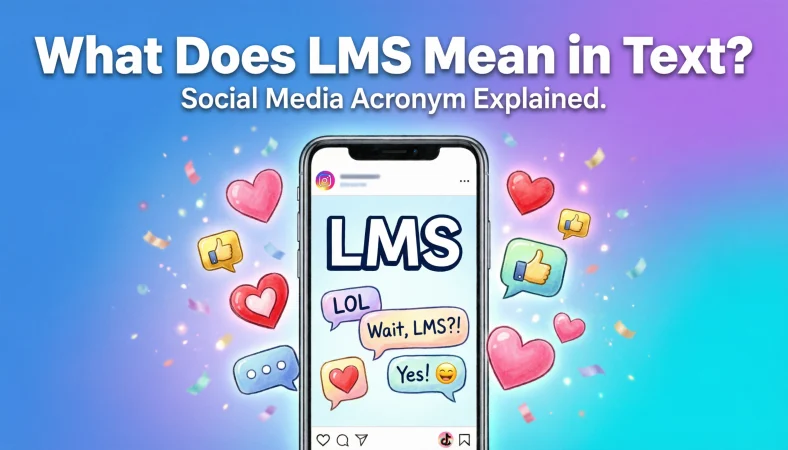
You’re scrolling through Instagram, and someone comments “LMS” on a friend’s selfie. Or you get a text that just says “LMS” with no explanation. What does it even mean? Is it a secret code? A new slang term your kids are using? Or something you’re supposed to respond to?
Welcome to the ever-evolving world of digital communication, where acronyms like LMS pop up everywhere. Whether you’re a parent trying to decode your teenager’s texts, a social media user seeing it in comments, or just someone curious about modern slang, understanding the LMS meaning in text can unlock a whole new level of digital literacy.
In this guide, we’ll break down everything about LMS, what it stands for, how to use it, why it matters, and how to navigate it like a pro. So let’s dive in and decode this popular acronym! 😊
LMS Meaning in Text – A Clear Definition
What Does LMS Mean in Text?
LMS is an acronym that stands for “Like My Status” or “Let Me See” depending on the context. In social media and texting, it’s most commonly used as a call to action asking people to engage with someone’s post or content.
Quick Facts About LMS
| Aspect | Detail |
| Most common meaning | Like My Status |
| Secondary meaning | Let Me See |
| Primary platform | Social media (Facebook, Instagram, Twitter) |
| Tone | Casual, friendly, sometimes playful |
| Generation | Popular with Millennials and Gen Z |
| Purpose | Request for engagement/attention |
At its core, LMS meaning in text is about digital engagement. It’s a quick, efficient way to ask for interaction without typing out a full sentence. Whether you’re seeking validation, starting a conversation, or just having fun, LMS helps you get your message across in three simple letters.
The Origin and Evolution of LMS
Where Did LMS Come From?
The acronym LMS emerged during the golden age of Facebook status updates roughly 2008 to 2012. People would post statuses like “LMS for a rate” or “LMS and I’ll tell you your best feature.” It was a playful way to engage friends and receive feedback, compliments, or funny responses.
The Facebook Era
During this time, Facebook engagement was everything. The more likes, comments, and reactions your status got, the more visible it became. LMS became a shortcut to boost engagement:
- “LMS for a like back” – A digital trade
- “LMS and I’ll rate you” – Fun interaction
- “LMS for a secret” – Exclusive content
Evolution to Other Platforms
As social media expanded, so did LMS. Today, you’ll find it on:
- Instagram – In comments and captions
- TikTok – In video captions
- Twitter/X – In tweets
- Snapchat – In quick chats
- WhatsApp – In status updates
Modern Usage
While originally used mostly on Facebook, LMS has become a cross-platform phenomenon. It now appears in personal messages, group chats, and public posts. The meaning has also expanded slightly, sometimes meaning “Let Me See” when asking to view something specific.
Why LMS Matters in Digital Communication
The Psychology Behind LMS
Understanding LMS meaning in text isn’t just about knowing the definition it’s about understanding why people use it:
Request for Validation
When someone posts “LMS,” they’re often seeking social validation. Likes and engagement provide a dopamine hit and a sense of connection.
Conversation Starter
LMS can be an easy way to start a conversation. It gives people a reason to comment or engage.
Playful Interaction
Many LMS posts are simply for fun lighthearted games between friends.
Attention Seeking
Some use LMS as a subtle (or not-so-subtle) way to ask for attention or compliments.
The Generational Divide
There’s often a gap between generations when it comes to digital slang. Parents see “LMS” and scratch their heads, while teenagers use it without thinking. Understanding LMS meaning in text bridges this communication gap and helps everyone stay connected.
Types of LMS Usage and Their Meanings
Different Contexts for LMS
| Context | Meaning | Example |
| Social media post | Like My Status | “LMS and I’ll tell you your celebrity twin” |
| Personal text | Let Me See | “LMS that picture you mentioned” |
| Group chat | Like My Status | “LMS if you agree with me” |
| Comment section | Like My Status | “LMS for more content like this” |
| Private message | Let Me See | “LMS your outfit before the party” |
Common LMS Variations
LMSR – “Like My Status and Rate”
LMSF – “Like My Status and Follow”
LMSM – “Like My Status for More”
LMSB – “Like My Status Back”
Real-World Examples of LMS Usage
Understanding LMS meaning in text becomes easier with real-world examples:
Friendly and Playful Usage
“Happy Friday, everyone! LMS if you’re ready for the weekend! 🎉”
Neutral and Observational Usage
“I posted my vacation photos. LMS if you want to see more.”
Negative or Dismissive Usage
“Another LMS post for attention? 🙄 Come on, just post your photos normally.”
Flirty Usage
“LMS for a like back and maybe a DM later 😉”
Supportive Usage
“Just started my new business page. LMS to show some love! 💕”
Professional Context
“We’re posting our quarterly results tomorrow. LMS if you want the breakdown.”
Comparison with Related Terms
LMS vs. Like, Comment, Share
| Aspect | LMS | Like/Comment/Share |
| Length | Short (3 letters) | Longer to type |
| Specificity | Asks specifically for likes | Asks for any engagement |
| Tone | Casual, friendly | Can be formal or informal |
| Generation | Millennials/Gen Z | All generations |
LMS vs. LYK (Let You Know)
| Aspect | LMS | LYK |
| Meaning | Like My Status / Let Me See | Let You Know |
| Purpose | Request engagement | Promise to inform |
| Context | Social media | Professional or informational |
LMS vs. LMK (Let Me Know)
| Aspect | LMS | LMK |
| Meaning | Like My Status / Let Me See | Let Me Know |
| Direction | Asking others to engage | Asking others to inform |
| Context | Social media, casual | Professional, casual |
LMS vs. LOL (Laugh Out Loud)
| Aspect | LMS | LOL |
| Type | Request for action | Reaction/emotion |
| Purpose | Engagement | Expressing laughter |
| Popularity | Moderate | Extremely widespread |
LMS vs. SMH (Shaking My Head)
| Aspect | LMS | SMH |
| Meaning | Like My Status / Let Me See | Shaking My Head |
| Tone | Positive/neutral | Negative/disapproval |
| Purpose | Request/curiosity | Disappointment/disbelief |
Alternative Meanings of LMS
While LMS meaning in text is primarily digital slang, the acronym has other interpretations in different contexts:
In Education and Corporate
- Learning Management System – Software for delivering educational courses
- Library Management System – Software for managing library resources
In Business
- Leave Management System – HR software for tracking employee leave
- Lead Management System – CRM tools for managing sales leads
In Healthcare
- Last Menstrual Period – Medical abbreviation for pregnancy dating
- Labor Management System – Hospital workforce management tools
In Logistics
- Logistics Management System – Supply chain management software
Example in Context
“The company needs a new LMS for employee training” – Learning Management System
“My OB/GYN asked about my LMS” – Last Menstrual Period
“She commented LMS on my photo” – Like My Status
Polite and Professional Alternatives
If you want to avoid misunderstandings or sound more professional, consider these alternatives:
For Social Media Requests
- “Show some love!” – Friendly and warm
- “Tap the like button!” – Clear and engaging
- “Drop a like if you agree” – Invitational
- “Enjoyed this? Hit like!” – Encouraging
For Asking to See Something
- “Let me see your…” – Direct and clear
- “Share that with me” – Requesting sharing
- “I’d love to see it” – Expressing interest
- “Would you mind sending that?” – Polite and respectful
Example in Context
Instead of: “LMS this post”
Try: “If you enjoyed this post, please hit the like button!”
Instead of: “LMS your outfit”
Try: “I’d love to see what you’re wearing! 😊”
Visual Guide: How LMS Works
The Flow of an LMS Request
- Person posts something – Photo, status, video
- Adds “LMS” – Usually in caption or comments
- Followers see it – Engaged by the call to action
- They like/comment – Following the request
- Person responds – Usually with promised content
- Cycle continues – More engagement follows
Example Flow
text
[Post: Vacation photo]
Caption: “LMS if you want travel tips! ✈️”
↓ 100 likes later
Response: “Wow! Since so many of you liked it, here’s my top 5 travel hacks…”
Your LMS Toolkit
Tips for Using LMS Effectively
For Posting:
- Be specific – What do you want likes for?
- Follow through – If you promise something, deliver!
- Don’t overuse – Too many LMS posts can annoy followers
- Mix it up – Use other engagement phrases too
- Be authentic – LMS works best when it feels natural
For Responding:
- You don’t have to – It’s optional engagement
- If you like, engage – Support friends’ posts
- Be genuine – Like only if you actually want to
- Watch for scams – Some LMS posts are engagement bait
For Parents/Teachers:
- Understand the culture – LMS is normal among teens
- Monitor usage – Ensure it’s used positively
- Teach balance – Not everything needs digital validation
- Learn the language – Staying current helps you connect
Red Flags to Watch For
- Excessive LMS posts – May indicate insecurity or attention-seeking
- Pressure to engage – No one should feel forced to like
- Promises that don’t deliver – Disappointing followers is bad practice
- Negative LMS posts – “LMS if you hate me” is unhealthy
FAQs
1. What does LMS mean in text?
LMS most commonly means “Like My Status” on social media. It can also mean “Let Me See” in personal text messages when someone wants to view something specific.
2. Is LMS used only on Facebook?
No. While it started on Facebook, LMS is now used across all social media platforms including Instagram, TikTok, Twitter, Snapchat, and WhatsApp.
3. What should I do when someone says LMS?
You can like their post if you want to engage. It’s optional you’re not obligated to respond. If they ask “Let Me See,” you can share whatever they’re asking about.
4. Is LMS the same as LMK?
No. LMS means “Like My Status” or “Let Me See,” while LMK means “Let Me Know.” They serve different purposes in conversation.
5. Is LMS still popular in 2024?
Yes, but its usage has evolved. While not as viral as during the Facebook heyday, LMS remains common in casual social media interactions and among younger generations.
6. Can I use LMS in professional settings?
Generally, no. LMS is informal and may confuse colleagues. Use alternatives like “Please engage” or “Let me know” in professional communication.
7. Is LMS considered annoying?
It can be if overused. Like any call to action, too many LMS posts can feel demanding or attention-seeking. Use it sparingly and authentically.
8. What if I see LMS but don’t understand the context?
Check the post’s caption or comments for clues. If it’s a photo or status, they likely want likes. If it’s a message, they’re probably asking to see something. When in doubt, just ask what they mean!
Conclusion
Understanding LMS meaning in text isn’t just about decoding three letters, it’s about staying connected in our increasingly digital world. Whether you’re a parent trying to understand your teen’s social media habits, a professional navigating workplace messaging, or just someone curious about modern slang, knowing LMS helps you communicate more effectively.
Key Takeaways
- LMS stands for “Like My Status” or “Let Me See”
- Used primarily on social media and in casual texting
- Originated on Facebook during the status update era
- Purpose is to request engagement or ask to view something
- Different contexts mean different interpretations
- Not for professionals – Use alternatives in formal settings
- Positive engagement – When used authentically, it builds connection
Final Advice
Language evolves, and digital slang is no exception. The key is staying informed and using these terms appropriately. Whether you’re posting an LMS or responding to one, remember that true connection happens when communication is genuine, not just when you collect likes.
So go ahead, post that status, engage with your friends, and confidently use LMS when it feels right. Just don’t forget to like back if someone engages with you! 😊
And remember: The best status updates don’t need a call to action; they’re engaging enough on their own. But sometimes, a little “LMS” never hurts to spark a conversation! 💬

Caleb Foster is a professional content creator at RepllyNova.com, recognized for producing clear, engaging and insightful articles. He is committed to making complex topics understandable, interesting and accessible for all audiences.