
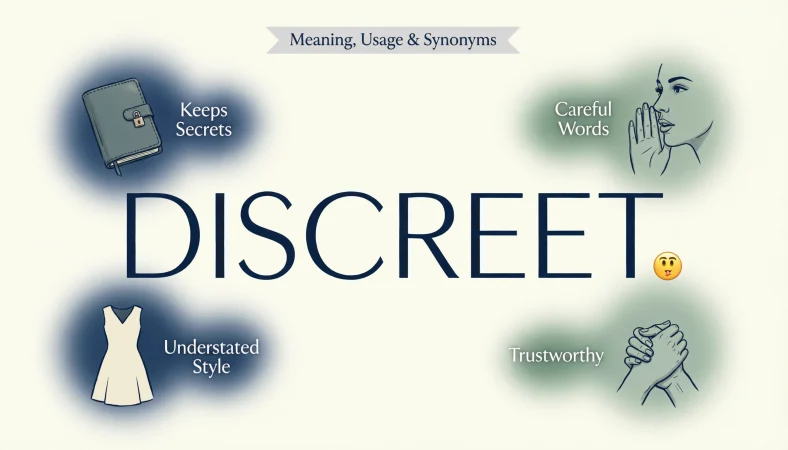
Discreet (adjective) means careful, cautious, and prudent in one’s speech or actions, especially to avoid causing offense, embarrassment, or revealing confidential information. A discreet person knows when to speak, when to listen, and when to maintain silence with grace and good judgment.
Have you ever heard someone described as discreet and wondered what it really means? This common English word often appears in conversations about privacy, professionalism, and good judgment. Because it sounds almost identical to discrete, many people confuse the two, even though they have completely different meanings.
Discreet means careful, tactful, and respectful of privacy or confidential information. A discreet person knows when to keep sensitive matters private and how to act with good judgment in personal and professional situations. The word is commonly used to describe people, services, or actions that avoid drawing unnecessary attention. In this guide, you’ll learn the meaning of discreet, how to use it correctly, common examples, and the difference between discreet and discrete so you can use the term with confidence.
Discreet Meaning
Breaking Down the Core Meaning
| Aspect | What Discreet Means |
| Speech | You don’t blurt out private information or gossip |
| Actions | You behave in a way that doesn’t draw unnecessary attention |
| Judgment | You know what’s appropriate in different social situations |
| Trustworthiness | People can confide in you without fear of betrayal |
| Tact | You deliver difficult news or opinions with kindness |
The Emotional Intelligence Connection
Here’s something interesting: discretion is actually a form of emotional intelligence. It requires:
- Self-awareness – Knowing your own tendencies and biases
- Social awareness – Reading the room and understanding others’ feelings
- Self-regulation – Controlling impulses to speak or act rashly
- Empathy – Understanding how your words might affect others
In other words, discretion isn’t just about keeping secrets it’s about being a thoughtful, considerate human being.
The Origin, Evolution, and Cultural Significance of “Discreet”
Where Did “Discreet” Come From?
The word “discreet” has a fascinating journey through history. It comes from the Old French word discret, which in turn came from the Latin word discretus, meaning “separated” or “distinguished.” The Latin root is discernere, which means “to discern” or “to separate.”
Here’s the beautiful irony: in its earliest usage, “discreet” was actually connected to the idea of being able to distinguish between things to separate truth from falsehood, wisdom from foolishness, what to say from what to keep private.
Over time, the meaning narrowed and refined itself into what we recognize today: the quality of being careful, prudent, and tactful.
The Evolution Through the Ages
| Era | How “Discreet” Was Used |
| Latin/Roman | Connected to discernment and the ability to separate truth from falsehood |
| Middle Ages | Associated with wisdom, prudence, and good judgment |
| Renaissance | A desirable quality in courtiers, diplomats, and trusted advisors |
| Victorian Era | Deeply connected to propriety, social grace, and “keeping up appearances” |
| Modern Day | Valued for emotional intelligence, trustworthiness, and social awareness |
Why Discretion Matters in Modern Times
In our hyper-connected, social-media-obsessed world, discretion has become more valuable and rarer than ever before.
- Social media culture encourages oversharing, making discreet people stand out as refreshingly thoughtful.
- Cancel culture means one careless comment can ruin a reputation, making discretion a survival skill.
- Workplace dynamics demand professionalism and confidentiality, where discretion is essential for career success.
- Mental health awareness has taught us that not everything needs to be broadcast; privacy is healthy.
Real-World Usage – How “Discreet” Shows Up in Daily Life
In Personal Relationships
This is where discretion matters most. Your friends, family, and romantic partners need to know they can trust you with their vulnerabilities.
Examples:
- “She’s the most discreet person I know. I’ve never heard her gossip about anyone.”
- “When my friend told me about her divorce, I was discreet and never mentioned it to mutual friends.”
- “He was incredibly discreet about our relationship until we were ready to go public.”
In Professional Settings
Workplaces are minefields of sensitive information. Discretion here can make or break your career.
Examples:
- “The HR manager was discreet when handling the employee complaints.”
- “My assistant is wonderfully discreet; she never discusses confidential matters.”
- “During the merger negotiations, both sides were extremely discreet about the details.”
In Everyday Social Situations
Even casual interactions call for discretion from time to time.
Examples:
- “When Sarah started crying at the party, I was discreet and guided her quietly to a private room.”
- “He made a discreet exit from the awkward conversation.”
- “The waiter was discreet when our friend was having an embarrassing moment.”
In Fashion and Appearance
“Discreet” can also describe clothing, jewelry, or overall style that is understated and not flashy.
Examples:
- “She wore a discreet black dress to the funeral.”
- “His watch was discreet, no flashy diamonds, just classic elegance.”
- “They entered through a discreet entrance to avoid the paparazzi.”
In Product Descriptions
You’ll often see “discreet” used in marketing for products that require privacy.
Examples:
- “Our discreet packaging ensures your order arrives without anyone knowing what’s inside.”
- “This discreet hearing aid is virtually invisible.”
- The discreet security camera blends perfectly into your home décor.
Examples of “Discreet” in Action – With Tone and Context
Let’s explore how “discreet” works in real sentences across different tones and situations.
Professional / Formal Tone 🤵
Example:
“The board members appreciated the CEO’s discreet handling of the financial irregularities, which allowed the company to address the issues internally without public scandal.”
Analysis: Professional discretion protects the organization’s reputation while still addressing problems. This is leadership done right.
Friendly / Supportive Tone 💛
Example:
“Thank you for being so discreet about my panic attack at the wedding. You didn’t make a scene, you just quietly got me some water and helped me find a quiet corner. I’ll never forget that kindness.”
Analysis: Discretion in moments of vulnerability is one of the purest forms of friendship. This person is showing gratitude for emotional support delivered with grace.
Slightly Cautionary Tone ⚠️
Example:
Look, I’m not saying you can’t tell anyone. Just be discreet about it. Not everyone needs to know the details, you know?
Analysis: A gentle reminder that oversharing might have consequences. The speaker is asking for consideration, not absolute secrecy.
Self-Reflective / Humble Tone 😌
Example:
“I’m trying to be more discreet this year. I realized I’ve been oversharing on social media and in conversations, and I want to be someone people can trust with sensitive information.
Analysis: Self-awareness and a desire to grow. This person recognizes that discretion is a skill worth developing.
Comparison with Similar Terms – Discreet vs. Discrete
This is the big one. The confusion between “discreet” and “discrete” is one of the most common spelling mistakes in the English language. Let’s clear it up once and for all.
Discreet vs. Discrete – The Ultimate Comparison
| Aspect | Discreet | Discrete |
| Meaning | Careful, prudent, tactful | Separate, distinct, individual |
| Part of Speech | Adjective | Adjective |
| Pronunciation | /dɪˈskriːt/ (same as discrete) | /dɪˈskriːt/ (same as discreet) |
| Common Usage | Describing a person, action, or behavior | Describing separate items, categories, or concepts |
| Example | “She was discreet about the surprise party.” | “The data was broken into discrete categories.” |
| Memory Trick | Discreet = “ee” for “eyes” (seeing when to be careful) | Discrete = “ete” for “separate” (thinking of “separate” having an “e”) |
How to Remember the Difference
Here’s a foolproof memory trick that actually works:
- Discreet has two “e’s” side by side (d-i-s-c-r-e-e-t). Think of them as two eyes watching carefully, being cautious.
- Discrete has an “e” and then another “e” separated by the “t” (d-i-s-c-r-e-t-e). Think of the es being separated, like the meaning of the word itself separate and distinct.
Another way to remember:
- Discreet = Being careful with your words (a personal quality)
- Discrete = Things that are separate and distinct (a mathematical/scientific quality)
Common Mistakes to Avoid
❌ Wrong: “Please be discrete about my personal information.”
✅ Right: “Please be discreet about my personal information.”
❌ Wrong: “The computer processes data in discreet chunks.”
✅ Right: “The computer processes data in discrete chunks.”
Comparison with Other Related Terms
Let’s see how “discreet” compares with other similar concepts.
| Term | Meaning | Key Difference from “Discreet” |
| Discreet | Careful, prudent, tactful | The focus is on wisdom and judgment |
| Secretive | Hiding things intentionally | Secretive implies deception; discreet implies wisdom |
| Tactful | Sensitive to others’ feelings | More narrowly focused on communication style |
| Prudent | Acting with good judgment | Broader term; discretion is a type of prudence |
| Confidential | Intended to be kept secret | Describes information, not a person’s quality |
| Subtle | Understated, not obvious | More about appearance than behavior |
| Cautious | Careful to avoid danger | Discreet is more about social awareness |
Alternate Meanings of “Discreet” – Brief Mention
While our focus is on the primary meaning, there are a few specialized contexts where “discreet” takes on slightly different shades.
In Legal and Professional Contexts
“Discreet” can refer to handling sensitive legal, financial, or corporate matters with care and confidentiality. A “discreet lawyer” is one who doesn’t leak information and manages client affairs with maximum privacy.
In Fashion and Design
“Discreet” describes clothing, accessories, or design elements that are understated, minimalist, and not flashy. A “discreet logo” means one that doesn’t scream for attention.
In Healthcare and Medicine
Discretion is crucial in healthcare discreet doctors, nurses, and receptionists handle patients’ personal health information with sensitivity and confidentiality.
Polite Alternatives and Synonyms for “Discreet”
If you want to express similar ideas without using the exact word “discreet” (or if you’re writing and want to avoid repetition), here are excellent alternatives for different contexts.
Professional and Formal Alternatives
| Situation | Instead of “Discreet” | Try This |
| Describing a trustworthy person | “She’s discreet” | “She’s someone I can trust with sensitive information” |
| Handling a delicate situation | “Be discreet” | “Please handle this with sensitivity” |
| Describing a confidential conversation | “A discreet discussion” | “A confidential discussion” |
| Describing a low-key action | “A discreet approach” | “A thoughtful, measured approach” |
| Professional reference | “He’s discreet” | “He exercises excellent judgment in sensitive matters” |
Casual and Everyday Alternatives
- “Low-key” – “She was low-key about the whole thing.”
- “Cool” – “He was cool about it and didn’t tell anyone.”
- Classy” – “That was a classy way to handle the situation.”
- “Under the radar” – “They kept it under the radar.”
- “Mum” – “She stayed mum about the details.”
- “On the down-low” – “Keep it on the down-low, okay?”
When “Discreet” Is the Best Choice
There are times when no other word quite captures the full meaning:
- Recommending someone for a sensitive role – “We need someone discreet for this position.”
- Describing a person’s overall character – “She’s one of the most discreet people I know.”
- In professional reference letters – “I can confidently say that John is a discreet and trustworthy individual.”
- When you mean the full package – Careful, tactful, and trustworthy combined.
Example Table – “Discreet” in Different Life Contexts
| Context | Example Sentence | Why Discreet Works Here |
| Friendship | “When I told her about my health scare, she was incredibly discreet and never mentioned it to anyone.” | Trust and confidentiality are the foundation of this friendship. |
| Workplace | “The HR manager was discreet during the investigation, protecting everyone’s dignity.” | Professional discretion prevents workplace drama and protects reputations. |
| Romantic Relationship | “We were discreet about dating until we were both ready to tell our families.” | Privacy and timing matter in relationships. |
| Social Etiquette | “He made a discreet exit from the awkward conversation.” | Graceful withdrawal from uncomfortable situations. |
| Travel | “We booked a discreet boutique hotel away from the tourist crowds.” | Privacy and exclusivity are valued. |
| Shopping | “The store offers discreet packaging for all orders.” | Customer privacy is respected. |
| Fashion | “Her outfit was elegant and discreet nothing too flashy.” | Understated elegance over loud attention-seeking. |
| Healthcare | “The discreet receptionist ushered me to a private waiting area.” | Patient privacy and dignity are prioritized. |
FAQs
1. What does a branded title mean?
A branded title means a vehicle’s history includes significant damage, repair, or legal issues that have been permanently recorded on its title by a state DMV or insurance company.
2. Can you fix a branded title?
You can repair the vehicle, but the brand itself never goes away. It remains permanently on the title to alert future buyers about its history.
3. Is a rebuilt title the same as a branded title?
No. A rebuilt title is a type of branded title. “Branded title” is the umbrella term, while “rebuilt” is one specific brand indicating the vehicle was salvaged and repaired.
4. Will insurance cover a branded title car?
Some companies will, but many charge higher premiums or refuse coverage entirely. Always check with your insurer before purchasing.
5. Can a dealership sell a car with a branded title?
Yes, but they must legally disclose the brand to buyers. Failing to do so is fraud.
6. How much cheaper is a branded title car?
Expect 20-60% less than similar clean-title vehicles. The exact discount depends on the brand type and damage severity.
7. Can I finance a branded title vehicle?
Most traditional lenders won’t finance them. Some specialty lenders do, but expect higher interest rates.
8. What’s the worst type of branded title?
Flood titles are often considered the worst because water damage can create permanent, unpredictable electrical problems that are expensive to fix.
Conclusion
Understanding the discreet meaning can help you communicate more clearly and choose the right word in different situations. Discreet describes someone or something that is careful, tactful, and respectful of privacy or sensitive information. It is often used to describe people who handle matters with good judgment and confidentiality.
Remember not to confuse discreet with discrete, which means separate or distinct. By learning the definition, common examples, and correct usage, you’ll be able to use discreet confidently in both everyday conversations and professional writing.

Caleb Foster is a professional content creator at RepllyNova.com, recognized for producing clear, engaging and insightful articles. He is committed to making complex topics understandable, interesting and accessible for all audiences.