
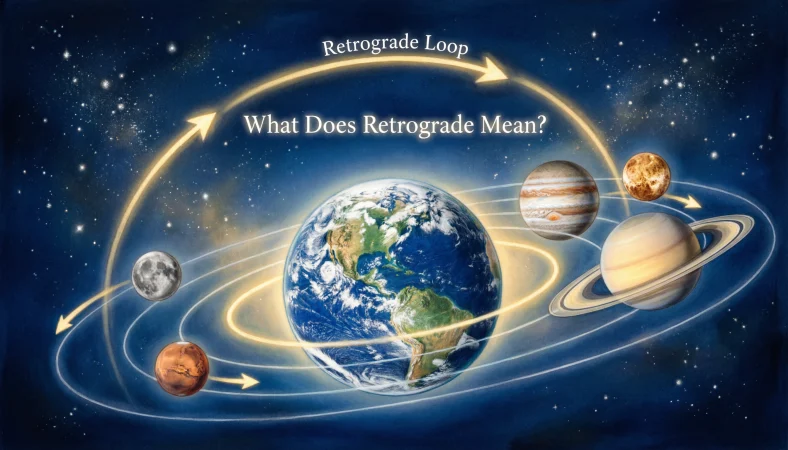

Retrograde (adjective): In astronomy, the apparent backward movement of a planet when observed from Earth, caused by the relative speeds of Earth and the planet in their orbits around the Sun. In astrology, a period when a planet’s apparent backward motion is believed to influence human affairs, communication, technology, and personal growth.
Have you ever heard someone say, “Mercury is in retrograde,” or come across the word retrograde in a science article and wondered what it actually means? Although the term is commonly associated with astrology, it has broader meanings in astronomy, medicine, and everyday language. Understanding the context is the key to interpreting the word correctly.
At its core, retrograde means moving backward or appearing to move backward. In astronomy, it describes the apparent backward motion of a planet as seen from Earth. In astrology, retrograde periods are believed by some to influence communication, relationships, or decision-making, though these beliefs are not supported by scientific evidence. The word can also describe regression or movement in the opposite direction in medical and general contexts. In this guide, you’ll learn the different meanings of retrograde, where the term comes from, and how it is used across various fields.
The Origin and History of Retrograde Understanding
Ancient Observations and Interpretations
Long before telescopes and modern astronomy, ancient civilizations noticed the strange behavior of planets in the night sky. Unlike fixed stars, planets from the Greek word planetes, meaning “wanderers” seemed to move erratically. They’d travel eastward, stop, move westward (retrograde), stop again, and resume eastward motion.
The Babylonians, Greeks, and Egyptians were among the first to document these planetary movements. They noticed that when planets went retrograde, something felt different on Earth. This observation eventually evolved into the astrological interpretations we know today.
Ptolemy’s Geocentric Model
The famous Greek astronomer Ptolemy developed a complex system to explain retrograde motion in his geocentric model, where Earth sat at the universe’s center. He proposed that planets moved in smaller circles (epicycles) while orbiting Earth. This explained why planets appeared to loop backward they were literally making loops in his model.
Although we now know Earth isn’t the center of the universe, Ptolemy’s work preserved ancient knowledge about retrograde patterns. His calculations remain remarkably accurate for predicting planetary positions.
Copernicus and the Modern Understanding
Nicolaus Copernicus revolutionized our understanding in the 16th century by placing the Sun at the center of the solar system. With this heliocentric model, the retrograde mystery solved itself: retrograde occurs when Earth, moving faster in its inner orbit, “laps” an outer planet like passing a slower car on the highway.
This scientific explanation didn’t diminish the cultural and astrological significance of retrograde periods. Instead, it deepened our appreciation for the cosmic dance between planets and our perspective as Earth-bound observers.
Why Retrograde Matters in Astrology
The Astrological Perspective
In astrology, the retrograde meaning shifts from a simple astronomical observation to a period of introspection, review, and reassessment. When a planet appears to move backward, its associated energies are believed to turn inward, creating opportunities for reflection and growth.
What Happens During Retrograde?
Astrologers suggest that when a planet goes retrograde, its themes become more internalized:
- Mercury retrograde – Communication, technology, travel, and contracts
- Venus retrograde – Love, relationships, beauty, and values
- Mars retrograde – Energy, action, ambition, and sexuality
- Jupiter retrograde – Expansion, luck, and personal growth
- Saturn retrograde – Responsibility, discipline, and boundaries
Each planetary retrograde offers a unique opportunity to examine different aspects of your life. Rather than fearing retrograde periods, many astrologers recommend embracing them as valuable times for reflection.
Common Symptoms of Retrograde Periods
People often report experiencing:
- Communication breakdowns – Misunderstandings, lost emails, or delayed messages
- Technology glitches – Devices acting up, files disappearing, or internet issues
- Travel delays – Flights getting canceled, traffic jams, or lost luggage
- Relationship tension – Revisiting old conflicts or unresolved issues
- Self-reflection – Increased introspection and internal processing
While these experiences vary by person and situation, they’ve contributed to the widespread belief that retrograde periods, especially Mercury retrograde, bring chaos or confusion.
Types of Retrograde and Their Meanings
Apparent vs. Actual Retrograde
It’s essential to distinguish between apparent retrograde (the optical illusion) and actual retrograde motion:
Apparent Retrograde
- Occurs from Earth’s perspective
- An optical illusion caused by different orbital speeds
- Affects all outer planets periodically
Actual Retrograde
- Planets physically moving backward in their orbits
- Extremely rare in our solar system
- Venus and Uranus have unusual axial rotations (retrograde rotation)
Outer Planets and Their Retrograde Effects
While all planets experience retrograde periods, they differ significantly in duration and frequency:
| Planet | Retrograde Frequency | Typical Duration | Key Themes |
| Mercury | 3-4 times per year | ~3 weeks | Communication, tech, travel |
| Venus | Every 18 months | ~40 days | Love, relationships, beauty |
| Mars | Every 26 months | ~2.5 months | Action, motivation, sexuality |
| Jupiter | Annual | ~4 months | Growth, luck, education |
| Saturn | Annual | ~4.5 months | Structure, responsibility, karma |
| Uranus | Annual | ~5 months | Change, innovation, freedom |
| Neptune | Annual | ~5 months | Dreams, intuition, spirituality |
| Pluto | Annual | ~5 months | Transformation, power, shadows |
Mercury Retrograde: The Most Famous
Mercury retrograde dominates popular culture because it happens most frequently and affects daily life most directly. Mercury rules communication, information, technology, and short-distance travel areas we engage with constantly.
What to do during Mercury retrograde:
- Back up your files and data
- Review contracts before signing
- Double-check travel arrangements
- Practice patience in communication
- Avoid making major purchases
- Reflect on past decisions
Real-World Examples of Retrograde Usage
Understanding retrograde meaning becomes easier with concrete examples. Here are some ways the term appears in everyday conversations:
Friendly and Informative Usage
“I’ve been thinking about our conversation from last week, and I want to clarify what I meant. Sometimes I feel like I’m in a personal retrograde when I miscommunicate. Let me try again.”
Neutral and Observational Usage
The science teacher explained that Mars appears retrograde about every 26 months, which makes it look like it’s moving backward from our perspective here on Earth.
Negative or Dismissive Usage
“You’re telling me the project got delayed again? Of course it did it’s Mercury retrograde, so I shouldn’t have expected smooth sailing. 🙄”
Pop Culture Reference
“My ex texted me out of nowhere. Must be Venus retrograde stirring up old feelings again. 😅”
Professional/Astrological Context
“During Saturn retrograde, we recommend reviewing your long-term goals and reassessing your commitments before pushing forward with new initiatives.”
Comparison with Related Terms
Understanding retrograde meaning alongside similar concepts helps clarify its unique position:
Retrograde vs. Direct
| Aspect | Retrograde | Direct (Prograde) |
| Direction | Appears backward | Appears forward |
| Energy | Internal, reflective | External, active |
| Action | Review, revise | Initiate, execute |
| Best for | Planning, reassessing | Starting new projects |
Retrograde vs. Station
When a planet prepares to shift direction, it appears to “stand still” in the sky this is called being stationary. These moments often feel intense because the planet’s energy is at its most concentrated point.
Retrograde vs. Shadow Period
The shadow period refers to the time before and after retrograde when the planet moves through the same degrees it will later retrace. Many astrologers believe these periods also carry significant influence, creating a “pre-retrograde” or “post-retrograde” effect.
Retrograde vs. Reversal
In general usage, “reversal” refers to any backward movement, while “retrograde” specifically applies to planetary or celestial motion. However, the terms sometimes overlap when describing personal or professional setbacks.
Alternative Meanings and Uses
While retrograde meaning primarily relates to celestial motion, the term has other interesting applications:
In Sociology and Cultural Studies
“Retrograde” can describe social or cultural backsliding returning to outdated attitudes or practices. For example: “Some view the recent policy changes as a retrograde step for civil rights.”
In Music
In music theory, “retrograde” refers to a technique where a melody or musical phrase is played backward. Composers use this technique to create interesting variations on themes.
In Psychology
The term occasionally appears in psychological contexts to describe revisiting past behaviors or thought patterns: “His emotional retrograde to childhood coping mechanisms was concerning.”
In Medicine
Some medical contexts use “retrograde” to describe backward flow or movement, such as retrograde amnesia (loss of memories before a trauma) or retrograde ejaculation.
Polite and Professional Alternatives
Depending on the context, you might want softer or more professional alternatives to “retrograde”:
For Astrological Contexts
- Reflective period – Emphasizes introspection
- Review phase – Highlights reassessment
- Cycle of reassessment – Focuses on evaluation
For Personal Situations
- Taking a step back – Casual and neutral
- Pausing to reflect – Suggests intentional reconsideration
- Reevaluating – Professional and precise
For Professional Settings
- Period of assessment – Business-appropriate
- Strategic review phase – Emphasizes planning
- Evaluation window – Clear and professional
Example in Context
Instead of: “We can’t launch during Mercury retrograde.”
Try: “We’re entering a review period, so let’s ensure our launch materials are thoroughly evaluated before proceeding.”
A Visual Guide to Retrograde Motion
Understanding the Retrograde Illusion
To understand retrograde meaning visually, imagine two cars on a circular racetrack:
- Car A (Earth) is on the inner lane
- Car B (Mars/outer planet) is on the outer lane
- Both travel counterclockwise at different speeds
When Car A passes Car B on the inside:
- Car B appears to move backward from Car A’s perspective
- This backward illusion continues until Car A moves far enough ahead
- Car B then appears to resume forward motion
This simple analogy explains why planets appear to loop backward in the night sky it’s entirely based on our changing viewpoint as Earth moves faster in its orbit.
Your Retrograde Survival Toolkit
Practical Tips for Navigating Retrograde Periods
Whether you’re a believer in astrology or simply curious, these practical strategies can help during retrograde periods:
Communication:
- Pause before responding to potentially explosive messages
- Clarify instructions to avoid misunderstandings
- Listen more than you speak
- Avoid making assumptions
Technology:
- Back up important documents and photos
- Save work frequently
- Update passwords
- Avoid buying new electronics if possible
Travel:
- Book flexible travel arrangements
- Allow extra time for delays
- Confirm reservations
- Pack backup plans
Relationships:
- Be patient with yourself and others
- Avoid starting heated arguments
- Revisit old issues constructively
- Practice forgiveness
Major Decisions:
- Wait before signing contracts
- Gather more information
- Consult trusted advisors
- Sleep on important decisions
FAQs
1. What does retrograde mean in astrology?
In astrology, retrograde refers to the period when a planet appears to move backward in the sky from Earth’s perspective. Astrologers believe this backward motion turns the planet’s energy inward, creating opportunities for reflection, review, and reassessment in areas governed by that planet.
2. Does Mercury retrograde really affect us?
While there’s no scientific proof that Mercury retrograde affects human affairs, many people report increased communication breakdowns, technology glitches, and travel delays during these periods. Whether it’s a genuine cosmic effect or heightened awareness, being prepared can help reduce stress.
3. What should I avoid during Mercury retrograde?
Common recommendations include: signing important contracts, buying electronics or vehicles, starting new projects or relationships, and making major life decisions. Instead, focus on reviewing past decisions, completing existing projects, and practicing patience.
4. How often does Mercury go retrograde?
Mercury goes retrograde three to four times each year, with each period lasting approximately three weeks. The shadow periods before and after extend the influence for several additional weeks.
5. Are all planetary retrogrades the same?
No. Each planet has different retrograde frequencies and durations. Mercury is retrograde most frequently, while Venus and Mars have longer gaps between retrograde periods. Each planet’s retrograde also emphasizes different life areas.
6. How does retrograde affect my zodiac sign?
Retrograde effects vary based on where the retrograde planet falls in your personal birth chart. Signs ruled by the retrograde planet may feel the effects more strongly, while the house placement indicates which life areas are affected.
7. What’s the difference between retrograde and direct motion?
Direct motion (prograde) is the normal forward movement of planets across the sky. Retrograde is the apparent backward movement caused by differences in orbital speed. Planets typically spend most of their time in direct motion.
8. Why do some people fear retrograde periods?
Cultural memes and social media have exaggerated retrograde periods, particularly Mercury retrograde, as times of chaos and misfortune. While challenges may arise, many astrologers view retrograde as valuable periods for growth and reassessment rather than fear.
Conclusion
Understanding retrograde meaning goes far beyond the astrological hype or astronomical definition. It’s a reminder that perspective shapes reality; what appears as backward motion is simply a different view of forward progress.
Whether you’re a die-hard astrology enthusiast, a curious skeptic, or someone who just wants to understand why your phone keeps glitching, retrograde periods offer meaningful opportunities:
- Review your choices and patterns
- Reflect on what’s working and what isn’t
- Reconnect with past insights and unfinished business
- Revise plans that need adjustment
- Reclaim energy you’ve been spreading too thin
The next time someone mentions Mercury retrograde, you can smile knowing the full picture the celestial dance that creates this illusion, the ancient wisdom behind the interpretation, and the practical wisdom to navigate it gracefully.
Key Takeaways
- Retrograde means an apparent backward motion of planets from Earth’s perspective
- The phenomenon is an optical illusion caused by different orbital speeds
- Retrograde meaning in astrology emphasizes introspection and review
- Mercury retrograde is the most discussed and frequent (3-4 times yearly)
- Each planet’s retrograde affects different life areas
- Practical preparation can ease any challenges during retrograde periods
- View retrograde as an opportunity, not an obstacle