
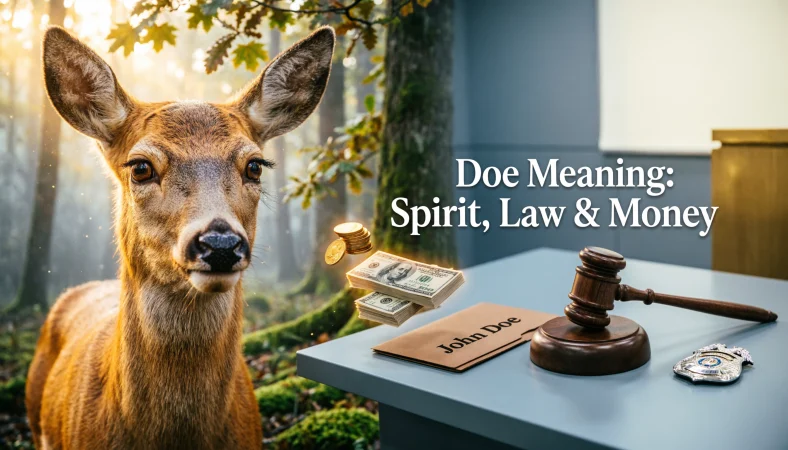
The meaning of “doe” primarily refers to an adult female deer, but it also extends to female animals of other species, including rabbits, kangaroos, and rats. In legal terminology, “John Doe” (or “Jane Doe”) is a placeholder name used for unidentified individuals, protecting their anonymity. Additionally, in slang and informal English, “doe” is a homophone for “dough,” which means money or cash.
Have you ever heard the word “doe” and immediately pictured a graceful deer in a sun-dappled forest, only to realize the person speaking was actually talking about a court case or money? You’re not alone. The word “doe” is a fascinating linguistic chameleon; it slips effortlessly between the worlds of wildlife, law, spirituality, and everyday slang. Whether you’re a nature enthusiast, a true-crime fanatic, or someone who just overheard a strange conversation and got curious, you’ve come to the right place.
Today, we are going to unpack the complete doe meaning, exploring everything from the gentle symbolism of the female deer to the anonymous placeholder in the courtroom and even the cheeky slang for cash. By the end of this article, you’ll never look at this three-letter word the same way again.
The Origin and Evolution of the Word “Doe”
Etymological Roots
To truly understand the doe meaning, we have to take a quick trip back in time. The word traces its origins to the Old English term dā or dāge, which referred specifically to a female fallow deer. This, in turn, has deeper Proto-Germanic roots, connecting it to similar words in Old Norse (dáinn) and Old High German (tēo). For centuries, it was purely a zoological term used by hunters and farmers.
The Shift into Legal Jargon
How did a deer become a legal placeholder? The story is fascinating. The term “John Doe” originated in English legal history, specifically during the reign of King Edward III, in the 14th century. It was used in fictitious lawsuits called “ejectment” cases disputes over land ownership. To protect the actual tenants involved, lawyers used the fictional names “John Doe” (the tenant) and “Richard Roe” (the person who ousted him). Over time, “John Doe” stuck and became the standard term for an unidentified male person in legal, medical, and police contexts. The feminine version, “Jane Doe,” followed suit in the 20th century.
The Slang Connection (Dough)
Then came the slang. While “doe” and “dough” are spelled differently, they sound exactly the same. The slang use of “dough” for money dates back to the mid-19th century, likely originating from the idea that bread (dough) was a basic necessity of life, and thus, by extension, a synonym for sustenance and wealth. Because people love wordplay, you’ll frequently see “doe” used in casual text messages, song lyrics, and social media posts to mean “cash,” especially because it looks cooler or more unique than the standard spelling.
Real-World Usage and Modern Interpretations
In today’s world, the doe meaning shifts entirely based on the context. If you’re hiking, it’s about wildlife. If you’re watching the news, it’s about crime. If you’re listening to a hip-hop track, it’s about money.
Here is a quick breakdown of how it’s used in everyday life:
| Context | Interpretation | Example Sentence |
| Wildlife/Nature | A female deer, rabbit, or kangaroo | “Look at that doe grazing at the edge of the woods with her fawn.” |
| Legal/Police | An unidentified person (John/Jane Doe) | “The hospital is treating a Jane Doe who was found in the park this morning.” |
| Slang/Money | Cash, currency, or wealth | “He’s just chasing the doe; he doesn’t care about the art.” |
| Spiritual/Symbolic | Gentleness, intuition, and nurturing energy | “Seeing a doe in your dreams often symbolizes a need for self-care.” |
Examples with Different Tones
Neutral/Informational Tone:
“In zoological terms, the word doe specifically denotes the female of the species, most commonly associated with deer. It is a standard biological classification used by wildlife agencies globally.”
Friendly/Conversational Tone:
“So, you saw a doe in your backyard this morning? That’s so cool! 🦌 In a lot of cultures, that’s considered a massive sign of good luck and gentleness coming your way.”
Playful/Humorous Tone:
“I’m just trying to stack up that doe so I can finally afford those concert tickets! 💸 Who needs a deer when you’ve got a paycheck, right?”
Dismissive/Skeptical Tone (about spiritual meanings):
While some people insist that a doe sighting is a divine message, the more logical explanation is that they just live near a forest. But hey, if it makes your day better, go with the universe thing!”
Doe vs. Buck vs. Fawn vs. Hind: A Detailed Comparison
To master the doe meaning, you have to understand how it fits into the larger family of deer terminology. Many people confuse these terms, so here is a clear comparison table to clear things up:
| Term | Meaning | Gender | Age | Species Specificity |
| Doe | Female deer, rabbit, or kangaroo | Female | Adult | Broad |
| Buck | Male deer, rabbit, or antelope | Male | Adult | Broad |
| Fawn | A baby deer (under one year old) | Neutral | Young | Broad |
| Hind | Female deer (specifically Red Deer) | Female | Adult | Specific |
| Stag | Male Red Deer (or a castrated male) | Male | Adult | Specific |
| John Doe | Unidentified male person | Male | Adult | Legal/Human |
The Complete Animal Terminology Dictionary
- Male Deer: Buck or Stag (depending on the species)
- Female Deer: Doe or Hind (depending on the species)
- Baby Deer: Fawn
- Group of Deer: Herd
- Male Rabbit: Buck
- Female Rabbit: Doe
- Baby Rabbit: Kit or Kitten
Spiritual and Symbolic Significance of the Doe
Beyond the dictionary definition, the doe meaning carries profound spiritual and symbolic weight. If you’ve been seeing does frequently, or if one has crossed your path, it might not just be a coincidence.
What Does a Doe Symbolize?
- Gentleness and Grace: Does move through the forest with quiet poise. Spiritually, seeing a doe is often a reminder to navigate your current situation with grace and compassion, rather than aggression.
- Intuition and Awakening: In many Native American traditions, the deer is a messenger of sensitivity. The doe encourages you to trust your instincts and listen to the subtle whispers of your heart.
- Motherhood and Nurturing: As the primary caregivers for fawns, does represent maternal love, protection, and the nurturing of new ideas. It might be a sign to care for a project or a person in your life.
- New Beginnings: Because the doe is often associated with the spring season (when fawns are born), it signifies new life, fresh starts, and clearing out the old.
Cultural Comparisons
- Celtic Mythology: The doe was often associated with the Otherworld and was considered a guide to the fairy realm. Seeing a white doe was considered an omen that something magical was about to happen.
- Christianity: The deer is mentioned multiple times in the Bible (e.g., “As the deer pants for streams of water”). The doe represents spiritual longing and the soul’s thirst for the divine.
Legal and Slang Interpretations (The “Other” Doe Meanings)
John/Jane Doe: The Unidentified Person
This is arguably the second most common use of the word. When police find an individual who cannot identify themselves whether due to injury, memory loss, or death they are assigned the placeholder name “John Doe” (male) or “Jane Doe” (female). This protects their real identity until it can be confirmed and is used in:
- Missing persons cases
- Hospital admissions (unconscious patients)
- Forensic files (unidentified remains)
- Lawsuits (where the plaintiff wishes to remain anonymous, e.g., sexual assault cases)
The Slang Connection: Money Matters
In pop culture, especially in hip-hop and urban slang, “doe” (from dough) means money.
- “He’s got a lot of doe stacked up.”
- “I need to make that doe.”
If you’re texting a friend, using “doe” instead of “dough” adds a playful, street-smart vibe to the conversation.
Alternate Meanings and Abbreviations
Did you know “DOE” is also an acronym? In certain professional circles, the doe meaning shifts entirely to a government agency or concept:
- Department of Energy (DOE): In the United States, the DOE is a cabinet-level department of the federal government responsible for energy policy and nuclear safety.
- Design of Experiments (DOE): A statistical methodology used in scientific research and engineering to determine the effects of multiple variables.
- Date of Entry (DOE): Used in immigration and travel documentation.
- Department of Education (sometimes shortened to DOE, though ED is more common): Used in state-level government contexts.
Polite and Professional Alternatives
If you are in a professional or formal setting and want to avoid the ambiguity of “doe,” consider these alternatives:
For Wildlife Contexts
- Female deer
- Adult female deer
- The hind (if specifying Red Deer)
- Breeding female (in zoological studies)
For Legal Contexts
- Unidentified individual or Unnamed person
- Anonymity placeholder
- The victim/patient
For Money Contexts
- Cash or Currency
- Income or Revenue
- Capital or Funds
Pro Tip: If you are writing a legal document, never use the word “doe” unless you are explicitly using the “John Doe” placeholder, as “female deer” is unprofessional. Conversely, in a formal scientific paper, avoid using “doe” as slang for money!
How to Respond When Someone Mentions a “Doe”
Because of the multiple meanings, don’t just assume! Here is how to navigate the conversation gracefully:
If Someone Points out a Wild Animal:
“Oh, look at that beautiful doe!”
- Reply: “Wow, she’s gorgeous! I wonder where her fawn is.”
If Someone Mentions “John Doe” in a News Story:
“The police are still trying to identify the John Doe.”
- Reply: “That’s so sad. I hope they find his family soon.”
If a Friend says: “I need to get that doe!
- Reply: “Don’t we all! Are you picking up extra shifts?” (Clarifies that you understand the money context).
For the Spiritual Enthusiast:
“I saw a doe in my dream last night.”
- Reply: “I’ve heard that means you need to stop being so hard on yourself and practice some self-care!”
Labeled Example Table: Contextual Usage of “Doe”
| Context Label | Sentence | Meaning Derived |
| Zoology | “The hunting season for doe begins in November.” | Refers to female deer (wildlife management). |
| True Crime | “The unidentified body was listed as a Jane Doe.” | Refers to an unknown female person (legal/forensic). |
| Music/Pop Culture | “This industry is all about chasing the doe.” | Refers to money/cash (slang). |
| Spiritual/Personal | “The doe crossed my path exactly when I needed peace.” | Symbolizes gentleness and spiritual reassurance. |
| Science | “The DOE results showed a significant variance in the data.” | Abbreviation for Design of Experiments (statistics). |
The Psychological Appeal: Why We Love Words with Double Meanings
The enduring popularity of the doe meaning across such diverse fields stems from human psychology. We love ambiguity when it’s harmless. It’s a pun, a secret code, and a linguistic shortcut all in one.
- Pattern Recognition: Just like the left-hand itching superstition, our brains are wired to find connections. If you hear “doe,” your brain instantly scans the context to figure out which box to put it in.
- The “Shock” of Wordplay: Using “doe” to mean money instead of “dough” gives the speaker a sense of being “in the know” or part of a cultural subgroup.
- Cultural Reinforcement: We learn these meanings from TV, music, and school. The more we hear “John Doe” on crime shows, the more normalized the legal meaning becomes.
FAQs
1. What does “doe” mean in slang?
Answer: In slang, “doe” is a homophone for “dough,” meaning money or cash. It’s commonly used in casual conversations, especially in the context of making a living, paying bills, or flaunting wealth. For example, “I’m working hard to get that doe.”
2. What is the difference between a doe and a fawn?
Answer: A doe is an adult female deer, while a fawn is a baby deer (under one year old). The fawn can be male or female. Think of it as mother (doe) and child (fawn).
3. What is a male deer called?
Answer: A male deer is called a buck. However, depending on the species (like the Red Deer), a mature male is referred to as a stag. Generally, in North America, “buck” is the standard term for males.
4. What does “Jane Doe” mean in court?
Answer: “Jane Doe” is a legal placeholder name used to refer to a female person whose real identity is unknown or being withheld. It is used in court cases, police investigations, and hospital records to protect the anonymity of the victim, patient, or witness.
5. What is the spiritual meaning of seeing a doe?
Answer: Spiritually, seeing a doe often symbolizes gentleness, intuition, nurturing, and new beginnings. It is seen as a reminder to trust your instincts, approach situations with grace, and take care of yourself and your loved ones.
6. Is a “doe” only a female deer?
Answer: No! While primarily associated with female deer, the word doe is also used for female rabbits, female kangaroos, and female rats. It is a general term for female animals in several mammalian species.
7. Why is an unidentified person called a “John Doe”?
Answer: The term originated in English land law in the 14th century during the reign of King Edward III. Lawyers used the fictional names “John Doe” and “Richard Roe” in property disputes to protect the real tenants’ identities. Eventually, it stuck as the default for any unidentified male.
8. Is it “doe” or “dough” for money?
Answer: Technically, the correct spelling for money is “dough.” However, in informal texting, social media, and music, people often shorten or stylize it as “doe” because it looks cooler, is shorter, and sounds exactly the same when spoken.
Conclusion:
The doe meaning is a perfect example of why English is such a fun, chaotic, and deeply rich language. It reminds us that words are not just static definitions on a page; they are living entities that shape-shift depending on where you are, who you’re talking to, and what you’re listening to.
Whether you’re gazing at a gentle doe in the forest, hearing about a Jane Doe on the nightly news, or trying to stack your “doe” at the end of the month, this tiny word packs a powerful punch. It bridges the gap between the natural world, the rigid halls of justice, and the bustling streets of pop culture.