
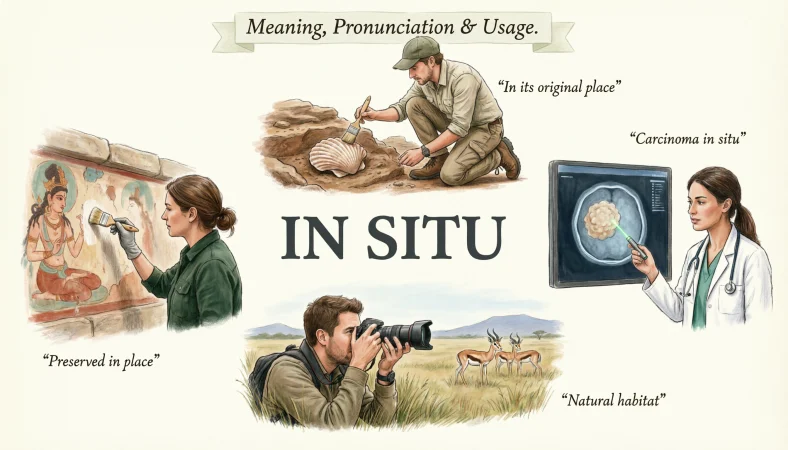

In situ is a Latin phrase that means “in its original place” or “in its natural position.” It’s used to describe something that is observed, studied, or left exactly where it naturally belongs, without being moved, removed, or altered from its original setting.
Have you ever been reading a scientific paper, watching a nature documentary, or browsing through a museum exhibit and suddenly come across two little Latin words that made you pause and scratch your head? In situ appears everywhere from archaeology digs to medical reports, from environmental science to art conservation and if you don’t know what it means, it can feel like everyone else is in on a secret you’ve somehow missed.
But here’s the thing: this isn’t just about learning a fancy phrase. Understanding in situ gives you a window into how experts think about context, preservation, and authenticity. When an archaeologist leaves a pot shard exactly where they found it, or when a doctor diagnoses “carcinoma in situ,” they’re making judgment calls that affect scientific discovery and patient outcomes.
This guide is built on real academic and medical research not surface-level explanations, but field-tested knowledge professionals rely on daily. By the end, you’ll know what in situ means, how to use it correctly across different contexts, and how to pronounce it with confidence. You’re in exactly the right place let’s dive in! 🔬🌍
In Situ Meaning – The Clear, Simple Definition
Let’s start with the absolute basics and get our definitions crystal clear.
In simpler terms: when something is in situ, it hasn’t been picked up, dug out, cut out, or taken anywhere else. It’s right where it’s supposed to be, doing exactly what it’s supposed to do, in the environment where it naturally exists.
Breaking Down the Core Meaning
| Aspect | What In Situ Means |
| Literal Translation | “In its place” or “in position” (from Latin) |
| Key Idea | Something is in its original, natural, or intended location |
| Opposite Concept | Ex situ (removed from its original position) |
| Common Contexts | Science, medicine, archaeology, conservation, art, engineering |
| Everyday Usage | Describing anything left in its natural place |
The Two Simple Words That Say So Much
The beauty of in situ is how much meaning it packs into just two little words. Instead of saying:
“The researchers examined the fossils exactly where they were found, without moving them to a laboratory.”
You can simply say:
“The researchers examined the fossils in situ.”
It’s elegant, efficient, and universally understood in academic and professional circles.
The Origin, Evolution, and Cultural Significance of “In Situ”
Where Did “In Situ” Come From?
In situ is a Latin phrase that has been used in academic and scientific writing for centuries. Latin, as you probably know, was the language of scholarship, medicine, and law in Europe for hundreds of years. Many Latin phrases have survived into modern English because they’re precise, universally understood, and don’t have a perfect one-word English equivalent.
- In = “in” or “within”
- Situ = the ablative case of situs, meaning “place,” “position,” or “site”
Put together: “in its place” or “in position.”
How It Entered Modern English
In situ began appearing in English scientific texts in the 17th and 18th centuries, as scholars increasingly wrote in vernacular languages rather than exclusively in Latin. However, many Latin terms were too useful to abandon, and in situ was one of them.
The phrase became particularly important in:
- Biology and ecology – Describing organisms in their natural habitats
- Medicine – Describing examinations or treatments performed without removing tissue or organs
- Archaeology – Describing artifacts found exactly where they were left
- Geology – Describing rock formations in their original position
- Art conservation – Describing artworks preserved in their original locations
Why “In Situ” Has Endured
Several factors have kept in situ alive and thriving in modern language:
- Precision – It says exactly what it means with no ambiguity.
- Brevity – It replaces longer English phrases like “in its original position.”
- Universality – It’s recognized across languages and disciplines.
- Authority – Using Latin phrases carries a sense of professionalism and expertise.
- Lack of perfect substitute – No single English word captures the exact meaning.
Real-World Usage – How “In Situ” Shows Up Across Different Fields
In Archaeology and Paleontology
This is perhaps where in situ is most famous. Archaeologists and paleontologists are obsessed with context, knowing exactly where an artifact or fossil was found is often more important than the object itself.
Why it matters:
- The position of an artifact tells you how it was used
- The surrounding soil gives clues about the environment
- Nearby objects reveal relationships and timelines
- Moving an artifact destroys its contextual information
Examples:
- “The pottery shards were discovered in situ, still arranged as they were when the ancient kitchen collapsed.”
- “The dinosaur skeleton was photographed in situ before being carefully excavated.”
- “Removing artifacts from their in situ context is considered a cardinal sin in archaeology.”
In Medicine and Healthcare
In medicine, in situ refers to examinations, treatments, or conditions that occur without removing tissue or organs from the body.
Common medical uses:
| Medical Context | What It Means |
| In situ carcinoma | Cancer that hasn’t spread beyond where it started (non-invasive) |
| In situ hybridization | A technique to detect specific DNA sequences in tissue samples |
| In situ testing | Testing performed on tissue while still in the body |
| In situ surgery | Surgery performed without removing the organ |
Examples:
- “The biopsy revealed carcinoma in situ, which means the cancer is confined and highly treatable.”
- “The surgeon used an in situ technique to repair the valve without removing the heart.”
- “In situ hybridization confirmed the presence of the genetic marker.”
In Biology and Ecology
Biologists use in situ to describe organisms or processes observed in their natural habitats rather than in a laboratory.
Examples:
- “The researchers studied the chimpanzees in situ, observing their natural behavior in the wild.”
- “In situ conservation means protecting species in their natural habitats.”
- “The coral bleaching was documented in situ by divers on the reef.”
Contrast with ex situ:
- In situ conservation – Protecting species in their natural habitat (e.g., national parks)
- Ex situ conservation – Protecting species outside their natural habitat (e.g., zoos, seed banks)
In Geology and Earth Sciences
Geologists use in situ to describe rock formations, soil, or minerals that haven’t been moved from their original location.
Examples:
- “The bedrock was examined in situ, revealing the region’s geological history.”
- “In situ soil testing measures the properties of soil without disturbing it.”
- “The mineral deposits were studied in situ to understand their formation.”
In Art, Architecture, and Conservation
Art historians and conservators use in situ to describe artworks, frescoes, or architectural elements that remain in their original location.
Famous in situ examples:
- The Sistine Chapel ceiling – Still in situ in the Vatican
- The cave paintings at Lascaux – Found in situ in their original cave
- Ancient Roman mosaics – Often preserved in situ at excavation sites
Examples:
- “The frescoes were preserved in situ rather than being removed to a museum.”
- “The sculpture remains in situ, exactly where it was placed 2,000 years ago.”
- “Conservators worked to protect the in situ mosaics from further deterioration.”
In Technology and Engineering
Even in modern tech, in situ has found a home.
Examples:
- “In situ sensors monitor the structural integrity of the bridge in real-time.”
- “The software allows for in situ data processing, eliminating the need to transfer files.”
- “In situ testing of the materials confirmed their suitability for the project.”
Examples of “In Situ” in Action – With Context Explanations
Let’s explore how in situ works in real sentences across different tones and situations.
Scientific / Academic Tone 🔬
Example:
“The research team documented the newly discovered coral species in situ, carefully recording its behavior, feeding habits, and interactions with other marine life before collecting any samples for laboratory analysis.”
Analysis: This emphasizes the importance of studying organisms in their natural environment before disturbing them. The in situ observation provides baseline data that lab studies cannot replicate.
Medical / Clinical Tone 🏥
Example:
“The patient was diagnosed with ductal carcinoma in situ, which means the abnormal cells are confined to the milk ducts and haven’t invaded surrounding breast tissue.”
Analysis: In this medical context, in situ provides crucial information about the stage and severity of the cancer. It’s a very specific, technical usage that carries significant clinical meaning.
Archaeological / Descriptive Tone 🏺
Example:
“The burial site was remarkable because the skeleton was found in situ, still wearing the jewelry and holding the ceremonial objects that had been placed with it thousands of years ago.”
Analysis: The in situ nature of the find tells archaeologists about funerary practices, social status, and cultural beliefs. If the skeleton had been moved, much of that information would have been lost.
Conservation / Environmental Tone 🌿
Example:
“In situ conservation remains the gold standard for protecting biodiversity, as it preserves entire ecosystems rather than just individual species in artificial settings.”
Analysis: This highlights the superiority of protecting species in their natural habitats versus zoos or seed banks. In situ conservation is considered more holistic and sustainable.
Everyday / Accessible Tone 🗣️
Example:
The tour guide pointed out the ancient Roman columns still standing in situ, exactly where they were erected nearly two thousand years ago, not moved to a museum or reconstructed elsewhere.
Analysis: Even in casual conversation, in situ is useful for conveying that something hasn’t been moved from its original location.
Comparison with Similar Terms – In Situ vs. Ex Situ vs. Other Related Phrases
This is a common point of confusion, so let’s break down how in situ compares with other similar terms.
In Situ vs. Ex Situ – The Big Contrast
| Aspect | In Situ | Ex Situ |
| Meaning | In its original place | Outside its original place |
| Latin Translation | “In position” | “Out of position” |
| Common Usage | Studying things in their natural context | Studying things after removal or relocation |
| Conservation | Protecting species in natural habitats | Protecting species in zoos, seed banks, etc. |
| Medicine | Treating without removing tissue | Treating after removal or in lab |
| Archaeology | Studying artifacts where found | Studying artifacts after excavation |
In Situ vs. In Vivo
| Term | Meaning | Key Difference |
| In situ | In its original place (location-focused) | About position/location |
| In vivo | Within a living organism (biological focus) | About living systems, not location |
Example:
- “The tumor was studied in situ” = Studied where it naturally occurs.
- “The drug was tested in vivo” = Tested in a living organism (could be in situ or not).
In Situ vs. In Vitro
| Term | Meaning | Key Difference |
| In situ | In its original place | Location-focused, natural setting |
| In vitro | In glass (lab setting) | Artificial, controlled environment |
Example:
- “The cells were examined in situ” = Examined in their natural tissue.
- “The cells were examined in vitro” = Examined in a petri dish.
In Situ vs. In Place
| Term | Meaning | Key Difference |
| In situ | In its natural, original position | Specific, academic, precise |
| In place | In the correct position | Broader, more general |
Example:
- “The statue was restored in place” = It stayed in the general location.
- “The statue was restored in situ” = It stayed exactly where it was originally placed.
Pronunciation Guide – How to Say “In Situ” Correctly
Let’s tackle the pronunciation. No more awkward moments!
American English Pronunciation
In situ is pronounced:
in SIT-oo
- In – pronounced like the English word “in”
- Situ – pronounced “SIT-oo” (rhymes with “bit too”)
British English Pronunciation
in SY-tchoo
- The “situ” sounds closer to “sy-tchoo”
- The “t” is more clearly pronounced
Common Mispronunciations to Avoid
❌ Wrong: “in SEE-too” – Too much emphasis on the “see”
❌ Wrong: “in SIGH-too” – Incorrect vowel sound
❌ Wrong: “in sit-YOU” – Overemphasizing the “you” sound
✅ Correct (US): “in SIT-oo”
✅ Correct (UK): “in SY-tchoo”
Audio-Like Breakdown
Think of it like this:
- “In” as in “inside”
- “Sit” as in “sit down”
- “Oo” as in “boot”
Put it together: in-SIT-oo
Alternate Meanings and Related Terms – Brief Mention
While “in situ” has a fairly consistent meaning across most contexts, there are a few specialized usages worth mentioning.
In Legal Contexts
In some legal and property contexts, “in situ” might refer to items or fixtures that are permanently attached to a property and therefore considered part of the real estate.
In Horticulture and Gardening
“In situ” can refer to planting seeds or plants directly in their permanent location rather than starting them elsewhere and transplanting them.
In Astronomy
“In situ” might be used to describe celestial bodies or features that formed in their current location rather than migrating there.
In Manufacturing
“In situ” can refer to processes or treatments performed on materials without removing them from their place of use.
Polite and Practical Alternatives to “In Situ”
If you want to avoid Latin phrases (perhaps you’re writing for a general audience or trying to keep things simple), here are excellent alternatives.
For Different Contexts
| Context | Instead of “In Situ” | Try This |
| General description | “in its original place” | “The artifact was found in its original place.” |
| Scientific observation | “in its natural habitat” | “The species was studied in its natural habitat.” |
| Medical diagnosis | “confined to the original site” | “The cancer is confined to the original site.” |
| Archaeology | “as it was found” | “The burial site was documented as it was found.” |
| Conservation | “in its natural environment” | “We prioritize protecting species in their natural environment.” |
| Art/Architecture | “in its original position” | “The mosaic remains in its original position.” |
When to Use Each Alternative
- “In its original place” – Best for general, everyday use
- “In its natural habitat” – Best for biology and ecology
- “Confined to the original site” – Best for medical contexts
- “As it was found” – Best for archaeology and paleontology
- “In its natural environment” – Best for conservation
- “Without moving it” – Best for simple, accessible language
When “In Situ” Is the Best Choice
Despite having alternatives, there are times when in situ is simply the most natural choice:
- Academic writing – Where Latin terms are expected
- Scientific papers – Where precision and brevity are valued
- Professional presentations – Where authority and expertise matter
- Technical documentation – Where readers expect standard terminology
- International communication – Where Latin terms transcend language barriers
Example Table – “In Situ” Across Different Disciplines
| Field | In Situ Example | Why It Matters |
| Archaeology | “The pottery was photographed in situ before excavation.” | Preserves contextual information about how objects were used and arranged. |
| Medicine | “The biopsy confirmed carcinoma in situ.” | Indicates cancer hasn’t spread, which affects prognosis and treatment. |
| Biology | “The primates were observed in situ in the rainforest.” | Provides accurate data about natural behavior, not lab conditions. |
| Geology | “The rock layers were examined in situ.” | Reveals geological history without disturbing formations. |
| Art Conservation | “The frescoes were preserved in situ.” | Maintains artwork in its intended spatial and architectural context. |
| Environmental Science | “In situ remediation cleans the soil without excavation.” | Less disruptive and often cheaper than removing contaminated material. |
| Engineering | “In situ sensors monitor structural health.” | Provides real-time data about structures in use. |
| Horticulture | “The seeds were planted in situ.” | Reduces transplant shock and improves survival rates. |
FAQs
1. What does “in situ” mean in simple terms?
In simple terms, in situ means “in its original place” or “in its natural position.” It describes something that hasn’t been moved, removed, or altered from where it naturally belongs.
2. How do you pronounce “in situ”?
In American English, it’s pronounced “in SIT-oo.” In British English, it’s closer to “in SY-tchoo.” Both are correct.
3. What is the opposite of “in situ”?
The opposite is ex situ, which means “outside its original place” or “removed from its natural position.”
4. What does “carcinoma in situ” mean?
“Carcinoma in situ” refers to a type of cancer where abnormal cells are confined to their original location and haven’t spread to surrounding tissue. It’s considered an early, highly treatable stage of cancer.
5. Is “in situ” italicized?
In most modern writing, in situ is no longer italicized because it’s considered a standard English phrase. However, some style guides still recommend italics for Latin terms. When in doubt, follow your publication’s style guide.
6. Can “in situ” be used in everyday conversation?
Yes, but it might sound a bit academic or formal. It’s perfectly fine to use in conversation, especially if the context makes sense. Otherwise, phrases like “in its original place” or “just as it was found” might be more natural.
7. What’s the difference between “in situ” and “in vivo”?
In situ means “in its original position” (location-focused). In vivo means “within a living organism” (biological focus). They overlap but aren’t identical. A study can be both in situ and in vivo, or one without the other.
8. Why do scientists use Latin phrases like “in situ”?
Scientists use Latin phrases because they’re precise, universally understood across languages, and have specific meanings that don’t have perfect one-word English equivalents. They also carry a sense of authority and tradition in academic writing
Conclusion
And there you have it a complete journey through the meaning, usage, and significance of in situ.
We started with the simple definition: in situ means “in its original place” or “in its natural position.” But as we’ve discovered, these two little Latin words carry enormous weight across countless fields. Whether it’s an archaeologist carefully documenting a fossil exactly where it was found, a doctor diagnosing carcinoma in situ, a biologist observing wildlife in its natural habitat, or an art conservator preserving a priceless fresco on the very wall where it was painted centuries ago in situ is the thread that connects them all.