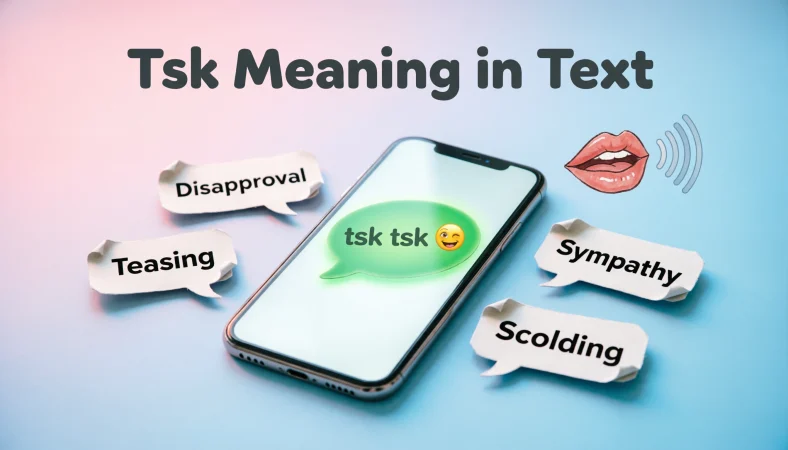

TSK (or “tsk”) in text messaging is an expression used to show disappointment, disapproval, irritation, or mild annoyance. It is not an acronym but an onomatopoeic sound that mimics the tongue-clicking sound people make when reacting to something they find frustrating or unimpressive.
Ever seen someone reply with “tsk” in a chat and wondered if it’s an acronym or just random letters? In texting and online conversations, “tsk” is not a word abbreviation but a sound-based expression used to show disappointment, disapproval, irritation, or mild frustration. It mimics the clicking sound people make with their tongue when they are unimpressed or slightly annoyed.
In digital communication, where tone is often hard to read, “tsk” helps convey emotion without needing full sentences. According to common linguistic usage in informal English and online slang, it’s widely used across messaging apps like WhatsApp, Instagram, and Snapchat to express a subtle reaction often without being overly harsh. Understanding such expressions is important for interpreting tone correctly in modern text conversations, especially in fast-paced social media communication.
Where Did “Tsk” Come From?
Believe it or not, “tsk” isn’t a modern invention born from the age of smartphones. The sound is a natural human vocalization known as a dental click. You make it by pressing your tongue against the roof of your mouth (just behind your teeth) and drawing it downward with a sharp suction of air.
Linguists have traced the written use of “tsk” back to the mid-20th century (specifically 1947, noted by linguist Kenneth Pike). However, the gesture itself is ancient and crosses virtually every culture.
When we moved our conversations from spoken word to text, we needed a way to spell this specific non-verbal sound. Tsk” fit the bill perfectly, evolving from a spoken reprimand into a swift, punchy way to react in chat rooms, DMs, and social media comments.
The 5 Core Meanings of “Tsk” in Texting
One of the reasons “tsk” is so confusing is that its meaning changes like a chameleon based on the situation. Here are the five primary ways people use it:
1. Playful Teasing (The “Oh, You!” Reaction)
This is the most common and friendliest use. You use it when a friend does something mildly silly or mischievous. There’s no real anger here—just affectionate ribbing.
You: “I totally just ate that entire tub of ice cream by myself.”
Friend: “Tsk tsk. Zero regrets, huh? 😂”
2. Mild Disappointment
When someone lets you down in a small way—like forgetting a minor detail—”tsk” communicates that you noticed, and you’re not thrilled, but you’re not furious either.
You: “I completely forgot to pick up the dry cleaning.”
Partner: “Tsk. I guess I’m wearing the wrinkled shirt tomorrow.”
3. Gentle Scolding
This is the classic “parental” or “teacher” vibe. It implies, “You know better than that.” It is usually used when someone breaks a minor rule or acts without thinking.
You: “I didn’t study for the quiz at all.”
Them: “Tsk tsk. That’s not the best strategy.”
4. Sarcastic Judgment
In the world of online memes and banter, “tsk” is often weaponized for sarcasm. It’s a way of playfully pointing out someone’s terrible life choices (usually lighthearted ones) with an exaggerated sense of shock.
You: “I spent $200 on takeout this week.”
Them: “Tsk. Your wallet must be crying.”
5. Sympathy or Regret
Less commonly, “tsk” can show empathy. If someone shares bad news that was somewhat their own fault, you might “tsk” to show your feelings for them while acknowledging the bad luck.
Friend: “I missed the train by ten seconds.”
You: “Tsk. That’s such a bummer, dude.”
“Tsk” in Action: Real Texting Examples
To really get it, you need to see it in the wild. Here’s a quick breakdown of how the same word can read totally differently:
| Conversation Context | Text Exchange | Tone Decoded |
| Group Chat Chaos | A: “I accidentally sent that meme to my boss.”B: “TSK. RIP your career.” | Playful horror / Sarcastic |
| Forgotten Plans | A: “Wait, was our meeting today?”B: “Tsk… Yes, it was 10 AM.” | Mild disappointment |
| Parenting Moment | A: “I ate cookies before dinner, don’t tell mom.”B: “Tsk tsk tsk. Your secret is safe.” | Playful scolding |
| Sympathy Move | A: “My plant died. I forgot to water it for a month.”B: “Tsk. Poor little fern.” | Empathetic regret |
| Annoyance | A: “I’m running 30 minutes late again.”B: “Tsk. Seriously?” | Frustration / Irritation |
“Tsk” vs. The Competition: How It Stacks Up
Texting slang is full of ways to express annoyance. How does “tsk” fit in with the rest of the crew?
- “Tsk” vs. “Tut” / “Tut-tut”: They are essentially the same sound. However, “tut” is the distinctly British spelling. If your friend is from the UK, they’re likely to type “tut” instead of “tsk.” “Tsk” is more common in American English.
- “Tsk” vs. “Tch”: While similar clicks, “tch” (or “tchah”) usually denotes irritation or frustration. If you spill coffee on your keyboard, you “tch.” If your friend spills coffee on your keyboard, you “tsk” at them.
- “Tsk” vs. “Sigh”: “Sigh” is about exhaustion and resignation (“I give up”). “Tsk” is about judgment and disapproval (“You should have done better”).
- “Tsk” vs. “Yikes”: “Yikes” is a reaction to an awkward or alarming situation. “Tsk” is a reaction to a bad choice. If someone shows you a terrible haircut, you say “Yikes.” If they chose that haircut, you say “Tsk.”
Wait, Does “TSK” Stand for Something Else?
If you see “TSK” written in all caps, your brain should pause. In formal or professional contexts, it often acts as an acronym:
| Acronym | Full Meaning |
| TSK | Task (Common in project management software) |
| TSK | Turkish Armed Forces (Türk Silahlı Kuvvetleri) |
| TSK | Tampa Scale for Kinesiophobia (A medical questionnaire) |
| TSK | Temporary Session Key (Cybersecurity jargon) |
Pro Tip: If you’re in a work chat and someone types “TSK,” they likely mean “Task.” If your friend types “tsk” in lowercase, they’re judging your life choices. Context is everything.
When to Use “Tsk” (And When to Swerve)
Using “tsk” is a bit like using hot sauce. A little adds flavor; too much ruins the dish. Here’s your guide to navigating the social minefield:
👍 Use It When:
- You are texting close friends or family.
- You are reacting to something minor and low-stakes (like a bad pun or a silly mistake).
- You are using it as a joke and pairing it with a laughing emoji (😂, 😅).
- You want to gently call someone out without starting a fight.
👎 Avoid It When:
- It’s a serious issue. If someone is genuinely upset or grieving, “tsk” sounds cold and dismissive.
- You are in a professional environment. Don’t reply to your boss’s email with “tsk.” Save it for the group chat.
- You are angry. If you are genuinely furious, “tsk” will sound passive-aggressive. Just say what’s on your mind.
- You aren’t sure how they’ll take it. If you have a dry sense of humor and they don’t, it might land like a slap.
Polite & Professional Alternatives to “Tsk”
Need to express disapproval without the casual click? Here are safer, more professional ways to get the same sentiment across:
- For Disappointment: “I was hoping for a different outcome.”
- For Gentle Correction: “Let’s try to do it differently next time.”
- For Playful Teasing (Pro Version): “Oh, you’re really going there, huh?”
- For Sympathy: “That’s such a shame.”
- For General Disapproval: “That’s not ideal.”
FAQs
1. What does “tsk” mean in text?
It’s a sound effect for a tongue click, used to show disapproval, disappointment, or playful scolding in digital chats.
2. Is “tsk” rude to say?
Usually not! It’s mostly playful. It only gets rude if you use it during a serious argument or with someone who doesn’t get your humor.
3. What’s the difference between “tsk” and “tsk tsk”?
“Tsk” is a quick reaction. “Tsk tsk” (doubled) is a stronger, more exaggerated finger-wagging reaction, often more playful.
4. How do you say “tsk” out loud?
Click your tongue against the roof of your mouth. If you spell it out, people say it as “tisk” (rhyming with “whisk”).
5. Is “tsk” used in professional emails?
Absolutely not. Keep it in text messages and social DMs. Never “tsk” your boss or client.
6. What does “TSK” mean in all caps?
Usually an acronym for “Task,” “Turkish Armed Forces,” or technical terms. Lowercase is the emotional reaction.
7. Can “tsk” mean something positive?
Rarely. It can be “positive” in the sense of affectionate teasing (“tsk, you’re so silly”), but it almost always carries a hint of judgment.
8. What emoji goes best with “tsk”?
😅 (sweat smile) for embarrassment, 🙄 (eye roll) for sarcasm, or 😏 (smirk) for playful teasing.
Final Thoghts:
In the grand symphony of texting slang, “tsk” holds a unique spot. It’s a tiny, three-letter orchestra that can play the tune of disappointment, humor, or empathy depending on how you conduct it.
The golden rule for using “tsk” is simple: Know your audience. With your bestie who gets your sarcasm? Go wild. With your colleague who takes things literally? Steer clear.
When used correctly, “tsk” is a fantastic tool to add flavor and personality to your chats. It’s quick, it’s classic, and it’s surprisingly expressive. So the next time a friend admits to something silly, don’t overthink it. Just drop the “tsk,” add a laughing emoji, and watch the conversation flow.