
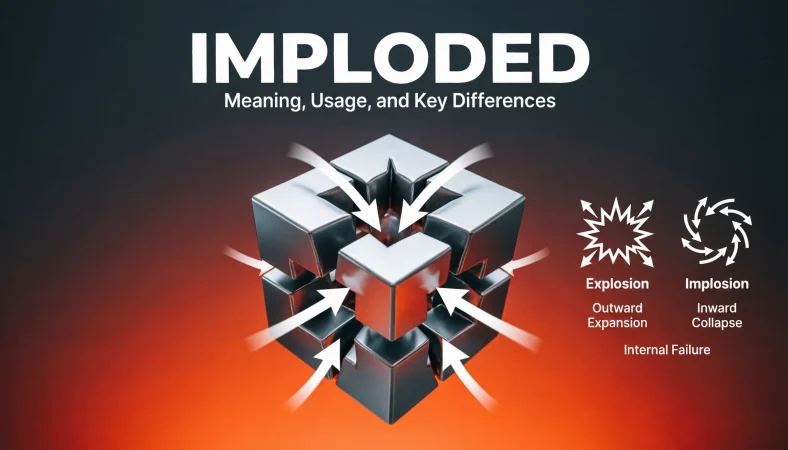
Imploded means to collapse or fall inward violently and suddenly. Unlike an explosion, which forces materials outward, an implosion forces matter inward toward the center. In everyday language, it is often used metaphorically to describe the sudden and complete failure of systems, organizations, relationships, or mental states due to internal pressures.
Have you ever watched a video of a massive skyscraper being demolished? One moment it stands tall against the skyline, and the next in a matter of seconds it crumbles straight down into a neat pile of rubble. That spectacular, inward collapse isn’t just a demolition trick; it’s the perfect visual definition of the word “imploded.”
But here’s the fascinating part: while that image is dramatic, the word doesn’t just belong to construction sites and physics textbooks. We use “imploded” to describe failing businesses, crumbling relationships, shattered mental states, and even disastrous political campaigns. It’s a word that packs a punch, carrying a sense of sudden, violent, and total failure.
If you’ve ever found yourself confused about whether something “imploded” or “exploded,” or if you simply want to use this powerful word correctly in your writing and conversations, you’ve come to the right place. Let’s dive deep into the true imploded meaning and explore how this single word captures the drama of collapse in almost every area of life.
What Is The Imploded Meaning?
Before we explore the nuances, let’s nail down the exact definition. Understanding the core imploded meaning is the foundation for using it effectively.
At its most literal level, an implosion happens when external pressure is greater than internal pressure. The object, structure, or system can no longer withstand the force pressing in on it, so it caves in on itself. Think of a vacuum-sealed container crumpling when the air is sucked out, or a submarine being crushed by the immense pressure of the deep ocean.
However, the imploded meaning has expanded far beyond physics. Today, we hear it used to describe:
- Businesses: “The company imploded after the CEO resigned.”
- Relationships: “Their marriage imploded over trust issues.”
- Mental Health: “He felt like his mind was imploding under the stress.”
- Politics/Sports: “The team imploded in the final quarter.”
The Origin and Evolution of “Imploded”
Where Did This Powerful Word Come From?
To truly appreciate the imploded meaning, it helps to understand its linguistic roots. Like many English words, it has a fascinating journey from ancient Latin to modern slang.
The Latin Roots
The word “implode” was first recorded in the English language in the 19th century. It derives from the Latin prefix “in-,” meaning “inward” or “into,” combined with the Latin verb “plodere,” which means “to clap” or “to strike.” So, etymologically, to implode meant to “strike inward” or “clap inward.” The opposite, “explode,” comes from “ex-,” meaning “outward,” and “plodere” to clap outward.
The Scientific Adoption
For much of its early life, the word remained strictly within the realm of physics and engineering. Scientists used it to describe the behavior of gases, the dynamics of vacuum tubes, and structural failures. It was a technical term, rarely heard in everyday conversation.
The Pop Culture Explosion (or Implosion?)
The turning point came in the late 20th century. As television broadcasts began showing dramatic controlled demolitions of old hotels and stadiums, the public became captivated by the visual spectacle of an implosion. The word entered the mainstream vocabulary. At the same time, business journalists and political commentators realized it was the perfect metaphor to describe spectacular corporate scandals and political meltdowns events like the Enron scandal were frequently described as an “implosion” because the failure came from within, driven by internal corruption rather than external attacks.
The Modern Metaphor
Today, the imploded meaning has fully matured into a versatile metaphor. We use it for anything that suffers a catastrophic internal breakdown. It’s dramatic, it’s visual, and it immediately conveys a sense of sudden, devastating failure that originates from within.
How Is “Imploded” Used in Real-World Contexts?
The Crucial Role of Tone and Context
The magic of the word “imploded” lies in its flexibility across different tones. However, misusing the tone can make you sound overly dramatic or, worse, insensitive. Let’s look at how the imploded meaning shifts depending on the situation.
1. Neutral and Factual Context (Literal Usage)
In a scientific or news reporting context, the word is used objectively to describe a physical event. The tone is matter-of-fact and observant.
- Example: “The building was imploded using strategically placed explosives to ensure it collapsed within its own footprint.”
- Example: “The deep-sea submersible imploded instantly due to the extreme water pressure.”
2. Friendly and Conversational Context (Hyperbole)
In casual chats, friends often use the word hyperbolically to describe minor personal disasters. It’s playful, relatable, and a little dramatic, often accompanied by emojis for comedic effect.
- Example: “I tried to assemble that IKEA furniture for four hours, and my brain literally imploded. 🧠💥”
- Example: “Our group chat imploded when we tried to decide on a restaurant for dinner. We ended up at the same place we always go! 😂”
3. Professional and Formal Context (Business/Journalism)
Here, the word carries serious weight. It signals total organizational failure driven by internal dysfunction, fraud, toxic culture, or poor leadership. The tone is analytical and somewhat grave.
- Example: “The startup imploded following the revelation of accounting irregularities and the subsequent mass exodus of its senior leadership.”
4. Negative/Dismissive or Judgment Context
When used in gossip or criticism, the word can sound judgmental or even gleeful about someone else’s misfortune. It implies incompetence or inherent instability.
- Example: “Did you see their launch event? It completely imploded. The speakers didn’t show up, and the Wi-Fi crashed. What a disaster.” (Tone: critical and dismissive).
- Example: “His political campaign imploded the second his old tweets surfaced.” (Tone: matter-of-fact but carries a sense of “he deserved it”).
5. Medical/Psychological Context (Emotional Implosion)
This is a serious use. It describes an internal mental or emotional breakdown where a person turns their pain inward, leading to depression, burnout, or a severe crisis. The tone should always be empathetic and careful.
- Example: “Unable to express his grief outwardly, he began to implode, withdrawing from friends and losing his appetite.”
Imploded Meaning Comparison: Related Terms & Abbreviations
One of the most common confusions is understanding how “implode” fits alongside other “destruction” words. Let’s clear this up with a detailed comparison.
Comparison Table: Imploded vs. Exploded vs. Collapsed vs. Crumbled
| Term | Primary Definition | Direction | Cause | Typical Use in Metaphor |
| Imploded | Collapse inward violently. | Inward | External pressure > Internal strength; OR internal corruption/failure. | Systemic failure, personal breakdown, business scandal. |
| Exploded | Burst outward violently. | Outward | Internal pressure > External containment. | Outbursts of anger, rapid growth, pop culture hits, sudden violence. |
| Collapsed | Fall down suddenly due to weakness. | Downward | Loss of structural integrity, exhaustion. | Market crashes, physical health, a chair breaking. |
| Crumbled | Break into small fragments gradually. | Inward/Downward | Long-term wear and tear, lack of maintenance. | Empires decaying, trust fading slowly, old buildings. |
Imploded vs. Exploded: The Core Difference
This is the most common comparison people search for. The difference is entirely about direction.
- The explosion is outward. Think of a bomb going off shrapnel, fire, and force spreading in every direction. Metaphorically, a person who “explodes” lashes out, yelling and throwing their anger at everyone else.
- Implosion is inward. Think of a star dying and collapsing into a black hole. It absorbs everything into a central void. Metaphorically, a person who “implodes” internalizes everything, shutting down rather than lashing out. They might suffer silently or self-destruct privately.
Imploded vs. Collapsed
While often used interchangeably, “collapsed” is more general. A bridge can collapse due to age or a flood. An implosion is a specific type of collapse where the force pulls inward. All implosions are collapses, but not all collapses are implosions. A building collapsing sideways is not an implosion; one collapsing straight down into its own basement is.
Alternate Meanings of “Imploded”
While the primary imploded meaning involves inward collapse, there are a few niche alternate uses worth noting:
- Phonetics (Linguistics):
- Context: The study of speech sounds.
- Meaning: Certain languages use “implosive consonants” sounds produced by drawing air inward while speaking.
- Example: “In some African languages, speakers use an imploded ‘b’ sound that is made by sucking air into the mouth.”
- Economics (Quantitative Easing):
- Context: Sometimes used to describe an economic bubble bursting inward.
- Meaning: A sharp contraction in economic activity originating from the failure of a central financial institution.
- Example: “The housing market imploded, taking the global economy with it.”
Polite and Professional Alternatives to “Imploded”
Because “imploded” is a dramatic and intense word, there are times especially in sensitive professional environments when you need a softer or more clinical alternative. Choosing the right word shows emotional intelligence.
Here are professional alternatives based on the context:
- For Business Failures:
- “Collapsed” (less violent, more neutral).
- “Failed” (straightforward).
- “Folded” (implies closure without the drama of shrapnel).
- “Went into receivership” (formal/legal).
- Example: “The company imploded” ➡️ “The company folded due to financial pressures.”
- For Emotional/Psychological States:
- “Retreated” (implies withdrawal).
- “Internalized” (implies keeping things inside without the violent crash).
- “Burned out” (implies exhaustion).
- Example: “He imploded under the pressure” ➡️ “He internalized the pressure and began to withdraw.”
- For Physical Structures:
- “Caved in” (less clinical).
- “Subsided” (implies settling).
- Example: “The mine shaft imploded” ➡️ “The mine shaft caved in.”
When to avoid “imploded”:
Avoid using it when describing trauma, grief, or mental health crises unless you are sure the person or their family is comfortable with such a stark metaphor. It can sound cold and sensationalist.
Examples of “Imploded” in Different Sentences
Seeing the imploded meaning in action across various sentences is the best way to cement your understanding.
Example 1: Literal/Demolition
Sentence: “The old stadium was imploded in a spectacular display of engineering precision, sending a cloud of dust straight into the air.”
Example 2: Business/Career
Sentence: “His career imploded after a single, unprofessional social media post went viral and lost him all his major clients.
Example 3: Sports
Sentence: “The team had a 20-point lead, but their defense imploded in the last five minutes, and they lost the game.”
Example 4: Personal/Social Media
Sentence: “My group chat just imploded over the season finale spoilers. I’m staying out of it! 🍿👀”
Example 5: Psychological
Sentence: “For years, she was the strong one in the family, but after her mother passed away, she finally imploded, unable to carry the weight of everyone else’s expectations.”
Example 6: Scientific (Physics)
Sentence: “Stars heavy enough eventually implode under their own gravity, leading to a massive supernova that scatters elements across the cosmos.”
FAQs
Here are concise answers to the top questions people ask when searching for the imploded meaning.
1. What does it mean when something implodes?
It collapses violently inward. In physics, outside pressure overwhelms inside pressure. Metaphorically, it means a sudden, catastrophic failure caused by internal problems (e.g., a business crashing due to fraud).
2. Is imploded the opposite of exploded?
Yes, in terms of direction. Explosion sends matter outward; implosion pulls matter inward. Emotionally, exploding is lashing out; imploding is collapsing internally.
3. What is the difference between collapse and implode?
A collapse is a general fall. An implosion is a specific type of collapse where the force pulls inward. All implosions are collapses, but not all collapses are implosions.
4. Can a person be described as imploding?
Yes. It metaphorically describes someone bottling up stress until they break down internally, withdrawing, self-destructing, or suffering in silence rather than lashing out.
5. What does “emotional implosion” mean?
It’s turning negative feelings inward. Instead of expressing emotions, a person internalizes them, leading to severe fatigue, isolation, self-criticism, or depression.
6. How do you use imploded in a sentence?
Literal: “The submarine imploded under extreme pressure.” Figurative: “Our vacation plans imploded when all flights were canceled.”
7. What does “business implosion” mean?
A business fails due to internal issues like fraud, toxic culture, mismanagement, or internal disputes rather than external market competition.
8. Why do buildings implode instead of explode?
For controlled demolition. Explosives at the base remove support, causing gravity to pull the building straight down into its own footprint, minimizing damage to surrounding structures.
A Sample Table: Imploded vs. Exploded in Everyday Life
To make the imploded meaning crystal clear, let’s look at how “implode” and “explode” manifest differently in specific life scenarios.
| Scenario | Imploded (Inward Focus) | Exploded (Outward Focus) |
| Anger | Silent treatment, passive aggression, plotting revenge internally. | Yelling, throwing objects, slamming doors, screaming at someone. |
| Business Failure | Internal fraud, boardroom power struggles, employee burnout leading to shutdown. | A major product recall, a viral PR disaster, losing a major lawsuit. |
| Star/Galaxy | Collapsing into a black hole or neutron star. | Going supernova, blasting gas and light out into the universe. |
| Relationship | The couple quietly grows distant, stops communicating, and drifts apart until the breakup. | A dramatic screaming fight in public, breaking up, and blocking each other on social media. |
| Social Media | A celebrity deleting all their posts and unfollowing everyone silently. | A celebrity posting a scathing rant that goes viral. |
Conclusion
To implode means to collapse violently inward, and the word carries a weight that goes far beyond its literal, physical definition. Whether you’re describing a building crumbling into its own footprint, a business failing due to internal corruption, or a person quietly breaking down under overwhelming stress, “imploded” captures a very specific kind of catastrophe one that originates from within and happens suddenly. It’s a word that paints a vivid picture of total failure, making it perfect for dramatic storytelling, business analysis, or even casual hyperbole among friends.
The key distinction to remember is direction: explosions send things outward, while implosions pull everything inward. Once you grasp that fundamental difference, you’ll never confuse the two again. Use “imploded” when you want to emphasize that the seeds of destruction were internal and the collapse was rapid and complete. But in sensitive contexts involving mental health or tragedy, consider gentler alternatives like “collapsed” or “internalized.” Understanding the imploded meaning gives you a powerful linguistic tool just use it wisely and with awareness of the situation at hand.