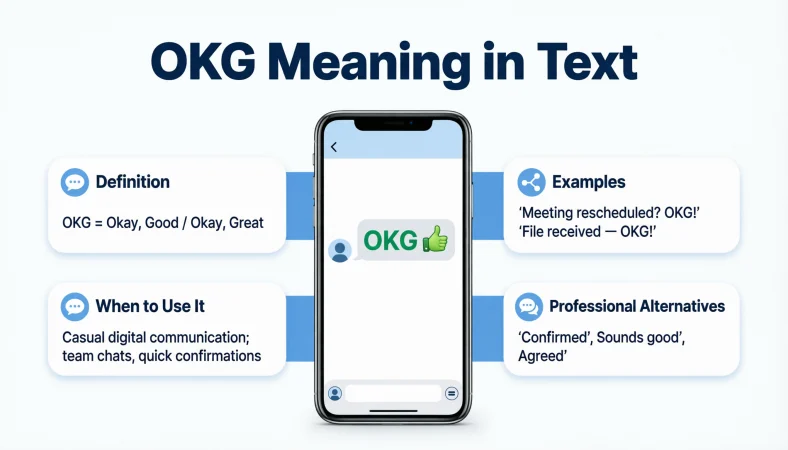

OKG is a texting abbreviation that typically means “Okay, Good” or “Okay, Great,” depending on the context of the conversation. People use it in text messages, social media chats, gaming, and instant messaging to show agreement, approval, or satisfaction.
Although it is less common than abbreviations like “OK” or “K,” it appears in casual conversations where someone wants to acknowledge information with a slightly more positive tone.
If you’ve received “OKG” in a message and wondered what it means, you’re not alone. Internet slang evolves quickly, and many abbreviations have multiple meanings depending on who is using them and where they are used. Understanding the context is the key to interpreting “OKG” correctly.
Whether you’re chatting with friends, messaging coworkers informally, or browsing social media comments, knowing the meaning of OKG can help you avoid confusion and respond naturally. In this guide, you’ll learn exactly what OKG means in text, where it came from, how people use it, examples in different situations, alternative meanings, and much more.
OKG Meaning in Text
In most online conversations, OKG means “Okay, Good” or “Okay, Great.”
It is a short acknowledgment that tells the other person:
- I understand.
- That sounds good.
- Everything is fine.
- I’m happy with that.
- I agree.
Unlike a simple “OK,” adding the G often makes the reply sound a little warmer or more enthusiastic.
Simple Definition
| Abbreviation | Meaning | Tone | Common Use |
|---|---|---|---|
| OKG | Okay, Good | Friendly | Texting, messaging, chats |
| OKG | Okay, Great | Positive | Casual conversations |
Origin of OKG
Unlike famous internet abbreviations such as LOL, BRB, or IMO, OKG doesn’t have one officially documented origin.
Instead, it appears to have developed naturally in online messaging where users shortened longer responses like:
- “Okay, good.”
- “Okay, great.”
Since typing quickly is common in texting, many users simply removed the spaces and punctuation, creating:
OK + G = OKG
The abbreviation never became as mainstream as:
- OK
- K
- KK
- Bet
- Sounds good
However, it still appears occasionally in:
- SMS conversations
- Discord
- Snapchat
- Facebook Messenger
- Gaming chats
Why People Use OKG
People use OKG because it’s:
- Faster than typing full words
- Friendly
- Positive
- Casual
- Easy to understand in context
It usually shows approval without sounding overly excited.
For example:
Friend: I’ll be there at 7.
You: OKG 👍
This tells them everything is settled.
How OKG Is Used in Text Messages
The meaning changes slightly depending on the conversation.
1. Showing Agreement
Person A:
I’ll send the files tonight.
Person B:
OKG.
Meaning:
“I’m okay with that.”
2. Confirming Plans
Friend:
Movie starts at 8.
You:
OKG!
Meaning:
“Sounds great.”
3. Showing Satisfaction
Mom:
Dinner is ready.
You:
OKG 😊
Meaning:
“Great, thanks.”
4. Ending a Conversation
Friend:
I’ll text you later.
You:
OKG.
Meaning:
“Alright.”
Example Table: OKG in Different Contexts
| Situation | Example | Meaning | Tone |
|---|---|---|---|
| Making plans | OKG, see you then! | Sounds good | Friendly |
| Receiving information | OKG thanks | I understand | Polite |
| Gaming | OKG let’s go | Ready | Excited |
| Group chat | OKG everyone | Agreed | Positive |
| School | OKG I’ll submit it | Confirming | Neutral |
| Family | OKG Mom ❤️ | Got it | Warm |
Tone of OKG
Although short, OKG can express different tones.
Friendly Tone 😊
“OKG! Can’t wait.”
Shows excitement.
Neutral Tone
“OKG.”
Simply confirms information.
Positive Tone 🎉
“OKG that’s awesome!”
Shows happiness.
Slightly Dismissive (Rare)
Sometimes a very short “OKG.” with no punctuation can sound like someone wants to end the conversation quickly.
Example:
Person A:
Sorry.
Person B:
OKG.
Here it may feel slightly cold, depending on the relationship.
Real-Life Examples
Example 1
Sarah:
Meeting moved to Friday.
John:
OKG.
Meaning:
“I’m fine with that.”
Example 2
Alex:
Pizza tonight?
Emma:
OKG 😄
Meaning:
“That sounds great.”
Example 3
Dad:
Pick up milk.
Son:
OKG.
Meaning:
“I’ll do it.”
Example 4
Friend:
I’ll call later.
You:
OKG 👍
Meaning:
“Alright.”
Is OKG Popular?
OKG is considered a less common texting abbreviation.
You’ll encounter these much more often:
- OK
- K
- KK
- Bet
- Sure
- Sounds good
- Yep
- Yup
Still, OKG occasionally appears among people who like using shorthand in casual conversations.
Where You Might See OKG
People may use OKG on:
- Messenger
- Snapchat
- Discord
- Instagram DMs
- TikTok comments
- Gaming chats
- SMS text messages
It’s uncommon in:
- Business emails
- Professional communication
- Academic writing
- Formal documents
When You Should Use OKG
OKG works well when talking to:
- Friends
- Family
- Siblings
- Gaming teammates
- Close classmates
Avoid using it in:
- Job applications
- Work emails
- Client communication
- College assignments
Professional Alternatives
Instead of OKG, consider these responses:
| Casual | Professional Alternative |
|---|---|
| OKG | Sounds good. |
| OKG | Understood. |
| OKG | Certainly. |
| OKG | Thank you for letting me know. |
| OKG | That works for me. |
| OKG | I appreciate the update. |
Comparison with Similar Text Abbreviations
| Abbreviation | Meaning | Difference |
|---|---|---|
| OK | Okay | Standard confirmation |
| K | Okay | Very short; may sound blunt |
| KK | Okay, okay | Friendlier than K |
| OKG | Okay, Good/Great | More positive |
| Bet | Agreed | Modern slang |
| Sure | Yes | More formal |
| Yep | Yes | Casual confirmation |
| Alright | Okay | Full-word alternative |
Alternate Meanings of OKG
Like many internet abbreviations, OKG can occasionally represent other phrases depending on the community or industry.
Possible alternate meanings include:
- Organization initials
- Company abbreviations
- Gaming clan names
- Internal workplace shorthand
- Personal nicknames
However, in everyday texting, the intended meaning is usually “Okay, Good” or “Okay, Great.”
Common Mistakes
Assuming Every Person Uses It the Same Way
Not everyone recognizes OKG, so context matters.
Using It Professionally
Many workplaces prefer complete responses instead of internet abbreviations.
Confusing It with OMG
People sometimes read quickly and mistake OKG for OMG.
Remember:
OMG = Oh My God
OKG = Okay, Good/Great
Tips for Understanding OKG
- Read the surrounding conversation.
- Consider who sent the message.
- Look at emojis.
- Notice punctuation.
- If unsure, politely ask what they meant.
FAQs
1. What does OKG mean in text?
OKG usually means “Okay, Good” or “Okay, Great.” It expresses agreement, approval, or satisfaction in casual conversations.
2. Is OKG a common texting abbreviation?
No. It is relatively uncommon compared with abbreviations like OK, K, LOL, or BRB, but some people still use it in casual chats.
3. Is OKG positive or negative?
Most of the time, it’s positive or neutral. It usually means someone agrees with or approves of what was said.
4. Can OKG sound rude?
Not usually. However, a very short reply without emojis or additional words may seem abrupt depending on the conversation.
5. Where is OKG mostly used?
You may see it on WhatsApp, Snapchat, Discord, Messenger, Instagram, gaming chats, and SMS.
6. Should I use OKG in work emails?
No. Professional communication is clearer when you write full responses like “Sounds good,” “Understood,” or “Thank you.”
7. Is OKG the same as OK?
They’re similar, but OKG often adds a slightly more positive feeling by implying “good” or “great.
8. What should I reply to OKG?
You can simply continue the conversation. For example:
- Thanks!
- Great!
- See you then.
- Perfect!
- Sounds good.
Conclusion
Although OKG isn’t one of the most common internet abbreviations, it generally means “Okay, Good” or “Okay, Great” in text messages. It’s a casual way to acknowledge information, confirm plans, or show approval without typing a longer response.
As with many pieces of internet slang, context matters. Pay attention to the surrounding conversation, emojis, and the relationship between the people chatting. When you’re texting friends or family, OKG can feel natural and friendly. In professional settings, however, full phrases like “Sounds good” or “Understood” are a better choice.
Understanding abbreviations like OKG helps you communicate more confidently, avoid misunderstandings, and keep up with the constantly changing language of digital conversations.