
Definition:
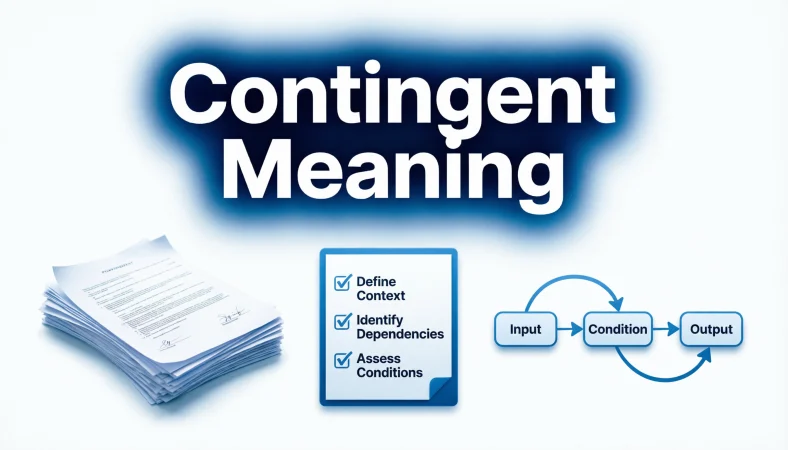
Contingent means dependent on something else happening first. It describes a situation, plan, agreement, or event that will only occur if certain conditions are met.
For example:
- “My vacation is contingent on getting approval from my boss.”
- “The house sale is contingent on financing.”
- “Success is contingent upon hard work.”
In all these examples, one thing depends on another before it can happen.
Understanding the word “contingent” is important because it appears in everyday conversations, business contracts, real estate deals, law, employment, finance, and even casual discussions online. While the term may sound formal, its meaning is actually simple once broken down clearly. Many people also search for contingent meaning in Tamil to better understand how the word is used in different languages and real-life situations.
The word has become increasingly common in workplaces, legal documents, and real estate transactions. Whether you are reading a contract, applying for a job, or talking about future plans, understanding “contingent meaning” helps you communicate more professionally and confidently.
What Does Contingent Mean?
The word contingent refers to something that depends on specific circumstances, conditions, or future events.
Simple Definition
Contingent = Conditional or dependent on something else
If something is contingent, it is not guaranteed until another requirement is fulfilled.
Quick Examples
| Sentence | Meaning |
|---|---|
| “The promotion is contingent on performance.” | Promotion depends on performance |
| “Our trip is contingent upon the weather.” | Weather decides whether the trip happens |
| “Payment is contingent on project completion.” | Payment happens only after completion |
Origin of the Word “Contingent”
The word contingent comes from the Latin word contingere, meaning:
- “to touch”
- “to happen”
- “to depend upon”
It entered Middle English through French and gradually evolved into a term used in philosophy, law, and business.
Historically, philosophers used “contingent” to describe events that are possible but not certain. Over time, the word became common in contracts, economics, insurance, and modern workplace language.
Today, it is widely used in:
- Real estate
- Business agreements
- Employment
- Law
- Finance
- Academic writing
- Everyday conversations
Contingent Meaning in Simple Everyday Language
In normal conversation, “contingent” usually means:
- “It depends”
- “Only if something happens”
- “Conditional”
Everyday Examples
- “I’ll go to dinner if I finish work early.”
- Dinner plans are contingent on finishing work.
- “The event is contingent upon good weather.”
- Bad weather may cancel the event.
- “Your bonus is contingent on sales targets.”
- Bonus depends on achieving goals.
How “Contingent” Is Used in Different Situations
Contingent in Real Estate
One of the most common places you’ll hear this word is in property sales.
When a house is marked “contingent,” it means the seller has accepted an offer, but certain conditions still need to be completed.
Common Real Estate Contingencies
| Contingency Type | Meaning |
|---|---|
| Financing contingency | Buyer must secure a loan |
| Inspection contingency | Home inspection must be satisfactory |
| Appraisal contingency | Property must meet appraised value |
| Sale contingency | Buyer must sell existing home first |
Example
“The property is contingent on inspection approval.”
This means the sale can still fall through if inspection problems arise.
Contingent Meaning in Employment
In the workplace, “contingent” often describes temporary or conditional workers.
Contingent Worker Meaning
A contingent worker is someone who is not a permanent employee.
This may include:
- Freelancers
- Contractors
- Consultants
- Temporary staff
- Gig workers
Example
“The company hired contingent workers during the busy season.”
This means they brought in temporary staff instead of permanent employees.
Contingent Meaning in Business and Contracts
Businesses frequently use the term when discussing agreements or payments.
Common Business Usage
- Contingent payment
- Contingent agreement
- Contingent liability
- Contingent contract
Example Sentences
- “The deal is contingent upon board approval.”
- “Funding is contingent on project success.”
- “Bonuses are contingent on yearly profits.”
This wording helps define conditions clearly and legally.
Contingent Meaning in Finance
In finance and accounting, “contingent” refers to uncertain future obligations or events.
Contingent Liability
A contingent liability is a possible financial responsibility that depends on future events.
Examples include:
- Lawsuits
- Warranty claims
- Pending legal disputes
Example
“The company disclosed a contingent liability in its annual report.”
This means a future financial risk may exist.
Contingent Meaning in Law
Legal documents often use “contingent” to clarify conditions.
Legal Example
“The agreement becomes valid contingent upon both parties signing.”
This means the agreement only works after signatures are completed.
Lawyers use the word because it creates clear conditional terms.
Contingent vs Related Words
Many people confuse “contingent” with similar words. Here’s a quick comparison.
| Word | Meaning | Difference |
|---|---|---|
| Contingent | Depends on conditions | Conditional |
| Conditional | Based on rules or requirements | Very similar |
| Dependent | Relies on something else | Broader usage |
| Temporary | Lasting for limited time | Not always conditional |
| Possible | Could happen | No dependency implied |
Contingent vs Conditional
These words are closely related but slightly different.
Contingent
Focuses on dependence.
“The event is contingent on weather.”
Conditional
Focuses on requirements or rules.
“Access is conditional upon payment.”
In many cases, the two words can overlap.
Tone and Context of the Word “Contingent”
The tone of “contingent” is usually:
- Professional
- Neutral
- Formal
It is commonly used in:
- Corporate communication
- Contracts
- Academic writing
- Real estate listings
Tone Examples
| Sentence | Tone |
|---|---|
| “Approval is contingent upon review.” | Professional |
| “Our plans are contingent on traffic 😅” | Casual/Friendly |
| “Your position is contingent on budget approval.” | Serious/Formal |
Examples of Contingent in Sentences
Professional Examples
- “The offer is contingent upon a background check.”
- “Project expansion is contingent on investor funding.”
- “Remote work approval is contingent on performance.”
Casual Examples
- “Movie night is contingent on everyone showing up 🍿”
- “I’ll join the trip if my schedule clears up.”
Academic Examples
- “Economic growth is contingent upon policy stability.”
- “The results are contingent on accurate data collection.”
Popular Phrases Using “Contingent”
Here are some of the most common expressions.
Contingent Upon
This is the most popular phrase.
Examples:
- “Success is contingent upon preparation.”
- “The agreement is contingent upon approval.”
Contingent Plan
A backup plan prepared for emergencies.
Example:
“We created a contingent plan in case sales dropped.”
Contingent Offer
An offer that depends on conditions.
Example:
“The university made a contingent admission offer.”
Alternate Meanings of Contingent
Although the conditional meaning is most common, “contingent” can also refer to a group of people representing a larger organization.
Example
“A large contingent of fans attended the match.”
In this case, contingent means:
- Delegation
- Group
- Section of people
Other Examples
- Military contingent
- Political contingent
- Student contingent
Synonyms of Contingent
Here are some commonly used alternatives.
| Synonym | Best Used In |
|---|---|
| Conditional | Formal writing |
| Dependent | General conversations |
| Subject to | Legal/business use |
| Based on | Casual usage |
| Hinged on | Informal speech |
Polite or Professional Alternatives to “Contingent”
If you want simpler or softer wording, these alternatives work well.
Professional Alternatives
- Subject to approval
- Dependent on results
- Pending confirmation
- Based on requirements
- Awaiting completion
Example Replacements
| Original | Alternative |
|---|---|
| “The offer is contingent upon approval.” | “The offer is subject to approval.” |
| “Payment is contingent on delivery.” | “Payment will be processed after delivery.” |
Why the Word “Contingent” Is Popular Today
The rise of remote work, contract jobs, and real estate content online has made the term more visible than ever.
Reasons for Popularity
- Growth of freelance jobs
- Increase in housing market discussions
- Business contract transparency
- Financial literacy content
- Workplace HR terminology
Social media creators, career coaches, and property agents now use the word frequently in educational content.
Common Mistakes People Make
Confusing “Contingent” With “Temporary”
Not everything temporary is contingent.
- Temporary = limited duration
- Contingent = condition-based
Using It Incorrectly in Casual Speech
Some people overuse the word in informal situations where “depends” sounds more natural.
Incorrect Example
❌ “I’m contingent to go.”
Correct Example
✅ “My plans are contingent on my schedule.”
How to Use “Contingent” Naturally
Easy Formula
Contingent + on/upon + condition
Examples
- “The trip is contingent on weather.”
- “Hiring is contingent upon experience.”
- “The launch depends on funding.”
Real-World Scenarios Where You’ll See “Contingent”
Workplace
- Job offers
- Bonuses
- Promotions
Real Estate
- Home inspections
- Financing approvals
- Property appraisals
Education
- Conditional admissions
- Scholarship approvals
Finance
- Risk disclosures
- Future liabilities
Law
- Contracts
- Settlement agreements
Example Table: Contingent Usage by Industry
| Industry | Example Sentence | Meaning |
|---|---|---|
| Real Estate | “Sale is contingent on financing.” | Loan approval required |
| HR | “Employment is contingent upon screening.” | Must pass background check |
| Finance | “Company reported contingent liabilities.” | Possible future debt |
| Law | “Agreement contingent upon signatures.” | Valid only after signing |
| Education | “Admission contingent on final grades.” | Grades must meet standards |
Is “Contingent” Positive or Negative?
The word itself is neutral.
However, context changes how it feels.
Positive Context
- “Scholarship approval is contingent on academic success.”
- Encouraging and motivating.
Neutral Context
- “The contract is contingent upon review.”
- Standard professional language.
Negative Context
- “Your job is contingent on budget cuts.”
- Suggests uncertainty or instability.
SEO and Semantic Variations of Contingent Meaning
People often search for related terms such as:
- contingent definition
- what does contingent mean
- contingent meaning in real estate
- contingent job meaning
- contingent upon meaning
- contingent worker meaning
- contingent offer meaning
- contingent contract meaning
Using these naturally throughout content helps search engines better understand the topic.
FAQ About Contingent Meaning
What does contingent mean in simple words?
Contingent means something depends on another condition or event happening first.
What does contingent mean in real estate?
In real estate, contingent means a seller accepted an offer, but certain conditions still must be completed before the sale becomes final.
Is contingent the same as pending?
No. Contingent means conditions are still active, while pending usually means conditions are completed and the deal is closer to finalization.
What is a contingent worker?
A contingent worker is a temporary, freelance, contract, or non-permanent employee.
What does contingent upon mean?
“Contingent upon” means dependent on something else happening.
Example:
“Approval is contingent upon verification.”
Is contingent positive or negative?
The word itself is neutral. Its meaning depends on context.
What is a contingent offer?
A contingent offer is an offer that only becomes valid if specific conditions are met.
How do you use contingent in a sentence?
Example:
“The project’s success is contingent on funding.”
Conclusion
The word “contingent” plays an important role in modern communication, especially in business, real estate, finance, law, and employment. At its core, the term simply means that something depends on another condition being met first.
Whether you encounter a contingent job offer, contingent property sale, or contingent agreement, understanding the word helps you interpret situations more accurately and professionally
By learning how and when to use “contingent,” you can improve your vocabulary, understand contracts more clearly, and communicate with greater confidence in both personal and professional situations.