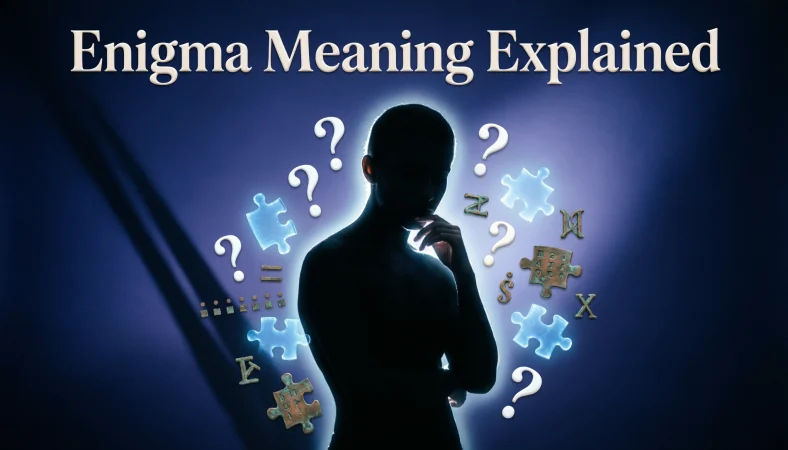
Definition:Enigma meaning: An enigma is a person, thing, or situation that is mysterious, puzzling, difficult to understand, or impossible to explain completely.
Have you ever heard someone described as “an enigma” and wondered what it really means? The word enigma appears everywhere from books and movies to social media captions and everyday conversations. It’s often used to describe mysterious people, confusing situations, or things that are difficult to understand.
The term carries a sense of curiosity and intrigue. Calling someone an enigma usually suggests that they are fascinating because nobody can fully figure them out. Depending on the context, the tone can feel positive, mysterious, intellectual, or slightly frustrating.
In this guide, you’ll learn the complete meaning of enigma, its origin, modern usage, examples in conversations, comparisons with similar words, tone explanations, alternate meanings, and much more.
What Does Enigma Mean?
The word enigma refers to something confusing, mysterious, or hard to explain.
It can describe:
- A mysterious person
- A puzzling event
- A confusing situation
- Something difficult to interpret
Simple Definition
| Word | Meaning |
|---|---|
| Enigma | A mystery or puzzle that is difficult to understand |
Quick Examples
- “She’s an enigma nobody at school truly understands.”
- “The disappearance remains an enigma.”
- “His calm behavior during chaos was an enigma to everyone.”
In everyday language, enigma often adds a dramatic or intellectual tone compared to simply saying “mystery.”
Origin of the Word Enigma
The word enigma comes from the Greek word ainigma, which means “riddle” or “puzzle.” It later entered Latin as aenigma before becoming part of the English language in the 1500s.
Originally, the term was associated with riddles, hidden meanings, and cryptic messages.
Historical Development
| Time Period | Development |
|---|---|
| Ancient Greek | Ainigma meant riddle or obscure statement |
| Latin Era | Became aenigma |
| Middle English | Adopted into English vocabulary |
| Modern Usage | Refers to mystery, puzzling people, or confusing situations |
Because of its historical roots, enigma still sounds more elegant and intellectual than words like “mystery” or “confusion.”
Why Is the Word Enigma So Popular?
The popularity of enigma comes from its dramatic and intriguing tone.
People use it because it sounds:
- Sophisticated
- Mysterious
- Literary
- Deep and thoughtful
It frequently appears in:
- Novels
- Psychology discussions
- Crime stories
- Social media captions
- Music and movie titles
- Personality descriptions
Social Media Usage
You might see captions like:
- “Some souls remain an enigma ✨”
- “Life itself is an enigma.”
- “He’s quiet, intelligent, and completely an enigma.”
The word creates emotional depth and curiosity, which is why it’s widely used online.
Enigma Meaning in Different Contexts
The meaning of enigma can slightly change depending on the situation.
Enigma as a Person
When describing a person, enigma means someone difficult to understand emotionally, mentally, or behaviorally.
Example
- “The new professor is an enigma — brilliant but impossible to predict.”
This often has a mysterious or attractive tone.
Enigma as a Situation
An event or situation can also be an enigma if nobody understands it fully.
Example
- “Scientists still consider dark matter an enigma.”
In this context, it means a puzzle or unresolved mystery.
Enigma in Literature and Movies
Writers often use enigmatic characters to build suspense.
Common Traits of an Enigmatic Character
- Quiet or secretive
- Unpredictable
- Emotionally complex
- Hard to read
- Intellectually mysterious
Examples appear frequently in detective stories, thrillers, and psychological dramas.
Tone of the Word Enigma
The tone of enigma depends on how it’s used.
| Tone | Meaning | Example |
|---|---|---|
| Positive | Intriguingly mysterious | “She’s an enigma in the best way.” |
| Neutral | Hard to understand | “The case remains an enigma.” |
| Negative | Frustratingly confusing | “His behavior is an enigma to the team.” |
Examples of Enigma in Real Conversations
Here are some natural conversation examples.
Friendly Tone
- “You’re such an enigma 😂 I never know what you’re thinking.”
- “Her artistic style is a beautiful enigma.”
Neutral Tone
- “The scientist called the phenomenon an enigma.”
- “His sudden resignation remains an enigma.”
Dramatic or Romantic Tone
- “He walked into the room like an enigma nobody could solve.”
- “Her silence made her even more of an enigma.”
Slightly Negative Tone
- “Working with him is difficult because he’s a total enigma.”
- “The instructions were an enigma to beginners.”
Enigma Meaning in Psychology
In psychology and personality discussions, an enigma often refers to someone psychologically difficult to understand.
These people may:
- Hide emotions well
- Behave unpredictably
- Keep personal details private
- Appear emotionally complex
Being called an enigma in this context is often seen as intriguing rather than insulting.
Enigma Meaning in Technology and History
The word Enigma also has an important historical meaning.
The Enigma Machine
The Enigma Machine was a cipher device used by Germany during World War II to encode secret military messages.
The machine became famous because its codes were extremely difficult to crack until mathematicians and codebreakers eventually decoded them.
Why It Matters
The Enigma Machine became a symbol of:
- Mystery
- Intelligence
- Cryptography
- Hidden messages
This historical association strengthened the word’s connection with puzzles and secrecy.
Enigma vs Similar Words
People often confuse enigma with related words like mystery, puzzle, or riddle.
Here’s the difference.
| Word | Meaning | Difference |
|---|---|---|
| Enigma | Something mysterious and hard to understand | More intellectual or dramatic |
| Mystery | Something unknown | More general |
| Puzzle | Something requiring a solution | Often practical |
| Riddle | A question with a hidden answer | Usually verbal |
| Paradox | A contradictory statement | Logical contradiction |
Example Comparison
- “She’s a mystery.” → General unknown quality
- “She’s an enigma.” → Deeply fascinating and difficult to understand
Synonyms of Enigma
Here are common synonyms for enigma.
| Synonym | Usage Tone |
|---|---|
| Mystery | Everyday conversation |
| Puzzle | Problem-solving situations |
| Riddle | Intellectual or playful |
| Secret | Hidden information |
| Conundrum | Complicated problem |
| Unknown | Neutral tone |
Antonyms of Enigma
Opposite words include:
- Clarity
- Explanation
- Certainty
- Transparency
- Understanding
How to Use Enigma Correctly
Many learners understand the word but misuse it in sentences.
Correct Usage Tips
Use enigma when describing:
✅ Something mysterious
✅ A person difficult to understand
✅ An unsolved issue
✅ A confusing phenomenon
Avoid using it for:
❌ Simple confusion
❌ Basic misunderstandings
❌ Everyday mistakes
Sentence Examples of Enigma
Formal Examples
- “The ancient civilization remains an archaeological enigma.”
- “Her leadership style was an enigma to political analysts.”
Casual Examples
- “Bro, you’re an enigma 😭”
- “That movie ending was such an enigma.”
Romantic Examples
- “Your eyes hold an enigma I can’t explain.”
- “He’s charming because he’s an enigma.”
Is Being Called an Enigma a Compliment?
Usually, yes.
Calling someone an enigma often implies they are:
- Interesting
- Deep
- Unique
- Fascinating
- Complex
However, context matters.
Positive Interpretation
- “She’s an enigma” → mysterious and attractive
Negative Interpretation
- “He’s an enigma to work with” → confusing and frustrating
Enigma in Pop Culture
The word frequently appears in:
- Song titles
- Movie plots
- Video games
- Psychological thrillers
- Fantasy stories
Writers love the term because it instantly creates mystery and emotional depth.
Alternate Meanings of Enigma
Although the primary meaning relates to mystery, Enigma can also refer to:
| Alternate Meaning | Explanation |
|---|---|
| Enigma Machine | WWII encryption device |
| Enigma (music project) | Popular music group |
| Enigma in gaming | Character or game title |
| Scientific enigma | Unsolved phenomenon |
Professional or Polite Alternatives to Enigma
Sometimes enigma may sound too dramatic or literary. Here are softer alternatives.
| Alternative | Best Use |
|---|---|
| Complex | Professional settings |
| Mysterious | Casual conversations |
| Hard to understand | Neutral explanation |
| Intriguing | Positive tone |
| Unpredictable | Behavioral context |
| Reserved | Personality descriptions |
Example
Instead of:
- “He’s an enigma.”
You could say:
- “He’s a very intriguing person.”
- “He’s difficult to read.”
- “She has a mysterious personality.”
Common Mistakes When Using Enigma
Using It for Simple Problems
Incorrect:
- “My math homework is an enigma.”
Better:
- “My math homework is confusing.”
Overusing It Dramatically
Because the word sounds sophisticated, some people overuse it in ordinary situations.
Why Enigma Sounds Powerful in Writing
Writers prefer enigma because it creates instant curiosity.
Compare these:
- “He was confusing.”
- “He was an enigma.”
The second sentence sounds richer, deeper, and more emotionally engaging.
That’s why journalists, novelists, and content creators frequently use it.
Example Table: Enigma in Different Situations
| Situation | Example Sentence | Tone |
|---|---|---|
| Friendship | “You’re such an enigma sometimes.” | Playful |
| Romance | “Her smile was an enigma.” | Mysterious |
| Science | “Black holes remain an enigma.” | Intellectual |
| Workplace | “His decisions are an enigma to the staff.” | Neutral/Negative |
| Literature | “The detective pursued the enigma relentlessly.” | Dramatic |
How Enigma Is Used on Social Media
On platforms like TikTok, Instagram, and X, the word often appears in aesthetic or emotional posts.
Popular Caption Examples
- “An enigma wrapped in silence 🖤”
- “Stay mysterious.”
- “Some people are beautiful enigmas.”
- “Not everyone deserves to understand you.”
The word fits perfectly into modern internet culture because it sounds emotional and poetic.
FAQs:
What does enigma mean in simple words?
An enigma is something or someone mysterious, puzzling, or difficult to understand.
Is enigma a positive word?
Usually yes. It often describes someone as interesting, mysterious, or intellectually fascinating.
What does it mean if a person is an enigma?
It means the person is difficult to understand emotionally, mentally, or behaviorally.
What is the difference between enigma and mystery?
A mystery is generally unknown, while an enigma feels more intellectually puzzling or emotionally complex.
Can enigma describe a situation?
Yes. An unsolved event, confusing issue, or unexplained phenomenon can all be called an enigma.
What is an enigmatic person?
An enigmatic person is mysterious, secretive, difficult to read, or emotionally complex.
Is enigma used in a romantic way?
Often yes. Calling someone an enigma can make them seem attractive, deep, and intriguing.
What is the Enigma Machine?
The Enigma Machine was a code-encryption device used during World War II for secret communication.
Conclusion
The word enigma is far more than just another word for mystery. It carries emotional depth, intellectual intrigue, and a sense of fascination that makes it powerful in conversations, writing, and modern culture.
Whether describing a mysterious person, an unsolved scientific phenomenon, or a confusing situation, enigma adds sophistication and curiosity to language. Its roots in ancient riddles and secret meanings continue to shape how people use it today.
The next time you hear someone called an enigma, you’ll understand that it usually means they are complex, intriguing, and difficult to fully figure out and that’s exactly what makes the word so memorable.