
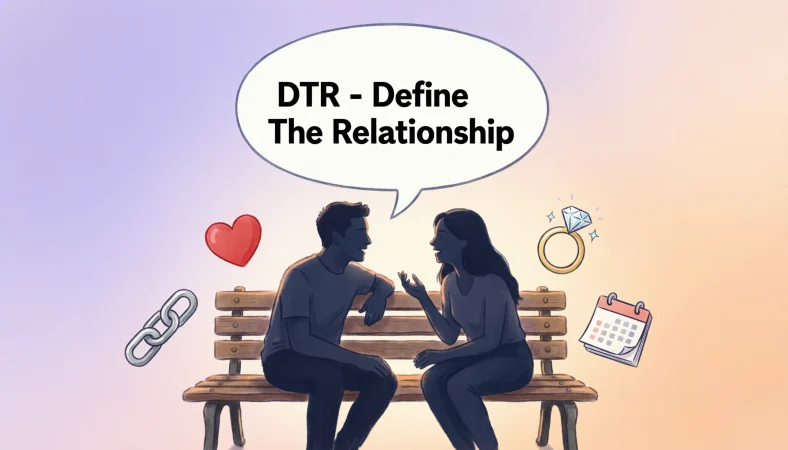
DTR stands for “Define the Relationship.” It refers to an honest conversation between two people about the status of their relationship, including whether they are casually dating, exclusive, or in a committed partnership. You’ll commonly see DTR used in texting, social media, dating apps, and relationship advice.
If you’ve come across DTR in a text message, dating app, or social media post, you might be wondering what it means and why people talk about having a “DTR conversation.” This popular dating acronym has become a common way to describe the moment when two people discuss where their relationship is headed and whether they share the same expectations.
In most cases, DTR means “Define the Relationship.” It’s widely used in modern dating to refer to a conversation about commitment, exclusivity, labels, and future intentions. While the exact outcome of a DTR talk varies from one relationship to another, understanding the term can help you better interpret conversations both online and in everyday life. In this guide, you’ll learn what DTR means, how it’s used in texting and dating, when people typically have a DTR conversation, and see real-life examples to help you use the acronym correctly.
The Primary DTR Meaning: Define The Relationship
Let us start with the most common and culturally significant DTR meaning: “Define The Relationship.” This is the conversation that has launched a thousand memes, inspired countless advice columns, and caused anxiety for people of all ages.
What Does “Define The Relationship” Actually Mean?
At its core, DTR is about clarity. It is the moment when two people stop guessing and start communicating. Instead of relying on vague hints, assumptions, or passive-aggressive Instagram posts, they actually talk about what they are doing.
The DTR conversation typically covers:
- Exclusivity: Are we seeing other people, or are we only dating each other?
- Labels: Are we boyfriend/girlfriend, partners, or something else?
- Commitment: Are we in this for the long haul, or is it casual?
- Expectations: What do we want from each other and this relationship?
- Future: Where is this heading: marriage, living together, or just having fun?
Why Is the DTR Conversation So Important?
- Avoids Misunderstandings: Without a DTR talk, two people can have completely different ideas about their relationship. One person might think they are exclusive; the other might think they are still free to date around.
- Reduces Anxiety: When you do not know where you stand, it is easy to overthink, overanalyze, and drive yourself crazy. Defining the relationship brings peace of mind.
- Builds Trust: Having an honest, vulnerable conversation strengthens the bond between two people. It shows emotional maturity and respect.
- Prevents Heartbreak: Knowing the reality of a situation is better than living in a fantasy. If the other person does not want the same thing, it is better to find out early.
When Should You Have the DTR Talk?
There is no magic formula, but here are some general guidelines:
- After 1–3 Months of Dating: This is the sweet spot for most couples. You have gotten to know each other, but you are not so deeply invested that a mismatch would be devastating.
- When You Feel Confused: If you are constantly wondering, “What are we?” it is probably time to ask.
- Before Getting Intimate: If physical intimacy is on the table, it is wise to know where you both stand emotionally.
- When You Want Exclusivity: If you want to stop seeing other people, you need to communicate that.
- When Your Feelings Deepen: If you are starting to fall for someone, it is fair to know if they feel the same way.
Real-World Examples of DTR in Action
To truly understand the DTR meaning, let us look at some practical, real-world scenarios with different tones and emotions.
Example 1: The Nervous (But Necessary) Conversation
Context: A couple has been dating for two months.
Example: “Hey, I really enjoy spending time with you. I was wondering if we could talk about where we see this going. I’m not trying to pressure you, but I think we should define the relationship.”
Tone: Vulnerable, sincere, hopeful. 💭💕
Example 2: The Casual (But Clear) Approach
Context: Two friends who have been hooking up.
Example: “So, I know we’ve been hanging out a lot. Are we just having fun, or is this heading toward something more? I just want to make sure we’re on the same page.”
Tone: Relaxed but direct. 😌🗣️
Example 3: The Awkward (But Honest) Exchange
Context: One person wants commitment; the other does not.
Example: “I really like you, but I’m not ready for a serious relationship right now. I think we need to define what this is, and honestly, I see us as friends right now.”
Tone: Gentle but firm, potentially disappointing. 💔😞
Example 4: The Celebratory (Positive Outcome)
Context: Both people want the same thing.
Example: “I’m so glad we had this talk. I want to be exclusive, and I’m really excited to see where this goes. We’re officially boyfriend and girlfriend now!”
Tone: Happy, relieved, enthusiastic. 🎉💖
Example 5: Text Message (Modern & Casual)
Context: Sending a pre-DTR text to test the waters.
Example: “Hey, I know this is random, but I’ve been thinking… What exactly are we? No pressure, just curious where your head is at.”
Tone: Casual but intentional. 📱🤔
Tips for a Successful DTR Conversation
Since the DTR meaning is so closely tied to this high-stakes conversation, let me share some practical advice to help you navigate it smoothly.
1. Choose the Right Time and Place
- Do: Pick a private, comfortable setting where you both can talk openly.
- Don’t: Have the conversation over text, at a crowded party, or right before bed.
2. Be Honest About Your Feelings
- Express what you want without expecting the other person to feel the same way.
- Use “I” statements: “I really enjoy being with you, and I am starting to develop feelings.”
3. Stay Calm and Open-Minded
- The other person might not want the same thing. Be prepared for any answer.
- Remember: their honesty is a gift, even if it is not what you wanted to hear.
4. Ask Questions, Listen, and Respect Boundaries
- Ask: “How do you feel about us?”
- Listen without interrupting.
- Respect their answer, even if it is not what you hoped for.
5. Avoid Ultimatums
- Do not say: “If you do not commit to me now, we are done.”
- Instead, say: “I think I need clarity to know how to move forward.
6. Be Prepared for Any Outcome
- They might want a relationship. 🎉
- They might not be ready. ⏳
- They might just want to be friends. 🤝
- Whatever happens, you will have clarity, and that is valuable.
Comparison with Related Relationship Terms
The DTR meaning is often grouped with other dating and relationship acronyms. Let us compare them so you can use them correctly.
| Term | Full Meaning | When to Use It |
| DTR | Define The Relationship | Having the conversation about exclusivity, labels, and commitment. |
| Situationship | An undefined romantic relationship | When you are dating but have not had the DTR talk yet. |
| FWB | Friends With Benefits | A casual sexual relationship with no romantic commitment. |
| Exclusive | Only dating each other | You have agreed not to see other people, but you may not have official labels. |
| Official | Publicly recognized as a couple | You have labels (boyfriend/girlfriend) and are open about it. |
| Ghosting | Suddenly cutting off communication | When someone disappears without explanation. |
DTR vs. Exclusive
- Exclusive means you are not seeing other people. It is about behavior.
- DTR is the conversation that establishes exclusivity and other commitments.
DTR vs. Official
- Official means you are publicly recognized as a couple.
- DTR is the talk that leads to becoming official.
Alternate Meanings of DTR
While “Define The Relationship” is the most common DTR meaning, the acronym has several other interpretations.
1. Deep Tendon Reflex (Medical)
In neurology and medicine, DTR stands for “Deep Tendon Reflex.” This is a physical test where a doctor taps a tendon (like the knee or elbow) with a reflex hammer to assess the function of the nervous system.
Why It Matters:
- Doctors use DTR to check for nerve damage, spinal cord issues, or neurological disorders.
- Common reflexes tested: knee jerk, bicep reflex, ankle reflex.
Example: “The neurologist tested my deep tendon reflexes and found them to be hyperactive, which may indicate a central nervous system issue.”
2. Daily Time Record (Business/HR)
In corporate and human resources settings, DTR stands for “Daily Time Record.” This refers to a log or system used by employees to track their working hours, attendance, and overtime.
Why It Matters:
- Used for payroll processing.
- Helps with project tracking and resource allocation.
Example: “Please submit your DTR by 5 PM every Friday so we can process your payroll accurately.”
3. Domestic Terminal Receiving (Logistics)
In shipping and supply chain management, DTR stands for “Domestic Terminal Receiving.” It refers to the process of receiving shipments at a local distribution center before they are dispatched to their final destinations.
Why It Matters:
- Ensures efficient inventory management.
- Tracks incoming shipments.
Example: “The package arrived at our DTR facility this morning and will be dispatched for delivery tomorrow.”
4. Don’t Trust Rats (Gaming)
In online gaming communities particularly in games like Among Us or Minecraft DTR can stand for “Don’t Trust Rats.” It is a playful, in-joke warning used when there is a suspicious player or a traitor in the game.
Example: “DTR, guys! I saw Red acting weird in the vents!”
5. Down to Ride (Casual Slang)
In some informal contexts, DTR can also mean “Down to Ride,” meaning someone is willing to support you, go with you, or back you up.
Example: “She is always DTR when I need her. A real friend.”
Polite and Professional Alternatives to DTR
If you are in a formal setting or want to avoid the pressure of the “DTR” label, here are some alternatives.
For Casual and Friendly Settings
- “Where do you see this going?”
- “What are we?”
- “Are we on the same page?”
- “How do you feel about us?”
For Professional and Formal Settings
- “I would like to clarify the status of our working relationship.”
- “Let us align on expectations and responsibilities.”
- “I want to ensure we have a mutual understanding.”
For Medical Settings
- Stick with “Deep Tendon Reflex” or “Reflex Test” to avoid confusion.
For Logistics and Business
- “Domestic Terminal Receiving” or “Daily Time Record” are self-explanatory.
Common Misunderstandings About DTR
Because the DTR meaning varies across contexts, misunderstandings are common.
Misunderstanding 1: DTR means you are breaking up.
Clarification: Not necessarily. It is a conversation to gain clarity, not to end things. Yes, it could lead to a breakup if you want different things, but it can also lead to a deeper commitment.
Misunderstanding 2: You should only have the DTR talk if it is going well.
Clarification: Actually, you should have it when you are confused, regardless of whether things are “good” or “bad.” Clarity is valuable either way.
Misunderstanding 3: DTR is only for serious relationships.
Clarification: You can have a DTR talk even in casual situations. You might define a relationship as “casual” or “friends with benefits.” The key is defining it.
Misunderstanding 4: The man should always initiate the DTR talk.
Clarification: Absolutely not. Anyone can initiate this conversation regardless of gender. It is about two people communicating honestly.
Misunderstanding 5: If you have a DTR talk, you are officially a couple.
Clarification: Not necessarily. It simply defines the relationship. You could define it as “friends with benefits” or “exclusive dating.” Labels are discussed during the talk.
The Psychology Behind the DTR Meaning
Understanding the DTR meaning also means understanding why it is such a big deal emotionally.
Why People Avoid the DTR Talk
- Fear of Rejection: What if they do not feel the same way?
- Fear of Ruining the Vibe: What if the conversation makes things awkward?
- Fear of Commitment: Some people are not ready for a serious relationship.
- Uncertainty: They might not even know what they want themselves.
Why People Want the DTR Talk
- Need for Security: Humans like to know where they stand.
- Deepening Feelings: When emotions grow, ambiguity becomes uncomfortable.
- Desire for Exclusivity: They want to stop sharing the person with others.
- Social Pressure: Friends and family might ask, “So, what are you two?
The Emotional Rollercoaster of DTR
The DTR conversation is rarely neutral. It can be:
- Exciting: When both people want the same thing.
- Nervous: When you are unsure of the outcome.
- Painful: When you realize you want different things.
- Liberating: When you finally know the truth, no matter what it is.
DTR in Different Demographics
The DTR meaning and its usage vary across age groups and communities.
Gen Z (Ages 13–26)
- Use DTR casually in texts and social media.
- Often have the conversation over text rather than in person.
- Less formal about labels; may prefer “situationship” or “talking.”
Millennials (Ages 27–42)
- Prefer in-person DTR conversations.
- More likely to discuss exclusivity and “where this is heading.”
- Often influenced by dating apps and modern dating culture.
Gen X and Baby Boomers
- May not use the acronym “DTR” but understand the concept of “having the talk.”
- Often more traditional about labels and commitment.
Frequently Asked Questions
Here are eight of the most common questions people ask about the DTR meaning.
1. What does DTR mean in dating?
DTR in dating stands for “Define The Relationship.” It is the conversation where two people discuss their relationship status, exclusivity, and future plans.
2. What does DTR mean in a text?
In a text, DTR usually means “Define The Relationship.” Someone might text, “I think we need to DTR” to initiate the conversation.
3. When should you have the DTR talk?
There is no perfect time, but generally after 1–3 months of dating, when you feel confused, or when you want exclusivity.
4. What does DTR stand for in medical terms?
In medicine, DTR stands for “Deep Tendon Reflex,” a test used to evaluate nervous system function.
5. Is DTR the same as being exclusive?
Not exactly. DTR is the conversation about exclusivity, labels, and commitment. Being exclusive is one possible outcome of that conversation.
6. How do you start a DTR conversation?
You can say something like, “I really enjoy spending time with you. I was wondering if we could talk about where we see this going.” Keep it honest, calm, and open.
7. What if the DTR talk goes badly?
It happens. The important thing is that you now have clarity. You can take time to process your feelings and decide what to do next. It is better to know than to be stuck in uncertainty.
8. Does DTR have other meanings?
Yes. It can mean “Daily Time Record” in business, “Domestic Terminal Receiving” in logistics, “Deep Tendon Reflex” in medicine, and “Don’t Trust Rats” in gaming.
Conclusion
The DTR meaning is far more than just an acronym; it is a milestone in modern relationships, a tool for clarity, and a reflection of how communication has evolved in the age of dating apps and casual hookups.
Let us summarize the key takeaways:
- Primary meaning: DTR stands for “Define The Relationship,” the conversation where two people clarify their status, exclusivity, and expectations.
- It is about clarity: The goal is to remove ambiguity, reduce anxiety, and build trust.
- It takes courage: The DTR talk can be scary, but it is almost always worth it.
- Alternate meanings exist: In medicine, it is “Deep Tendon Reflex” ; in business, “Daily Time Record” ; in logistics, “Domestic Terminal Receiving” ; and in gaming, “Don’t Trust Rats.”
- Context is key: Always consider the setting before interpreting what DTR means.
- Tips for success: Choose the right time, be honest, stay calm, and be prepared for any outcome.
- It is empowering: Knowing where you stand is better than living in confusion.
Whether you are gearing up for your own DTR talk, decoding a message, or just curious about modern slang, understanding this acronym will serve you well. Relationships thrive on communication and defining the relationship is one of the most important conversations you can have.
So, take a deep breath, be honest, and have the talk. You have got this!

Caleb Foster is a professional content creator at RepllyNova.com, recognized for producing clear, engaging and insightful articles. He is committed to making complex topics understandable, interesting and accessible for all audiences.